Dating App Development Cost in 2027: What It Really Costs to Build an App Like Tinder, Hinge or Muzz
A dating app costs $10,000 to $150,000+ to build in 2027. See costs by tier, what an app like Tinder or Hinge really takes, matrimony app pricing for the Gulf, safety and age-verification rules by country, and the monthly cost of running a dating app.
Harsh Mangal
PRINCIPAL ARCHITECT10 MIN READ
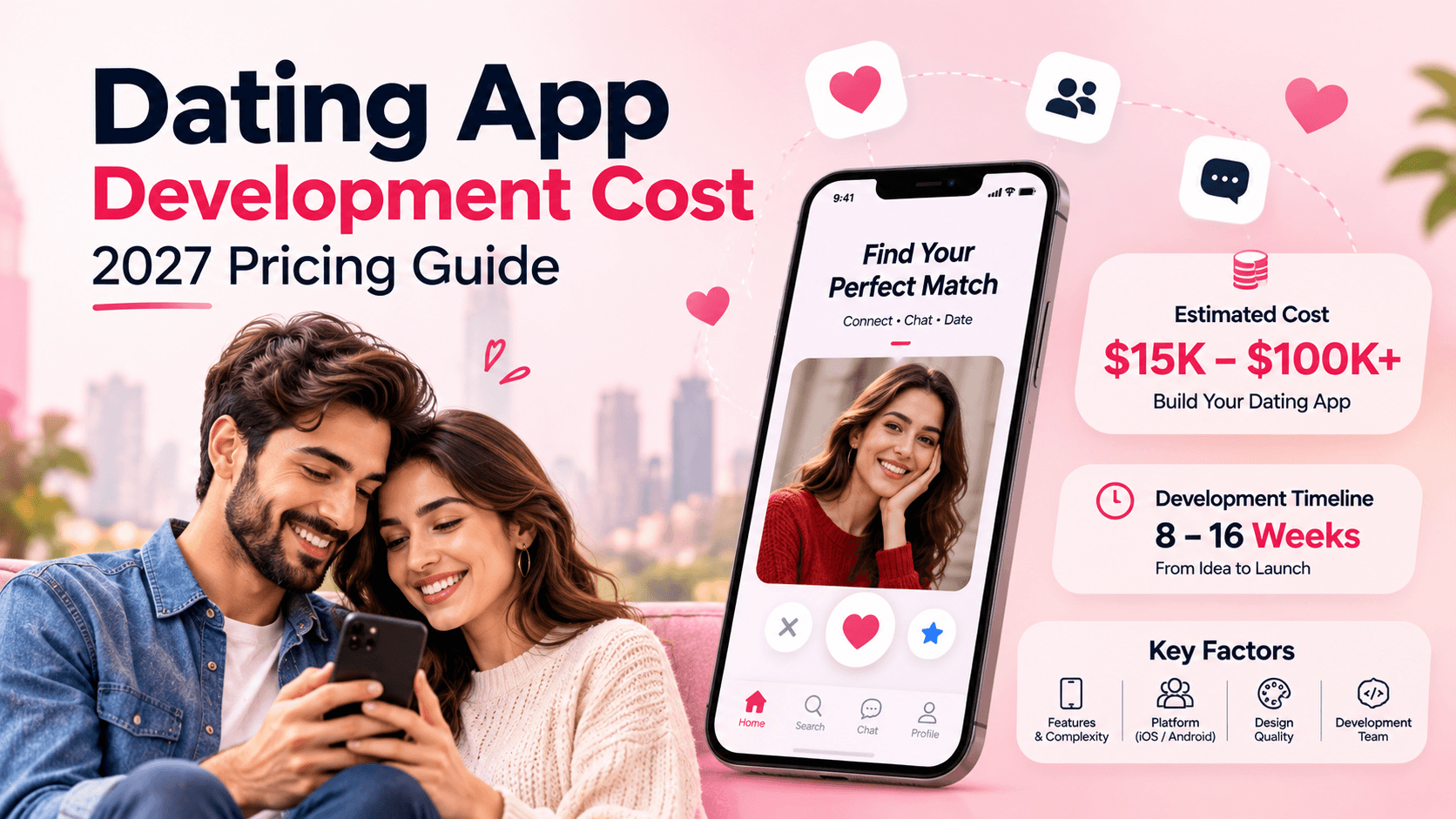
A dating app costs $10,000 to $25,000 for an MVP with profiles, matching, chat and subscriptions (10 to 14 weeks), $16,000 to $60,000 for an AI-matching app with verification and moderation (16 to 20 weeks), and $60,000 to $150,000+ for a full platform with video dating and live events (22 to 30 weeks). iSkylar builds dating and matrimony apps for the US, UK, Canada, Australia, UAE and Saudi Arabia.
In 2027, the hard part of a dating app is no longer the swipe screen. It is trust. Regulators in the UK and Australia now expect real age checks and safety tooling, users expect verified profiles, and AI-generated catfish accounts are cheap to make. This guide shows what a dating app really costs to build and run in 2027, which features you cannot skip, and how costs change for niche, faith-based and Gulf-focused apps.
How much does dating app development cost in 2027?
Building a dating app costs between $10,000 and $150,000+ in 2027. Where you land depends on your matching logic, safety stack, video features and how many markets you launch in.
App tier | Build cost | Timeline | Core features |
|---|---|---|---|
Launch MVP | $10,000 to $25,000 | 10 to 14 weeks | iOS and Android (cross-platform), sign-up and profiles, photo upload, preference and distance filters, swipe or like matching, encrypted chat, freemium subscription, block and report, admin panel |
AI matching app | $16,000 to $60,000 | 16 to 20 weeks | Everything in MVP plus AI compatibility matching, liveness-based photo verification, AI content moderation, profile prompts, voice notes, boosts and in-app purchases, re-engagement nudges, analytics |
Full dating platform | $60,000 to $150,000 | 22 to 30 weeks | In-app video dating (WebRTC), virtual speed dating and events, multi-modal moderation (image, text, video), AI conversation starters, multi-language, multi-country payments, human review queue |
Scale platform (Tinder or Hinge class) | $150,000+ | 9 months+ | Millions of daily users, advanced recommendation systems, trust and safety operations tooling, A/B testing at scale, dedicated engineering team |
Our dating app development Growth package starts from $12,000 and includes AI matching, encrypted chat, photo verification, subscription billing, App Store launch and 90 days of hypercare, with full source code ownership.
How much does it cost to build an app like Tinder, Bumble or Hinge?
A Tinder-style launch version costs $25,000 to $60,000; matching the real Tinder, Bumble or Hinge at scale costs well over $150,000 and keeps costing every month. The core idea is simple. What you are really paying for at scale is recommendation quality, safety operations and infrastructure for millions of real-time chats.
Like Tinder: swipe discovery, location-based queue, super likes and boosts. The UI is simple; ranking and anti-spam are the hard parts.
Like Bumble: adds rules on who can message first, timers on matches and separate modes (date, friends, networking). Each mode is effectively its own product flow.
Like Hinge: prompt-based profiles, likes on specific photos or answers, and "designed to be deleted" compatibility matching. Needs stronger matching logic and more content moderation.
Copying a big brand head-on is rarely the winning plan. Many of the strongest recent launches target a clear community: faith, profession, age group, language or lifestyle.
What features does a dating app need in 2027?
Every 2027 dating app needs four layers: discovery, connection, safety and monetization. Skipping the safety layer is now the fastest way to get rejected by the App Store or reported by users.
Discovery and matching: profile builder, filters (age, distance, intent, religion, language), a daily curated queue and AI compatibility scoring based on behavior, not only stated preferences.
Connection: real-time encrypted chat, read receipts, voice notes, GIFs and in-app video calls so users can meet safely before sharing phone numbers.
Trust and safety: selfie liveness verification, AI screening of photos and messages at upload time, block, report and unmatch, a human review queue and age assurance.
Monetization: freemium tiers, weekly and monthly subscriptions, boosts, super likes, virtual gifts and premium visibility.
Why are safety and verification now a major cost line?
Because scams are costly for users and regulators are acting. In 2024 the FBI's Internet Crime Complaint Center recorded nearly 18,000 confidence and romance fraud complaints with over $672 million in reported losses in the US alone. Match Group reported that Tinder's Face Check verification cut exposure to bad actors by more than 60%.
Plan to spend 15% to 25% of your build budget on trust and safety: liveness checks, AI moderation, reporting workflows, admin tools and audit logs. It protects users, keeps you inside App Store guidelines and is now a selling point in your marketing.
Which dating app laws apply in the US, UK, Canada, Australia, UAE and Saudi Arabia?
Dating apps handle some of the most sensitive data there is: photos, location, sexual orientation, religion and private messages. That puts them under stricter rules than most consumer apps.
Market | Key rules | What it means for the build |
|---|---|---|
UK | Online Safety Act 2023, enforced by Ofcom; UK GDPR | "Highly effective age assurance" to keep under-18s off the platform since July 2025 (photo ID, facial age estimation or similar). Fines reach up to 18 million pounds or 10% of global revenue. Special category data needs explicit consent. |
Australia | Online Dating Industry Code (enforced from April 1, 2025), Privacy Act 1988 | Systems to detect online-enabled harm, clear reporting tools, action on incidents and published reports on terminated Australian accounts. |
USA | CCPA/CPRA, Illinois BIPA and similar biometric laws, Washington's My Health My Data Act, state age-verification laws, FTC rules on auto-renewing subscriptions | Written consent before face scans, clear data deletion, easy cancellation flows and careful handling of health or orientation data. |
Canada | PIPEDA, Quebec Law 25 | Privacy impact assessments, explicit consent for sensitive data, French-language experience for Quebec users. |
UAE | Federal Decree-Law No. 45 of 2021 (PDPL), TDRA content rules | Consent and cross-border transfer controls, conservative content moderation, privacy-first photo settings. |
Saudi Arabia | PDPL (SDAIA), CST rules on digital content | Data localization planning, Arabic privacy notices and a marriage-focused product positioning that fits local norms. |
Compliance work typically adds $5,000 to $15,000 to a build. It is far cheaper to design consent flows, data deletion and age checks into version one than to retrofit them after launch.
How much does a Muslim matrimony or halal dating app cost to build?
A marriage-focused app for Muslim communities costs $20,000 to $70,000 to build, depending on the privacy and family features you add. This is one of the strongest niches for Gulf, UK, Canadian and Australian founders. Muzz, the largest app in the space, reports over 15 million members and more than 600,000 marriages.
Features that make this category different, and what they add to cost:
Chaperone or guardian (wali) mode that lets a family member view conversations: 1 to 2 weeks.
Photo privacy: blurred photos until a match is made, or photos shared only on request: about 1 week.
Faith and intent filters: sect, prayer habits, marriage timeline, relocation, family involvement: part of matching design.
Bilingual Arabic-English with right-to-left UI: adds roughly 15% to 25% to front-end and QA effort.
Stronger verification: optional ID checks for a verified badge, which users in this category value highly.
How much does it cost to run a dating app every month?
Expect $1,000 to $8,000 per month in running costs for a growing dating app, plus app store fees.
Cost item | Typical cost | Notes |
|---|---|---|
Cloud hosting, database, real-time chat | $400 to $5,000 per month | Grows with daily active users and media storage |
Video calling (WebRTC service) | Fractions of a cent per user minute | Only if you offer video dates |
Photo and ID verification | $0.50 to $2.00 per check | Selfie liveness is cheaper than full ID checks |
AI moderation and matching | $200 to $1,500 per month | Image, text and behavior screening |
Apple App Store and Google Play fees | 15% to 30% of in-app revenue | 15% for most subscriptions after year one and for small businesses |
Maintenance and updates | 15% to 20% of build cost per year | OS updates, new features, security patches |
Do not forget user acquisition. A dating app is a network product, so set aside a launch marketing budget for your first city that is comparable to the cost of version one.
How long does it take to build a dating app?
An MVP takes 10 to 14 weeks; a focused AI matching app takes 16 to 20 weeks; a full platform with video and events takes 22 to 30 weeks. Our build runs in four stages:
Community and matching design: who the app is for, matching signals, safety model and business model.
UX design and onboarding tests: prototypes tested with real target users, because onboarding completion decides early retention.
Agile build and App Store compliance: two-week sprints, matching model setup, moderation calibration and store review preparation.
Soft launch and hypercare: invite-only or single-city launch, then 90 days of monitoring and tuning.
Which tech stack is best for a dating app?
For most dating startups, a cross-platform app with a real-time back end is the best value. Our typical stack is React Native or Flutter for iOS and Android (Swift and Kotlin for video-heavy apps), Node.js and Python on the back end, PostgreSQL with PostGIS for location search, Redis for queues and presence, Socket.io and WebRTC for chat and video, TensorFlow for matching models, and AWS or Firebase for hosting. If you are choosing between frameworks, our mobile app development team can walk you through the trade-offs for your feature list.
How do dating apps make money?
Subscriptions drive most dating app revenue, with in-app purchases on top. The models that work best in 2027:
Freemium plus tiers: free swiping, paid tiers for unlimited likes, see-who-liked-you and advanced filters.
Consumables: boosts, super likes, roses or virtual gifts.
AI premium features: profile reviews, photo selection help and conversation suggestions, offered as opt-in tools.
Events and experiences: paid virtual speed dating or local in-person events, popular in niche and faith-based apps.
Why build your dating app with iSkylar?
We have shipped two-sided, real-time consumer apps that scaled past 100,000+ downloads. See how we built and scaled a two-sided marketplace app to 100K+ downloads. The same building blocks power dating apps: matching two sides, real-time chat, trust and safety, and subscription billing. You get full IP and source code ownership, App Store compliance built in from day one and 90 days of hypercare after launch.
Get your dating app cost estimate
Share your target community, launch city and must-have features, and we will send a fixed-scope plan with cost, timeline and first-year running costs. Book a free dating app consultation or explore our dating app development services.
WRITTEN BY
Harsh Mangal
Having 8+ years of experience helping founders across the US, UK, Middle East and Australia plan, budget and launch on-demand platforms.
Frequently Asked Questions
What is the cheapest way to build a dating app?
Can I build a dating app for under $20,000?
Is a white-label or clone dating script a good idea?
How do dating apps stop fake profiles and scammers?
Do dating apps need age verification in 2027?
Can a dating app work in Saudi Arabia and the UAE?
How long does App Store approval take for a dating app?
Further Reading
Stay at the forefront of innovation.
innovation.
Join our inner circle of industry leaders and get exclusive insights delivered to your inbox every Thursday morning.
WE RESPECT YOUR PRIVACY. NO SPAM, EVER.
Updated At: