
E-Wallet App Development Cost in 2026: A Complete Breakdown
eWallet app development cost in 2026 runs $30K to $400K+. Get real ranges by tier, feature, region and compliance, plus timelines.

Harsh Singh Rajput
PRINCIPAL ARCHITECT
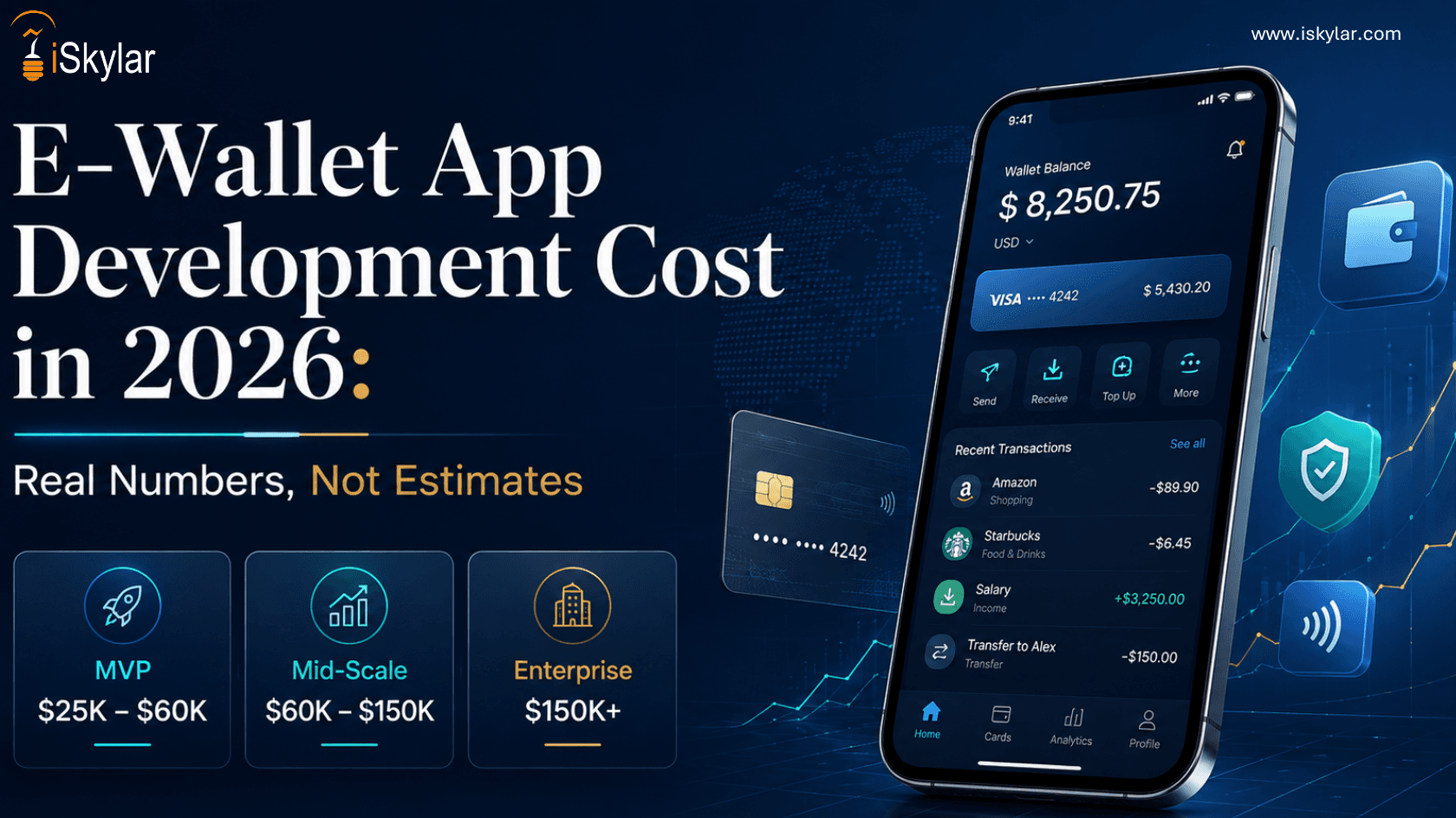
iSkylar builds custom eWallet apps for fintechs, banks and retailers in the US, UK, Australia, Canada and the UAE. A typical MVP costs $15,000 to $30,000 and takes 12 to 16 weeks, including KYC, payments and PCI DSS-ready security. Mid-range wallets cost $60,000 to $150,000. Enterprise builds start at $150,000.
Everyone wants a straight number for eWallet app development cost. The honest answer depends on four things: how many features you launch with, which markets you serve, how many payment rails you connect and who builds it. This guide gives you real ranges for each, so you can budget with confidence instead of guessing.
How much does it cost to develop an eWallet app in 2026?
An eWallet app costs $15,000 to $60,000 for an MVP, $60,000 to $150,000 for a mid-level wallet and $150,000 to $400,000+ for an enterprise platform. Compliance and integrations, not screens, drive most of the difference.
MVP
Mid-level
Enterprise
Price range (USD)
$15,000 to $60,000
$60,000 to $150,000
$150,000 to $400,000+
Timeline
12 to 16 weeks
5 to 8 months
9 to 14 months
Platforms
Cross-platform iOS and Android
Cross-platform plus web admin
Native or cross-platform, web, merchant app
Included features
KYC onboarding, wallet top-up, P2P transfers, bill pay, transaction history, biometric login
Everything in MVP plus QR and NFC payments, merchant app, admin panel, multi-currency, rewards, rules-based fraud checks
Everything in Mid-level plus virtual and physical card issuance, open banking, AI fraud scoring, multi-region compliance, super-app modules
Compliance scope
PCI DSS-ready via tokenization, single-market KYC/AML
Full KYC/AML workflows, transaction monitoring, audit logging
Multi-jurisdiction licensing support, SOC 2, PCI DSS Level 1 readiness
Best for
Startups validating demand
Funded fintechs and retailers
Banks, neobanks, payment companies
Published 2026 estimates show the same spread. CMARIX prices a basic Android wallet at $20,000 to $45,000 and an advanced one up to $150,000. Raftlabs puts a fintech MVP at $80,000 to $250,000 once it is built to pass audits. The gap is mostly compliance depth.
Want a number for your exact scope? Our eWallet app development team can scope it in a single call.
Which eWallet features cost the most to build?
The ledger, payment integrations and fraud detection take the biggest share of the budget. User-facing screens are usually less than a quarter of the total.
Feature module
What drives the cost
Estimated cost (USD)
Wallet ledger and transaction engine
Double-entry accounting, idempotent transfers, reconciliation
$15,000 to $45,000
Payment gateway and bank integrations
Each rail (cards, ACH, UPI, SEPA, Faster Payments) adds work
$8,000 to $30,000
Fraud detection
Rules engine first, machine learning scoring later
$8,000 to $40,000
Merchant app and admin panel
Settlements, refunds, disputes, user management
$10,000 to $35,000
KYC and onboarding
ID verification vendor, liveness checks, risk scoring
$6,000 to $20,000
Security layer
Encryption, biometrics, device binding, tokenization
$8,000 to $25,000
QR and NFC payments
Merchant QR flows, tokenized tap-to-pay
$6,000 to $18,000
UI/UX design
Onboarding flows, trust cues, accessibility
$5,000 to $20,000
QR payments deserve early priority. Juniper Research expected QR to be the most popular digital wallet transaction type in 2026, at over 40% of volume. If you plan AI fraud scoring, our AI development team starts with rules and adds models once real transaction data exists.
What compliance does an eWallet need in the US, UK, Australia, Canada and UAE?
Every eWallet that handles card data needs PCI DSS, and every market requires KYC/AML. Beyond that, each region has its own regulator, license and data law. Budget 30 to 40% extra for this layer, which is the range Raftlabs found compliance adds to a fintech build.
Region
Regulators and rules
License you may need
Region-specific features
United States
PCI DSS v4.0, Bank Secrecy Act and FinCEN AML rules, CFPB and Regulation E, state money transmitter laws, CCPA
State money transmitter licenses, or a sponsor bank
ACH and RTP or FedNow rails, Reg E dispute flows, OFAC sanctions screening
United Kingdom
FCA, Electronic Money Regulations 2011, Payment Services Regulations 2017, Money Laundering Regulations 2017, UK GDPR
FCA Electronic Money Institution (EMI) authorisation
Strong Customer Authentication, Faster Payments, Open Banking APIs, Confirmation of Payee
Australia
ASIC, AUSTRAC under the AML/CTF Act 2006, Privacy Act 1988
Australian Financial Services Licence (AFSL), with APRA oversight for larger stored-value facilities
NPP and PayID, Consumer Data Right open banking
Canada
FINTRAC, Retail Payment Activities Act (Bank of Canada), PIPEDA
Registration with FINTRAC and the Bank of Canada
Interac e-Transfer, bilingual (English and French) UX
UAE
Central Bank of the UAE Stored Value Facilities regulation, UAE AML law, PDPL; DFSA or FSRA in free zones
CBUAE Stored Value Facility license
Arabic RTL interface, UAE Pass identity, Aani instant payments
The single biggest cost lever is card data. Tokenize through a certified processor like Stripe or Adyen, and raw card numbers never enter your system. Trio found this one architecture choice can swing PCI DSS cost by 4 to 5 times.
For wider fintech regulation, including lending and open banking, see our fintech software development page.
How long does eWallet app development take?
An eWallet MVP takes 12 to 16 weeks. A mid-level wallet takes 5 to 8 months, and enterprise platforms take 9 to 14 months, mostly because of bank partner reviews and audits.
Here is how a mid-level build usually splits:
Discovery and compliance scoping (2 to 4 weeks): markets, licenses, payment rails, KYC vendor
UI/UX design (4 to 6 weeks): wireframes, clickable prototypes, onboarding tests
Development (12 to 20 weeks): ledger, integrations, mobile apps, admin panel
Testing and security (4 to 6 weeks): load tests, penetration tests, payment sandbox runs
Launch and audit (2 to 6 weeks): app store review, PCI DSS and bank partner sign-off
Compliance is where timelines slip. Start bank and regulator conversations during discovery, not after development.
Does team location change eWallet development cost?
Yes. The same wallet can cost 3 to 4 times more depending on where the team sits and how you hire it.
Region
Typical senior fintech rate (USD/hour)
Mid-level wallet at about 2,500 hours
United States, Canada
$100 to $180
$250,000 to $450,000
UK, Western Europe, Australia
$80 to $150
$200,000 to $375,000
Eastern Europe
$40 to $75
$100,000 to $190,000
India
$25 to $50
$37,500 to $125,000
Rates are approximate market ranges, not quotes.
The hiring model matters as much as location. Building an in-house fintech team means months of recruiting first. A dedicated development team starts in weeks and scales down after launch. We compared both paths in Should You Hire Developers or Use Dedicated Teams?
What does a real eWallet build look like?
Our E-Wallet case study shows a fintech platform that scaled from MVP to $2M+ in processed transactions, with real-time processing and PCI-compliant payment infrastructure.
Tech stack we use for eWallet apps:
→ Mobile: React Native (iOS and Android from one codebase)
→ Web and admin: React
→ Backend: Node.js microservices
→ Database and ledger: PostgreSQL
→ Cloud: AWS, with encryption at rest and in transit
→ Payments and KYC: tokenized processors such as Stripe, plus third-party identity verification
Building compliance in from sprint one always costs less than bolting it on after launch.
What does an eWallet cost to run after launch?
Plan for 15 to 20% of your build cost every year. Elinext reports that maintenance and scaling typically consume this share of the initial budget annually. For a $120,000 wallet, that is $18,000 to $24,000 a year.
→ Cloud hosting and monitoring, which grows with transaction volume
→ Third-party fees for KYC checks, SMS OTPs and payment processing
→ Compliance upkeep: annual PCI DSS assessments, penetration tests, policy updates. Raftlabs puts PCI DSS maintenance at $10,000 to $25,000 a year.
→ OS and SDK updates for new iOS, Android and processor API releases
How can you reduce eWallet development cost?
Launch in one market, buy the regulated parts and keep card data out of your system. Those three choices save more than any rate negotiation.
→ Start with one market. Every new country adds a license, rails and KYC rules.
→ Go cross-platform. React Native or Flutter covers iOS and Android from one codebase.
→ Buy, do not build, regulated components. KYC vendors, tokenization vaults and Banking-as-a-Service partners shrink your compliance scope.
→ Ship rules-based fraud first. Add machine learning once you have transaction data.
→ Use a dedicated team for the build. Scale down after launch instead of carrying full payroll.
Planning your eWallet?
Every range here is a starting point. Your real number depends on your markets, your rails and how much compliance you own versus outsource. Our eWallet app development team scopes wallets the way a banking partner would audit them.
So, if you could launch in one market with five features, which five would you pick?

WRITTEN BY
Harsh Singh Rajput
Senior technical Content writer
Frequently Asked Questions
How much does it cost to build an eWallet app like PayPal?
How much does an eWallet MVP cost?
How long does it take to develop an eWallet app?
Do I need PCI DSS compliance for an eWallet app
What license do I need to launch an eWallet in the UK?
Do I need a money transmitter license for an eWallet in the US?
Is it cheaper to build an eWallet app in India?
What are the ongoing costs of running an eWallet app?
Further Reading



Solutions & Industry Insights that might interest you
Explore MoreStay at the forefront of innovation.
innovation.
Join our inner circle of industry leaders and get exclusive insights delivered to your inbox every Thursday morning.
WE RESPECT YOUR PRIVACY. NO SPAM, EVER.