
How Much Does It Cost to Build an E-Wallet App in the USA?
iSkylar Editorial Team
PRINCIPAL ARCHITECT10 MIN READ
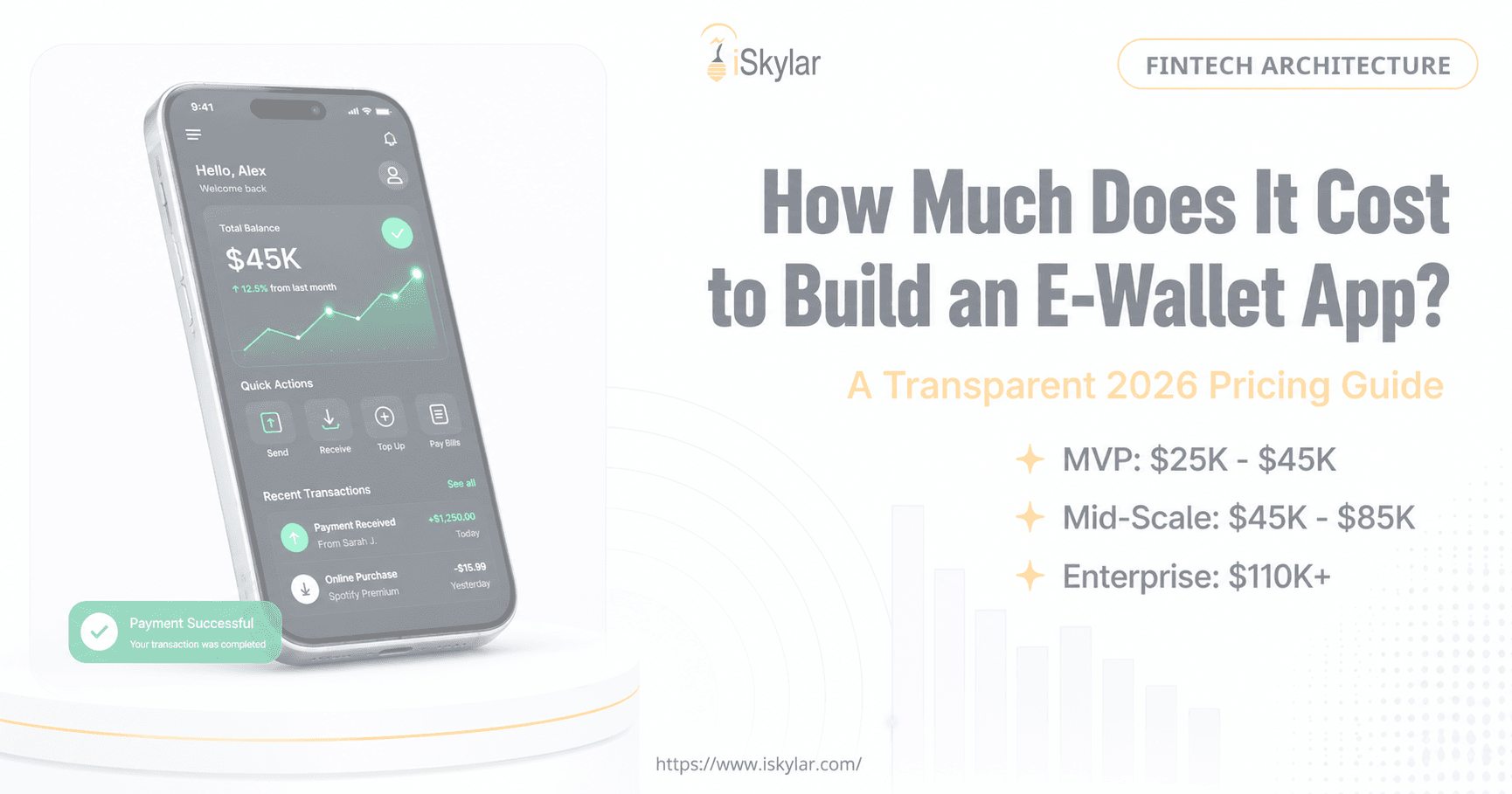
<h2>Introduction</h2> <p>The US digital payments ecosystem is undergoing a historic structural shift. Driven by the mainstream adoption of instant payment rails like FedNow and the Real-Time Payments (RTP) network, American businesses are moving rapidly away from legacy, high-fee processing loops. Whether you are a fintech startup aiming to challenge traditional banking platforms, a real estate entity automating escrow distributions, or a retail brand rolling out closed-loop merchant accounts, your core engineering framework begins with a definitive question: <strong>What is the actual e-wallet app development cost in the US market?</strong></p> <p>A standard online search will yield generic, generalized software estimates that completely overlook the realities of the US financial landscape. In secure American financial engineering, template code structures fail. Your ultimate development budget depends heavily on state and federal compliance frameworks, strict data-encryption protocols, and how deeply your backend architecture hooks into US clearing houses.</p> <p>As an expert mobile and backend architecture team, we have mapped out this transparent, developer-centric breakdown of the costs, essential feature lists, and regulatory cost drivers involved in launching a secure digital wallet app for the US market.</p> <h2>1. US E-Wallet Cost Breakdown by Complexity Matrix</h2> <p>The core software architecture of your digital wallet dictates its pricing. The more external payment networks, biometric verification paths, and custom administrative controls you introduce, the more engineering sprints are required to design, test, and deploy the platform.</p> <h3>US Minimum Viable Product (MVP) Wallet — Estimated Budget: $25,000 - $45,000</h3> <p>An MVP focuses strictly on core transactional utility. It allows early-stage US startups to validate market interest, secure angel funding, or test loops with pilot merchant groups without over-engineering the backend. A standard US wallet MVP includes:</p> <ul> <li>Standard QR-code or phone-number mapping for instant user-to-user (P2P) transfers.</li> <li>A single, trusted US payment processor integration (such as Stripe API) for initial account funding.</li> <li>Basic multi-factor authentication (MFA) alongside simple digital transaction ledgers.</li> </ul> <h3>Custom Mid-Scale Commercial Wallets — Estimated Budget: $45,000 - $85,000</h3> <p>Designed for mid-market operations, fast-growing American fintech platforms, or commercial B2B fleets looking for total data ownership without restrictive licensing fees. This layer bypasses generic templates to deploy custom management panels and deep database integrations. Core components include:</p> <ul> <li><strong>Custom CRM & Operator Dashboards:</strong> Building an independent, high-velocity administration backend to track real-time system performance, manage multi-user access permissions, handle manual compliance overrides, and review account statuses natively.</li> <li><strong>Automated Balance Trigger Features:</strong> Advanced tokenization logic enabling users to configure automated recharges (e.g., auto-debiting $50 from a linked US bank account via ACH whenever the wallet balance drops below $15).</li> <li><strong>Instant White-Labeled Invoice Generation:</strong> Automated billing engines that instantly distribute compliant tax invoices or receipts to corporate or individual accounts the second a balance recharge concludes successfully.</li> </ul> <h3>Enterprise & Neobank Wallet Infrastructure — Estimated Budget: $110,000+</h3> <p>Built for scaled challenger banks, global multi-currency payment providers, or enterprise systems handling high-frequency micro-transactions simultaneously across multiple states. This architecture requires zero layout friction and complete data decoupling. Key additions include:</p> <ul> <li><strong>Dual-Database Topologies:</strong> Merging flexible document systems (like MongoDB for user metadata and rapid card linking profiles) with robust relational models (like PostgreSQL) to secure historical transaction logs with full ACID compliance.</li> <li><strong>Sub-50ms AI Anomaly Prevention:</strong> Machine learning models running continuously in the background to analyze usage patterns, flag suspicious card recharges, and score risk parameters instantly to prevent chargeback losses.</li> <li><strong>Decoupled Web and Mobile Front-Ends:</strong> Utilizing highly responsive Next.js and TypeScript structures alongside native mobile applications to optimize load speed and lower cart abandonment rates during checkouts.</li> </ul> <h2>2. US-Specific Feature Sets and Direct Engineering Costs</h2> <p>When calculating your comprehensive e-wallet app development cost, every operational layer requires dedicated developer allocation. Here is a baseline look at typical itemized feature workloads required for a smooth US deployment:</p> <ul> <li><strong>Biometric Security Frameworks:</strong> Integrating Apple TouchID/FaceID and Android Biometric Prompt alongside device-level encrypted token loops to verify payments securely adds roughly <strong>$4,000 to $7,000</strong>.</li> <li><strong>US Open Banking & API Gateway Arrays:</strong> Configuring real-time connections with networks like Plaid or Finicity to securely link US bank accounts without manual micro-deposits runs between <strong>$6,000 and $12,000</strong>.</li> <li><strong>Automated USA PATRIOT Act Compliance Core:</strong> Linking user registrations to background verification services (like Onfido, Jumio, or Alloy) for instant automated Customer Identification Program (CIP) and Office of Foreign Assets Control (OFAC) sanctions screening costs about <strong>$4,500 to $8,000</strong>.</li> <li><strong>Instant Push Notification Hub & SMS Gateways:</strong> Real-time transactional tracking notifications via Twilio, Firebase, or custom socket channels run roughly <strong>$2,500 to $5,000</strong>.</li> </ul> <h2>3. The Real Driver of US Fintech Costs: Regulatory Compliance</h2> <p>In the US, software engineering cannot be separated from financial law. Building a digital wallet means operating within a highly scrutinized regulatory framework. True budgetary extensions stem from building compliance-ready code architectures from day one:</p> <blockquote>Compliance in US financial tech is structural, not cosmetic. Ensuring your database layer achieves seamless PCI-DSS Level 1 validation and aligns with Nacha operating rules requires deep database partitioning and immutable audit records from the very first line of code.</blockquote> <ul> <li><strong>FinCEN & State Money Transmitter Licenses (MTLs):</strong> If your wallet holds, moves, or exchanges money, you are classified as a Money Services Business (MSB) under FinCEN. While getting legal licenses is a corporate cost, building your backend to generate automated SARs (Suspicious Activity Reports) and CTRs (Currency Transaction Reports) requires specific ledger tracking logic.</li> <li><strong>Nacha Operating Rules & Banking-as-a-Service (BaaS):</strong> To link directly to the ACH network, your software architecture must strictly monitor Nacha risk thresholds for returned transactions. Most US startups partner with a BaaS sponsor bank (e.g., Evolve, Cross River) via APIs, requiring developers to match the sponsor bank's exact payload schemas, data tokenization standards, and ledger alignment rules.</li> <li><strong>Rigorous Security Audits:</strong> Your platform must actively pass audits for PCI-DSS data handling, SOC 2 Type II data safety, or regional laws (like the California Consumer Privacy Act/CCPA). Incorporating these compliance blueprints early prevents expensive architectural re-writes later.</li> </ul> <h2>4. Cost Optimization: The Hybrid Offshore Engineering Advantage</h2> <p>The geography of your chosen engineering vendor is often the single biggest factor influencing your total development pricing. Relying entirely on onshore US design agencies often leads to premium hourly rates ($150–$250/hr), causing software budgets to exceed $180,000 very quickly for standard platforms.</p> <p>To maximize capital efficiency, modern American fintech startups leverage a <strong>hybrid offshore development model</strong>. Partnering with an established offshore engineering team in South Asia (averaging $35–$65/hr) grants your business direct access to elite full-stack engineering expertise—such as Next.js front-ends, MERN stack setups, secure cloud orchestration via AWS, and complex API parsing—at a fraction of the onshore cost structure, typically landing the full deployment between <strong>$35,000 and $85,000</strong>.</p> <h2>5. Technical FAQ Matrix (US Market Focus)</h2> <h3>Does our e-wallet app need to be FDIC-insured?</h3> <p>E-wallet apps themselves are not banks and cannot provide native FDIC insurance. However, if you store user balances in a "pass-through" account at your BaaS partner bank (which is a member FDIC institution), those user funds can be protected up to the standard legal limits. Your backend system must be engineered to accurately track individual user balances within a singular omnibus account at the sponsor bank.</p> <h3>How do we handle instant payouts in the US market?</h3> <p>To offer instant balance withdrawals, your backend should be integrated with either the FedNow network, the Clearing House's RTP network, or Visa Direct / Mastercard Send rails via specialized payment APIs (such as Stripe, Moov, or Astra). Standard ACH takes 1–3 business days, while Same-Day ACH can speed up processing, but true instant clearing requires modern API integration protocols.</p> <h3>Can we migrate an existing legacy CRM into our custom payment backend?</h3> <p>Yes. We specialize in engineering structural database migrations, replacing slow third-party enterprise tools like Salesforce with custom, lightweight backend platforms built on the MERN stack. This removes high monthly licensing overhead while improving real-time data lookup efficiency across your platform by up to 75%.</p> <h2>Final Thoughts</h2> <p>Budgeting for a high-performance digital wallet in the US requires balancing your intended feature matrix against state and federal compliance needs. Moving away from rigid, out-of-the-box legacy wrappers in favor of custom, fully owned software infrastructure is the single most efficient way to lower ongoing overhead while securing a fast user experience.</p> <p>Are you trying to map out a clear budget roadmap for a US-based MVP or transition a scaling payment platform to a high-velocity custom backend? Contact our engineering team today to receive a transparent technical estimate tailored to your project goals.</p>
WRITTEN BY
iSkylar Editorial Team
Stay at the forefront of innovation.
innovation.
Join our inner circle of industry leaders and get exclusive insights delivered to your inbox every Thursday morning.
WE RESPECT YOUR PRIVACY. NO SPAM, EVER.