
Flutter vs React Native in 2027: Performance, Cost and Which to Choose
Flutter or React Native for your next app? This 2027 comparison covers the latest versions, real performance benchmarks, build costs and developer rates, Arabic and RTL support, and a simple decision guide for startups and enterprises.

Harsh Mangal
PRINCIPAL ARCHITECT10 MIN READ
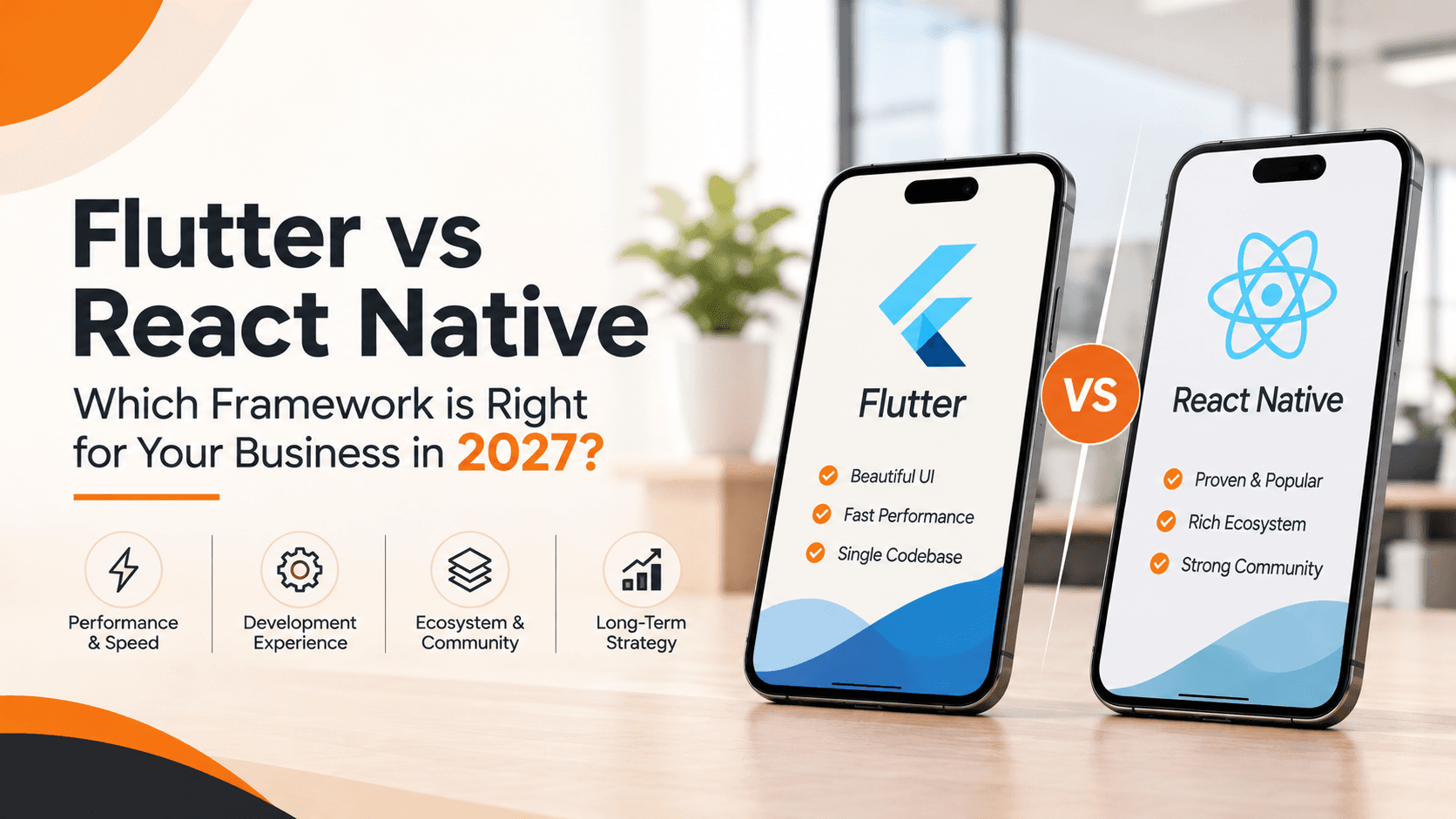
In 2027, choose Flutter for custom, design-led apps that need consistent performance and strong Arabic and RTL support, and choose React Native if you have a JavaScript or React team, want code sharing with web, or need the widest hiring pool. Build costs are nearly the same: about $8,000 to $43,000 for an MVP and $10,000 to $91,000 for a full app, roughly 30% to 45% less than two native apps.
Flutter vs React Native is still the biggest decision in cross-platform app development, but the debate has changed. Both frameworks have fixed their biggest weaknesses. React Native now runs only on its New Architecture with Hermes V1, and Flutter has moved to the Impeller rendering engine and is building AI-driven interfaces into its roadmap. The old arguments about "the bridge" and "jank" no longer decide the question.
This guide compares Flutter and React Native as they stand going into 2027: performance, cost, hiring, ecosystem, Arabic support and which to choose for your type of project.
Flutter vs React Native at a Glance (2027)
Factor | Flutter | React Native |
|---|---|---|
Backed by | Meta | |
Language | Dart | JavaScript / TypeScript |
Latest stable (Nov 2026) | Flutter 3.50, Dart 3.14 | React Native 0.88 (0.89 due Dec 2026) |
Rendering | Own engine (Impeller), draws every pixel | Native platform components via the New Architecture |
Performance | Very consistent frame pacing | Near-native; much improved since 2025 |
Base app size | Usually larger | Usually smaller |
Hiring pool | Strong and growing | Largest, thanks to React developers |
Web and desktop | Web (WebAssembly), Windows, macOS, Linux | Web via React / React Native Web; desktop via Microsoft forks |
Over-the-air updates | Via Shorebird | Via Expo EAS Update |
Arabic / RTL | Automatic from locale | Supported via I18nManager; direction switch needs restart |
Best for | Design-led, animated, multi-platform apps | JS teams, web code sharing, fast hiring |
What Changed in 2026 for Each Framework
Flutter in 2026
Flutter 3.50 (November 2026) moved Material and Cupertino into standalone packages, made direct native interop (FFIgen and JNIgen) stable and reduced iOS touch latency.
WebAssembly is now the default for Flutter web on Chrome and Edge, with Safari and Firefox support opt-in.
The 2026 roadmap focuses on the GenUI SDK and A2UI protocol for AI-generated, adaptive interfaces, finishing the Impeller migration on Android, desktop multi-window and AI agent tooling (MCP servers).
Widget Previews became stable, which speeds up UI work.
React Native in 2026
New Architecture only. Since React Native 0.82, the legacy architecture no longer runs, so every app uses the faster JSI-based system.
Hermes V1 by default from 0.84, along with precompiled iOS binaries that cut build times.
React Native 0.88 (October 2026) ships React 19.3, web-standard event handling and experimental Swift Package Manager support, with no breaking changes for users.
Expo continues as the recommended way to start, with SDK 57 released in June 2026 and frequent updates since.
Performance: Flutter vs React Native Benchmarks
Published benchmarks vary, so treat them as direction rather than law. A 2025 test by SynergyBoat on an iPhone 16 Plus and Galaxy Z Fold 6 found:
Metric | Flutter | React Native |
|---|---|---|
Average FPS (iOS) | 59.3 | 57.5 |
Dropped frames (iOS) | 0% | 15.5% |
Time to first frame (Android) | 10.3 ms | 15.3 ms |
Memory increase (Android) | 14 MB | 33 MB |
That test ran before React Native's legacy architecture was removed, and newer analyses show the gap has narrowed. Independent 2026 estimates put cold start on mid-range Android at roughly 450 to 590 ms for Flutter and 480 to 620 ms for React Native, while React Native often ships a smaller base download. In practice:
Flutter has the edge for heavy animation, custom graphics, games-like UI and consistent behaviour on low-end Android devices.
React Native is fully competitive for forms, feeds, commerce, booking and dashboard apps, which covers most business software.
Poor state management, oversized images and chatty APIs slow apps far more than the framework choice.
Popularity and Ecosystem
Developer usage: in the 2024 Stack Overflow Developer Survey, 9.4% of respondents used Flutter and 8.4% used React Native.
GitHub: as of July 2026, Flutter had about 178,000 stars and React Native about 126,000, but React Native had more contributors (about 4,200 vs 2,400).
npm growth: React Native downloads roughly doubled year on year, to about 296 million over 12 months.
Real apps: Appfigures data from December 2025 found Flutter in 1,184 and React Native in 1,350 of the top 10,000 non-game iOS apps. React Native led among apps earning over $1 million a month (173 vs 37).
Who uses Flutter: Google Pay, Google Ads, myBMW, Nubank, eBay Motors, Philips Hue. Who uses React Native: Instagram, Microsoft Office, Shopify, Discord, Pinterest, Walmart, Bloomberg.
Flutter vs React Native Cost in 2027
For the same features, design and testing, build costs are almost identical. The bigger saving is against native development. We benchmarked current agency guides and set these ranges slightly below the market average:
App scope | Flutter or React Native | Two native apps (iOS + Android) | Timeline |
|---|---|---|---|
MVP (core flows, auth, payments, admin) | $8,000 to $43,000 | $12,000 to $77,000 | 8 to 14 weeks |
Full-featured app | $10,000 to $91,000 | $15,000 to $150,000 | 14 to 20 weeks |
Complex platform (real-time, AI, multi-role) | $12,500 to $175,000+ | $20,000 to $290,000+ | 5 to 9 months |
Over three years, cross-platform teams usually save 35% to 45% in total cost of ownership versus two native codebases, mainly because every feature and bug fix is built once.
Developer rates by region
Region | Flutter | React Native |
|---|---|---|
USA (agency / senior contract) | $67 to $144/hour | $67 to $144/hour |
UK (contract, median day rate) | About £475/day | About £500/day |
Western Europe | $48 to $115/hour | $48 to $115/hour |
India (agency) | $15 to $67/hour | $15 to $67/hour |
US senior salaries are similar for both (roughly $145,000 to $190,000). React Native roles are easier to fill quickly because React web developers can move across. For a full app budget breakdown, see our mobile app development services.
Arabic and RTL Support for UAE and Saudi Apps
For Gulf businesses, Arabic quality is often the deciding factor. Both frameworks can deliver excellent bilingual apps, but they handle direction differently:
Flutter reads text direction from the user's locale and mirrors layouts automatically. Flutter 3.50 also improved ordering of mixed Arabic and English text and selection handles.
React Native uses I18nManager to allow or force RTL. Changing direction at runtime usually needs an app restart, and Android and iOS each need extra configuration.
For both: plan for Arabic fonts and numerals, longer strings, and fields that must stay left-to-right, such as OTP codes, IBANs and phone numbers. Test with real Gulf users, not just translated strings.
Gulf apps also commonly need local payment options (mada, Apple Pay, STC Pay, Tabby, Tamara), UAE PDPL or Saudi PDPL compliance, and hosting in regional cloud regions. Both frameworks support these through mature SDKs.
Which Should You Choose? A Simple Decision Guide
Your situation | Our pick |
|---|---|
Your team already writes React or TypeScript | React Native |
You need a web app sharing logic with mobile | React Native |
Brand-led UI, rich animation, custom design system | Flutter |
Bilingual Arabic and English app for the UAE or Saudi Arabia | Flutter (React Native also works well) |
Mobile plus desktop (Windows, macOS) from one codebase | Flutter |
You must hire fast in the US, UK, Canada or Australia | React Native |
Existing native app, adding cross-platform screens gradually | React Native, or Kotlin Multiplatform for shared logic |
Fintech, health or enterprise apps with strict security | Either; the team's experience matters more than the framework |
If you are still undecided, build a two-week spike of your hardest screen in both frameworks. It costs far less than switching after launch.
How iSkylar Can Help
iSkylar builds Flutter and React Native apps for startups and enterprises across the USA, UK, UAE, Saudi Arabia, Canada and Australia, including bilingual Arabic apps and AI-powered features. Explore our Flutter app development services, our wider mobile app development offer, flexible engagement models, or plan AI features with our agentic AI services.

WRITTEN BY
Harsh Mangal
Writes about AI, automation and mobile product strategy at iSkylar, helping founders and operations leaders in the US, UK, Gulf, Canada and Australia make build decisions with real numbers.
Frequently Asked Questions
Which is better in 2027, Flutter or React Native?
Is Flutter faster than React Native?
Is Flutter or React Native cheaper to build?
Should a startup choose Flutter or React Native?
Will Flutter or React Native be discontinued?
Which framework has more developers to hire?
Which is better for Arabic apps in the UAE and Saudi Arabia?
Where does Kotlin Multiplatform fit in?
Further Reading





Stay at the forefront of innovation.
innovation.
Join our inner circle of industry leaders and get exclusive insights delivered to your inbox every Thursday morning.
WE RESPECT YOUR PRIVACY. NO SPAM, EVER.
Updated At: