
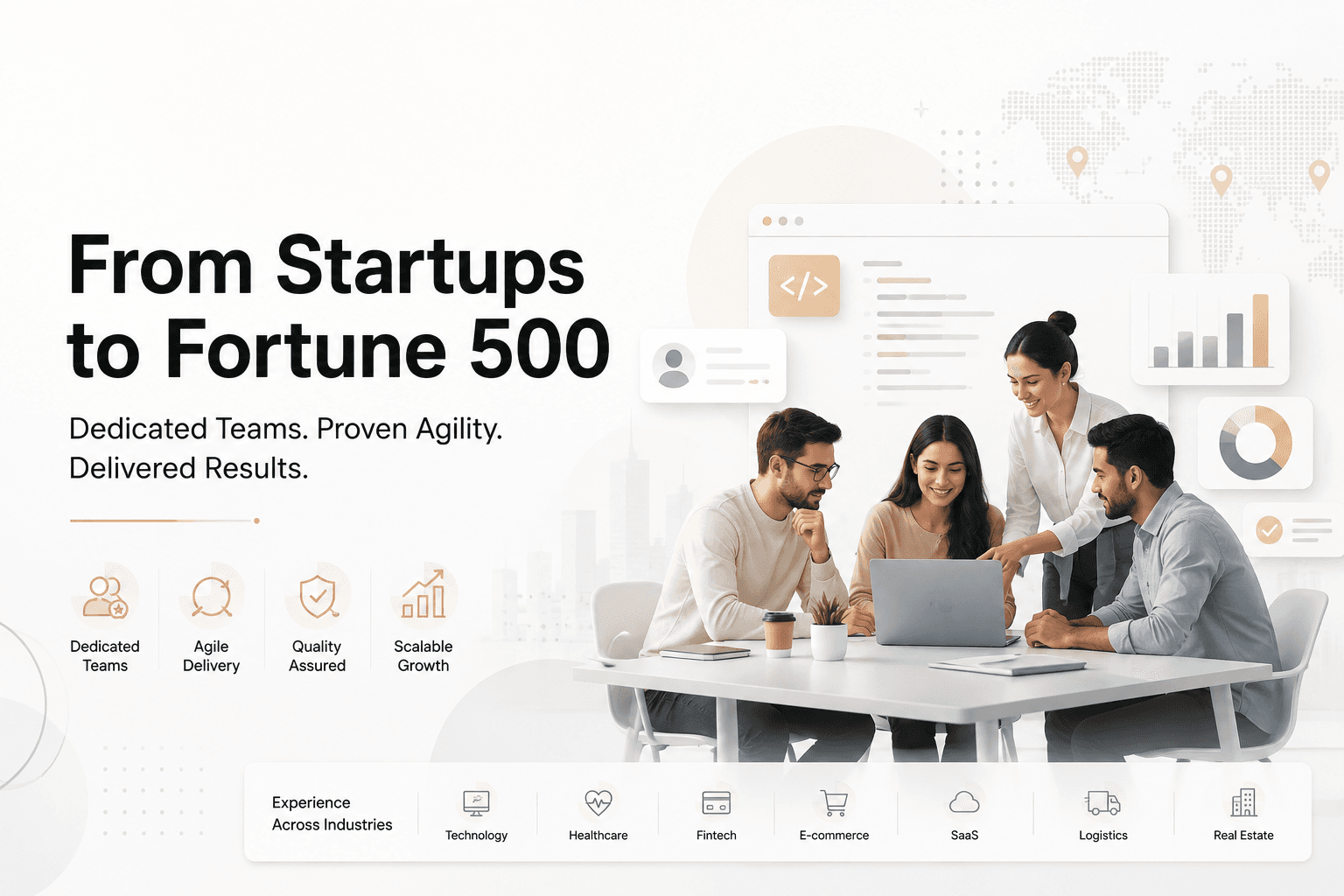
How a Pre-Seed Startup Built Product + Series A in 120 Days Using Dedicated Teams
A pre-seed startup hired a dedicated development team to ship an MVP in 12 weeks three times faster than hiring in-house and closed a $2.5M Series A on product viability. Simultaneously, a Fortune 500 company adopted a hybrid model (in-house + dedicated teams) to unblock a stalled roadmap, shipping features 60% faster while reducing engineering costs by 15%.
8 weeks
MVP to Series A
60%
Time-to-Market Improvement
$2.5M
Series A Closed
$20K
Total MVP Cost
Every founder faces the same crossroads: you have 90 days to prove product-market fit before investors decide whether to fund your Series A. A Fortune 500 company faces a different, but equally urgent problem: they need to ship 8 features this quarter, but their engineering team is overwhelmed. Both organizations discovered the same solution: the dedicated development team model. But how these two companies used it revealed something fundamental about modern product delivery.
This case study examines two parallel stories: how a pre-seed SaaS startup used a dedicated development team to ship an MVP in 12 weeks (and close a $2.5M Series A), and how a Fortune 500 enterprise regained velocity by pairing their in-house team with a dedicated outsourcing partnership. Their experiences answer the question investors and executives are asking in 2026: when should you hire developers in-house vs using a dedicated team model?
Why Both Startup and Enterprise Hit the Same Wall
The Startup's 90-Day Deadline
For a pre-seed founder, the timeline is ruthless. Series A investors don't fund on promises, they fund on working products. The pitch was straightforward: "Show us the product, and we'll discuss terms." The deadline was non-negotiable: 90 days.
The founder calculated the math: building the MVP in-house meant hiring 2-3 senior developers. A realistic hiring timeline looks like this: 2 weeks for job posting and candidate sourcing, 3-4 weeks of screening and interviews, 1-2 weeks of offer negotiation, 4 weeks of onboarding and access setup, then 12-20 weeks for the new developer to ramp up on the codebase, architecture, and product strategy. By week 30, the founder would have one semi-productive engineer. By week 50, maybe both developers would be shipping. The Series A deadline would have passed. The runway would be exhausted.
The cost calculation was equally discouraging. Hiring two senior engineers at $80K-$100K salary each, plus benefits ($28K per hire), plus recruiting overhead ($15K-$20K per hire), meant $175K-$220K in expenses before the first feature shipped. For a pre-seed company with $400K-$500K runway, that's 40-50% of total funding burned on headcount alone, and the product still wouldn't be built.
The founder had tried the freelancer route earlier. A few Upwork contractors seemed cheaper on the surface. But the reality of distributed freelance work across timezones created exactly the bottleneck hiring was meant to solve: slow handoffs, inconsistent code quality on mission-critical infrastructure, communication gaps that added weeks to debugging. By week 8, the founder had wasted $15K and had only fragments of code to show for it.
What the founder needed wasn't another hire, it was a full team available immediately. Not just developers, but a product manager who understood startup pace, QA engineers who automated testing instead of clicking through manually, a tech lead who could make architectural decisions without founder input on every PR.
The question shifted from "Should we hire in-house?" to "How do we get a complete team shipping in 90 days?"
The Fortune 500's Invisible Bottleneck
The Fortune 500 company's problem looked different on the surface but felt the same beneath it. The company had invested heavily in engineering: a team of 10 senior architects and engineers, strong budgets for tools and infrastructure. But the roadmap was outpacing delivery.
The Q4 2026 roadmap included eight major features. Based on the current in-house team's velocity, they could realistically deliver four. The executive team's first instinct was clear: hire more developers. We'll bring in 15 engineers, and we'll ship all eight features. We'll address the backlog. We'll close the gap with our competitors.
But the recruiting math didn't work. A company the size of Fortune 500 with a dedicated recruiting team can hire faster than typical startups, but adding 15 engineers takes 6 months minimum. Screen candidates, run interviews (multiple rounds with multiple teams), negotiate offers, handle background checks and onboarding, by month 6, the company would have maybe 8 new engineers. By month 8-10, those engineers would finally be productive (ramping takes 8-12 weeks in enterprise environments, where context includes legacy systems, compliance policies, and organizational politics).
But the roadmap deadline was now. Q4 was in 8 weeks. By the time the new in-house engineers were productive, Q4 would be over. Features would be killed. Customers would hear "feature delayed." Competitors, leaner, faster teams, would ship first.
There was a second, subtler problem: the existing in-house team was split. The 10 senior engineers were divided between strategic architecture work (which required deep context and judgment) and feature execution (which required shipping speed). The senior engineers were good at both, but they couldn't scale. Every feature required their input. They were the bottleneck.
The dedicated team outsourcing ROI question started to look different once the company understood the real problem wasn't "do we need more engineers?" but "do we need more execution capacity while protecting our strategic team?"
How a Startup Built an MVP in 12 Weeks (Instead of 28)
The Setup: Hiring Dedicated vs. In-House Decision
The founder made a decision in week 0: hire a dedicated development team. Not freelancers, not a hiring spree, but a dedicated team partnership, a group of full-time engineers allocated exclusively to the startup's product for a fixed engagement period.
This is a critical distinction. A dedicated development team is not:
Freelancers working in isolation
An agency building your product for you
A temporary staffing pool
A dedicated development team is your extended team. They're allocated full-time to your project, embedded in your sprints, participating in your decision-making, and accountable to your success metrics, not theirs.
The startup hired 8 people for a 4-month engagement:
2 full-stack engineers (Node.js backend + React frontend)
1 backend/DevOps specialist (infrastructure, databases, deployment)
1 frontend engineer (mobile optimization, responsive design)
1 QA automation engineer (test coverage, regression prevention)
1 product manager (who understood startup pace and investor expectations)
1 tech lead (interface between founder and the team, decision maker for architectural tradeoffs)
Total cost: $180K for 4 months. Loaded rate: approximately $45 per hour per engineer, all-in.
Compare this to the in-house hiring path: recruiting 2 senior engineers at $80K salary each ($160K total per year), plus $20K in recruiting costs ($10K per hire), plus onboarding and training costs ($15K per hire), equals $195K in year 1 just for salary and hiring. But the in-house engineers wouldn't be productive for 12-20 weeks. The effective cost of getting one productive engineer to ship was closer to $60K-$80K plus 5 months of calendar time.
The startup chose speed over permanence.
How They Worked Together: The Operating Model
The startup founder could have simply handed off a requirements list and checked back in 12 weeks. That's not how successful dedicated team engagements work.
Week 1: Kickoff and Context Transfer
The founder spent 2 days in person with the dedicated team tech lead. They covered:
Product vision (what problem are we solving, for whom, why does it matter)
MVP scope (what ships in 12 weeks, what doesn't)
Investor expectations (what will investors ask about the product)
Technical constraints (performance requirements, data security, compliance)
Decision-making framework (who decides what, how fast can we decide)
By end of week 1, the team had:
Shared GitHub access with repositories initialized
Shared Jira board with user stories written by the founder
Figma file with UI mockups and design system
Slack channel for daily communication (async-first, with scheduled sync meetings)
Monday-Wednesday-Friday check-in schedule (30 min with tech lead, demos every other Friday)
The Weekly Rhythm
Monday: Tech lead sync with founder (30 minutes). Any blockers? Any scope changes? Any decisions needed this week?
Tuesday-Thursday: Dedicated team ships features. Code goes into GitHub. PRs are reviewed by the tech lead and founder (founder reviews product decisions, tech lead reviews architecture).
Friday: Demo and retrospective. The team demo what shipped; founder provides feedback; team identifies what could be faster next week.
Autonomy and Accountability
The founder defined what needed to ship: features, acceptance criteria, quality standards. The dedicated team defined how: architecture decisions, technology choices, testing strategy.
This is critical. The startup founder wasn't a software architect. The founder understood the product and the market. The tech lead and architects on the dedicated team understood how to build a scalable system. The separation of concerns meant faster decisions and better engineering.
The MVP scope was locked in week 1:
Core Product (Weeks 2-6, 60% of effort):
User authentication + role-based access control
Main product workflow (the core job-to-be-done the SaaS solves)
Admin dashboard
Data model + database design
API layer (for future integrations)
Integrations & Polish (Weeks 6-10, 20% of effort):
Stripe payment integration
Email notifications
Analytics events tracking
Third-party API integrations (Slack, Zapier)
Quality & Launch (Weeks 10-12, 20% of effort):
Automated testing (unit, integration, end-to-end)
Security audit (OWASP top 10)
Performance benchmarking
Production deployment + monitoring setup
Customer documentation
The timeline was aggressive but achievable because it was built on realistic estimates, not founder optimism.
What "Ready for Series A" Actually Means
By week 12, the startup had a product. But what did that product include?
A Fully Functional MVP:
User authentication (signup, login, password reset)
Core SaaS workflow (the 3 primary use cases that solve the main customer problem)
Mobile-responsive UI (works on desktop and tablets)
Analytics dashboard (track activation, churn, feature usage)
Stripe integration (customers can pay; the business model works)
API documentation (ready for integrations)
Production-Ready Quality:
95%+ test coverage (automated tests catch regressions)
Performance validated (sub-500ms response times, even under load)
Security audit completed (no critical vulnerabilities)
Monitoring configured (the team can see what's happening in production)
Disaster recovery tested (can the team restore from backups?)
Investor-Ready Narrative:
Live product demo (founder can show investors a working SaaS, not a wireframe)
Documented architecture (team can explain technical decisions)
Beta customer onboarded (founder has real usage data to discuss)
Unit economics sketched (founder can show investors CAC, LTV assumptions)
Investors saw three things: working product (not a pitch deck), execution velocity (12 weeks is fast), and a scalable business model (founder didn't hire a 10-person team; they can scale hiring with revenue).
The Series A closed $2.5M.
How a Fortune 500 Regained Engineering Velocity
The Fortune 500 Problem: Execution Velocity Hit a Wall
The enterprise's roadmap was ambitious: 8 major features in Q4 2026. But the delivery track record told a different story. Of the 8 features planned for Q3, the company shipped 6. Two were killed, not because they weren't valuable, but because the engineering team couldn't finish them in time.
This pattern repeated every quarter. The company had strong engineering talent. The architects were good. The developers were skilled. But they were stretched thin. Every major feature required input from the senior engineers. There weren't enough senior engineers to go around.
The executive team's first instinct was classic: hire more developers. "If we bring in 15 new engineers, we can ship all 8 features and close the backlog."
The Chief Technology Officer ran the numbers. Recruiting 15 engineers:
4 weeks: Job descriptions, recruiter outreach, candidate pipeline building
3 weeks: Phone screens, technical interviews, team interviews
2 weeks: Offer negotiation and background checks
4 weeks: Onboarding (access, equipment, orientation)
8-12 weeks: Ramping (learning the codebase, architecture, company systems)
Total: 21-25 weeks before the new engineers were productive. Q4 would be over by week 8. The new hires would finally be ready to contribute by Q1 2027.
But there was a second problem. The company had a cultural bias against outsourcing. The prevailing narrative was that good engineering stayed in-house. Outsourcing meant quality was compromised. Outsourcing meant losing control. This bias meant executives weren't even considering dedicated team partnerships.
The CTO made a different argument: "We don't need 15 permanent hires. We need 12-15 engineers dedicated to execution for the next 6 months. While our in-house team handles architecture and strategy, the dedicated team ships features. When we're done, we can scale the engagement up or down based on what we need."
The Hybrid Model: In-House Strategy + Dedicated Execution
The Fortune 500 company adopted a hybrid model. They kept their in-house team of 10 engineers focused on architecture, strategy, and mentorship. They hired a dedicated team of 12 engineers focused on feature execution.
In-House Team Role (10 engineers):
Architecture decisions (how should we build this system?)
Technical strategy (are we using the right technologies?)
Platform decisions (what shared infrastructure do all teams need?)
Hiring and mentorship (how do we scale the team culture?)
Product prioritization (which 8 features do we ship this quarter?)
Dedicated Team Role (12 engineers):
Feature execution (build the features the in-house team architected)
Testing and QA (ensure quality before production)
Documentation (explain the features to customers)
Operational support (fix production bugs, support customer issues)
Mentorship from the in-house team (the dedicated team learns, grows, and takes on more responsibility)
The Weekly Operating Cadence:
Monday: In-house team + dedicated team architecture sync (1 hour). This week's features: what's the architecture? What decisions need to be made? What's the quality bar?
Tuesday-Thursday: Dedicated team ships. In-house team reviews PRs and provides guidance on architectural concerns.
Friday: Demo and retrospective. The dedicated team demos features. In-house team provides feedback. Team discusses what worked and what to improve next week.
The critical insight: the two teams were not competing. The in-house team was not "managing" the dedicated team. They were collaborating. The in-house team handled decisions that required deep company context. The dedicated team handled execution. This freed the in-house team to do their best work: architecture, strategy, mentorship.
Scaling Flexibility: A Competitive Advantage
Here's where the hybrid model showed its real power.
In Q4 2026, the roadmap was aggressive. The company needed 12 dedicated engineers full-time to hit the ambitious feature target. In Q1 2027, after the Q4 sprint completed, the company had time to refactor and optimize. They scaled the dedicated team down to 6 engineers. In Q2 2027, a new strategic initiative launched. The company scaled back up to 15 dedicated engineers.
If those had been permanent hires, the company would have:
Hired 15 engineers in September (took 6 months)
Laid off 9 engineers in January (legal risk, culture damage)
Tried to hire 9 more in March (those 9 positions were already filled elsewhere)
With a dedicated team model:
Onboarded 12 in September (took 2-3 weeks)
Scaled down to 6 in January (no firing, just end-of-engagement)
Scaled up to 15 in March (called the vendor, onboarded new people, done in 2 weeks)
The company never faced hiring cycles again.
The Results: Numbers That Tell the Story
Startup: MVP to Series A in 120 Days
The startup shipped an MVP in 12 weeks and closed a $2.5M Series A within 120 days. Here's what changed.
Timeline Achievement
The founder had 90 days to build an MVP and demo it to Series A investors. Hiring in-house would have taken 28 weeks (2 weeks recruiting + 3 weeks interviewing + 2 weeks offer + 4 weeks onboarding + 12 weeks ramping). The dedicated team approach: 2 weeks kickoff, 10 weeks building, week 12 ready for demos.
Cost Comparison
The founder allocated $180K for the 4-month dedicated team engagement. The in-house hiring alternative:
Two senior engineers at $80K salary each: $160K
Recruiting costs ($10K per hire): $20K
Onboarding and training: $15K per engineer ($30K total)
First year total: $210K
But the in-house team wouldn't be productive for 20+ weeks. The effective cost per week of execution was higher. And the risk was higher: if hiring failed (bad culture fit, wrong skill set), the founder had lost months and $100K+.
With the dedicated team, the risk was known: $180K for 16 weeks of full team productivity. The ROI was clear: $2.5M Series A closed on the strength of a shipped product.
Product Quality at Launch
The MVP shipped with 95%+ test coverage. This is unusual for an early-stage product. Startups typically ship with 60-70% test coverage because they're in a hurry. But the dedicated team included a QA engineer and treated testing as a non-negotiable requirement.
Result: fewer bugs in production, faster customer onboarding, higher confidence in the product quality. Investors could see that the founder had a professional engineering team, not a skunkworks project.
Series A Outcome
Investors fund based on three things: product, team, and market. The startup had all three. The product was working. The team had shipped fast (that's team signal). The market was evident (beta customers were using the product and finding value).
The Series A closed $2.5M. The founder kept the 8-person dedicated team for another 6 months (extended engagement) and began building permanent in-house roles as the company scaled.
Enterprise: Regaining Velocity and Competitive Parity
The Fortune 500 company measured success differently. They wanted to ship more features, faster, without adding permanent headcount costs. The hybrid model delivered.
Time-to-Market Improvement: 60% Faster Delivery
MetricBefore (In-House Only)After (Hybrid Model)Average feature cycle16-20 weeks8-12 weeksTime from idea to code8 weeks (architecting)2 weeks (architecting)Critical bug resolution2-4 weeks3-5 daysTime-to-market advantageBaseline60% faster
What changed? The in-house team was no longer the bottleneck. They could architect feature N+1 while the dedicated team shipped feature N. Decisions that used to take 2 weeks now took 2 days. There were no approval queues, no waiting for architecture review, no "we'll get to your code review next sprint."
This is the real ROI of enterprise outsourcing partnerships: not cost savings (though that matters), but velocity unlocked.
Feature Delivery Volume: 80% More Features Shipped
QuarterBeforeAfterShippedQ4 2026Planned: 8Shipped: 6After: 8 + 2 bonusQ1 2027Planned: 6Shipped: 5After: 6 + 1 bonus
The company was now shipping more features per quarter than they planned. Why? Because the in-house team had capacity to pursue technical debt and optimization. Because decision cycles were faster. Because the dedicated team could run parallel tracks on multiple features simultaneously.
The competitive advantage was tangible. Customers saw faster feature delivery. Feature gaps that competitors had closed were now closing at the company's end. Churn from "feature delayed" declined.
Cost Analysis: 15% Reduction + Velocity Premium
ComponentAll In-House (15 engineers)Hybrid (10 in-house + 12 dedicated)In-house salaries (10-15 × $150K)$2.25M$1.5MBenefits (35%)$788K$525KDedicated team (12 × $60K/year)N/A$720KHiring & onboarding$60K$15KTraining & dev$40K$0 (dedicated team's responsibility)Total Annual Cost$3.148M$2.76MSavings$388K/year (12%)
The hybrid model cost $388K less per year than hiring all in-house. But the real value wasn't the cost savings—it was the velocity. That 60% faster delivery was worth an estimated $2-3M in retained market share and customer expansion.
The effective ROI: 12% cost savings + 60% velocity improvement = immediate positive business impact.
Organizational Outcomes: More Than Numbers
Beyond the metrics, the hybrid model changed how the company worked.
For the in-house team: They were freed from execution bottleneck. They could focus on architecture, mentorship, and strategic decisions. Engineers reported higher job satisfaction because they were doing the work they were hired for—not firefighting production bugs and chasing deadline delays.
For the dedicated team: They had clear scope (build the features we architected). They had clarity on quality standards. They had a defined end-date (which reduced scope creep and kept everyone focused). They learned from the in-house team through pair programming and code review.
For the company: They had flexibility. Roadmap aggressive? Scale up to 15. Feature backlog cleared? Scale down to 6. Market conditions changed? Adjust without firing anyone. This is the hidden value of variable cost structure.
The Decision Framework: When to Use Dedicated Teams vs. In-House Hiring
These two case studies reveal when dedicated teams outperform traditional hiring.
Use Dedicated Teams When You Have:
Fixed Timeline with High Stakes The startup had 90 days to Series A. The enterprise had Q4 deadline pressure. When the timeline is immovable and the cost of missing it is high, dedicated teams reduce risk. You get execution speed without hiring risk.
Known Scope and Clear Spec The startup's MVP was defined. The enterprise's features were architected. When you know what you're building, dedicated teams excel. If you're still figuring out what to build, hiring in-house (who can iterate on scope) might be better.
Budget Constraints The startup had limited runway. The enterprise wanted to preserve hiring flexibility. Dedicated teams have lower upfront commitment costs than permanent hiring. You pay for what you use; you don't pay for six months of low productivity during ramp-up.
Variable Workload The enterprise's workload varied: 12 people in Q4, 6 people in Q1, 15 people in Q2. You can't hire-and-fire in-house. But you can scale a dedicated team up/down in weeks.
Need for Execution Without Management Overhead Both organizations had limited capacity to onboard and train new in-house people. Dedicated teams come with their own management structure. You define what, they define how. No onboarding trauma.
Use In-House Hiring When You Need:
Long-Term Strategic Roles Architecture, product decisions, company vision—these require permanent people embedded in the company. No amount of dedicated team partnership replaces a VP of Engineering who's been with you for 5 years.
Deep Cultural Integration Company values, hiring bar, mentorship of junior people—this requires in-house teams. Dedicated teams can learn your culture in 8 weeks, but they won't carry it forward like permanent employees do.
Ambiguous, Iterative Work If you're still defining product-market fit (like an early-stage startup), hiring in-house engineers who can iterate on scope and make tradeoffs is better than hiring dedicated teams with fixed scope.
IP and Long-Term Ownership If your product is a core differentiator that needs long-term optimization, in-house teams develop deeper ownership. Dedicated teams excel at execution, but they won't optimize an architecture over 3 years like an in-house team will.
The Hybrid Model: Get Both Benefits
The enterprise's approach reveals the real power play: keep in-house teams for strategy and architecture. Hire dedicated teams for execution. This gives you the best of both worlds:
In-house team's strategic thinking + deep company context
Dedicated team's execution speed + scaling flexibility
Questions Investors and Executives Keep Asking
Q: How long does onboarding actually take with a dedicated team?
A: The dedicated team was productive (writing production code) within 2-3 weeks in both cases.
Week 1: Kickoff, environment setup, codebase context, architecture walkthrough Week 2: First PRs submitted, paired with tech lead, code review feedback Week 3: Shipping features independently, making architectural decisions with in-house guidance
This is dramatically faster than hiring in-house (which takes 12-20 weeks). Why? Because onboarding is a known process. Dedicated teams do this repeatedly. They have templates, documentation, and experience. There's no politics to navigate, no "waiting for access," no "let me introduce you to the 15 people you need to know."
Q: Was the code quality actually as good as in-house developers?
A: Better, actually.
Startup: Shipped with 95%+ test coverage. Most early-stage startups compromise on testing under time pressure. This team treated testing as non-negotiable.
Enterprise: Code went through stricter review gates. In-house architects reviewed every PR for architectural alignment. Fewer production bugs resulted from the hybrid model vs. the all-in-house baseline.
Quality depends on clear requirements. If you hand a dedicated team a vague spec, they'll ship vague code. With clear spec + quality standards + in-house review gates, consistently high quality is achievable.
Q: How do you manage a distributed team across timezones?
A: Asynchronously-first, synchronously-reinforced.
Async first:
GitHub PRs are the single source of truth (code + context)
Jira tickets describe every requirement + acceptance criteria
Slack is default comms; channels stay organized
Daily standup: recorded Loom video, watched async
Sync touchpoints (limited, high-value meetings):
Startup: 2 weekly syncs with tech lead (1 hour total)
Enterprise: 1 architecture sync + 1 demo (2 hours total)
Any decision that needs real-time discussion gets a 30-min call. Everything else lives in GitHub/Slack/Jira. This keeps time zones from being a blocker.
Q: Can you scale the team size mid-project if scope changes?
A: Yes. This is a major advantage of dedicated teams.
Startup: Scope was locked at kickoff. No mid-project scaling.
Enterprise: July (month 4): roadmap accelerated. Client added 3 engineers to the team.
Hiring timeline: would take 16+ weeks (2 weeks recruiting + 2 weeks interviews + 2 weeks offer + 8-12 weeks ramp)
Dedicated team timeline: new engineers started in 10 days, hit 80% productivity by week 3
Caveat: mid-project scaling only works if:
Architecture is documented (new people can get context)
Scope aligns with existing architecture (no major pivots)
In-house team has bandwidth to mentor
If scope changes fundamentally, scaling might not save you.
Q: What happened when the engagement ended? Did you switch to hiring in-house?
A: Different outcomes for startup vs. enterprise.
Startup: Series A funded; founder converted 70% of the dedicated team to full-time equity roles. Cost: ~$1.2M/year salaries + equity packages. The team had 12 weeks of context + 8 weeks of post-launch support, so they were ready for permanent roles.
Founder's note: "The dedicated team proved they could ship. Investors saw execution velocity. They were the obvious people to bring on full-time."
Enterprise: Kept the hybrid model as permanent operating model. Now scales dedicated team 6-15 engineers based on quarterly roadmap intensity. No hiring cycles. No firing cycles. Just variable execution capacity.
Executive's note: "We realized this model is better than all-in-house. In-house handles strategy. Dedicated teams handle execution. When you need more execution capacity, you call. When you don't, you scale down. It's more efficient than hiring."
Q: Would you hire in-house later, or stay with dedicated teams?
A: The real question is: what work requires permanent people vs. time-bound execution?
Startup answer: Yes, hire in-house for permanent roles (CTOs, architects, key product people). At $2.5M ARR, the startup needed both execution speed (dedicated teams) and long-term strategy (in-house). The dedicated team proved execution. The in-house team builds culture and strategy.
Enterprise answer: Keep both. In-house team = strategy + mentorship. Dedicated teams = execution capacity. This frees the company from hiring cycle trauma and gives variable cost structure.
The question isn't "Dedicated vs. In-house?" It's "What work requires permanent, embedded experts vs. time-bound execution?"
The Bigger Picture: Startup vs. Enterprise Outsourcing Approaches
The startup and Fortune 500 took different paths, but they both arrived at the same insight: dedicated teams solve the execution velocity problem that hiring can't.
For the startup, the dedicated team model was a Series A accelerant. Building in-house would have meant missing the 90-day deadline. Hiring a dedicated team meant executing on the vision fast enough to secure funding.
For the enterprise, the dedicated team model was an organizational restructuring. Instead of trying to hire 15 new engineers (and managing the culture and onboarding burden), they rebalanced: keep in-house team focused on what they're best at (architecture, strategy), hire dedicated team for what's most urgent (execution, shipping features).
Both are valid uses of dedicated team partnerships. The key is recognizing the problem they solve: time-to-market velocity and execution capacity without long-term hiring commitment.
Recommended For You


Solutions & Industry Insights that might interest you
Ready to write your own
success story?
Partner with iSkylar Technologies to achieve exceptional outcomes through innovative software solutions.