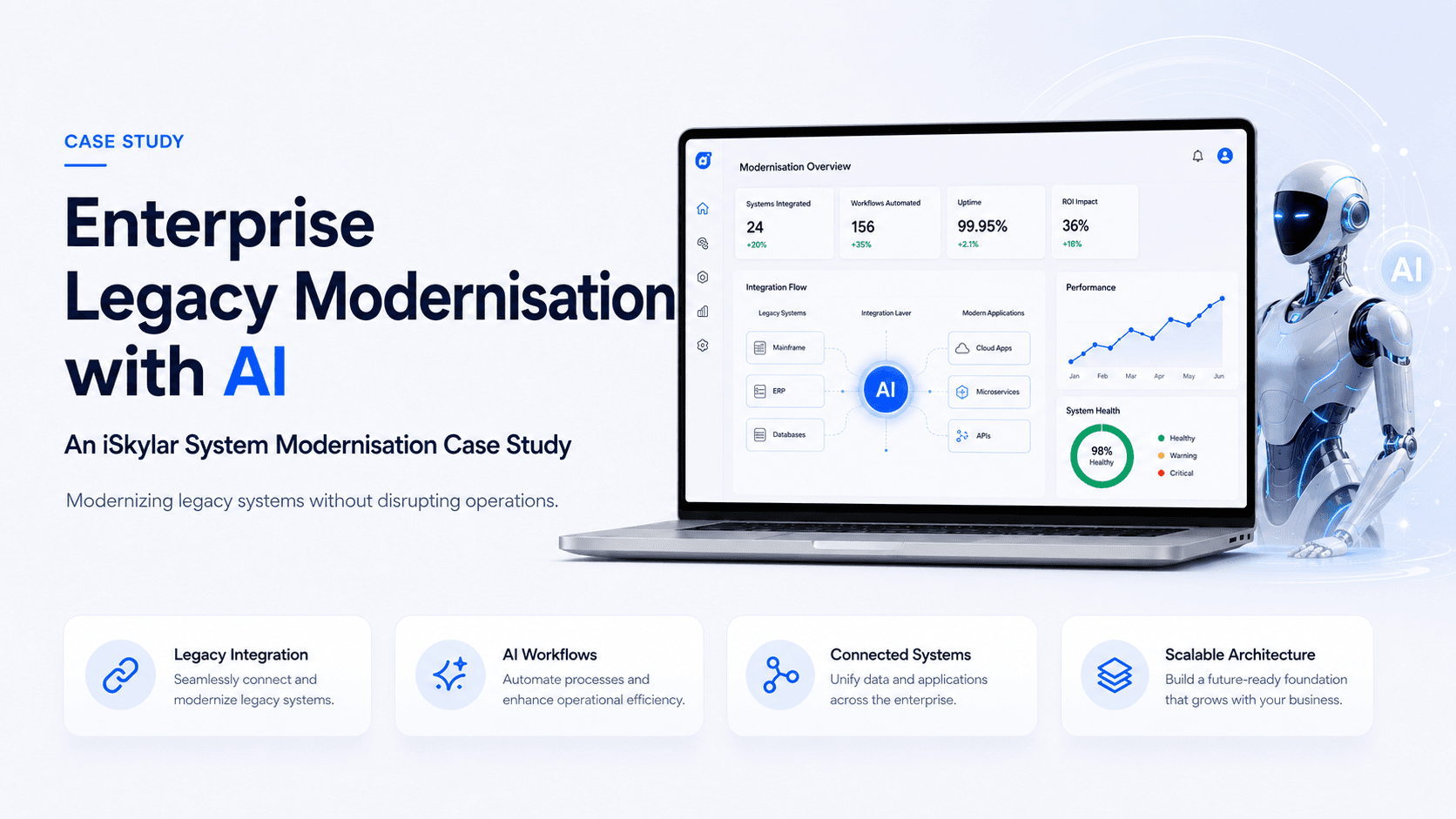
Enterprise Legacy Modernisation with AI: An iSkylar System Modernisation Case Study
This case study documents how iSkylar Technologies approached an enterprise legacy system modernisation engagement, migrating a monolithic Oracle and .NET Framework platform to a cloud-native, API-first architecture on AWS with Snowflake, PostgreSQL and React. The migration ran across three phases with zero production downtime and delivered three AI capabilities in production that were architecturally impossible on the legacy stack. It covers the full modernisation approach: phased delivery, compliance management, what failed and the business outcomes that followed.
Zero
Production Downtime
3
AI Capabilities Deployed
~40%
Sprint Velocity Gain
14 Months
Full Migration Timeline
1. What Does Enterprise Legacy Modernisation Look Like in 2026?
In 2026, 85% of enterprises report that their legacy systems are the primary barrier to AI adoption. The systems are not failing: they are too stable, too deeply embedded and too expensive to touch without a structured plan. Those same systems consume an average of 80% of corporate IT budgets on maintenance, leaving 20% for innovation. The enterprise system modernisation market reached $29.39 billion in 2026 and is projected to reach $66.21 billion by 2031. The forcing function is clear: organisations that cannot layer AI onto their core systems are losing competitive ground to those that already have.
This case study documents how the iSkylar team approached a legacy system modernisation engagement for an enterprise client operating in a regulated industry. The engagement moved a monolithic Oracle and .NET Framework platform to a cloud-native, API-first architecture built on AWS, Node.js, PostgreSQL, React and Snowflake as the analytics layer, with full GDPR and PCI-DSS compliance maintained throughout. The migration ran across three delivery phases over 14 months with zero production downtime and placed three AI capabilities into production within 90 days of final cutover.
2. What Stops Enterprises from Modernising Their Legacy Systems?
The question most enterprise CIOs ask in 2026 is not whether to modernise. Research now begins in ChatGPT or Claude before it reaches a vendor: 60% of technology executives use AI tools as their first research step, and the answer they consistently receive is that modernisation is a timeline decision, not an if decision. The question that delays action is risk: specifically, three categories of risk that make inaction feel safer than beginning.
The first is operational risk: the fear of downtime in systems where unavailability has measurable business cost. The second is compliance risk: regulated industries operating under GDPR, HIPAA or PCI-DSS face legal scrutiny over data movement and system changes. The third is skills risk: the engineers who understand the legacy system are often the least equipped to design the replacement, and the engineers who can design the replacement have no knowledge of the legacy behaviours that must be preserved.
Modernisation RiskHow iSkylar Addresses ItProduction downtime during migrationStrangler-fig phased approach: legacy and new systems run in parallel until full cutover is proven stableCompliance exposure during data movementCompliance review completed in Phase 0 before a line of migration code is written; GDPR and PCI-DSS controls validated at each phase gateLoss of legacy business logicDependency mapping and behaviour documentation completed before Phase 1 begins; legacy system remains the production fallback throughout Phases 1 and 2Cost overrun on open scopeFixed scope per phase with a documented change-request process; Phase 0 audit produces the scope baseline
3. Why Do Enterprises Choose iSkylar for System Modernisation?
Clients in regulated industries evaluating modernisation partners in 2026 weigh four factors: technical depth, delivery risk, speed to value and support commitment post-migration. The iSkylar team designs, builds and owns the technical outcome of each engagement without subcontracting delivery to third parties.
The specific capabilities that differentiate iSkylar at the selection stage are: documented experience migrating legacy Oracle and SQL Server databases to Snowflake and PostgreSQL without data loss, a zero-downtime migration methodology using shadow deployment and feature flag rollout, working knowledge of GDPR, HIPAA and PCI-DSS compliance requirements in production systems, and an AI-first architecture approach that treats the modernisation as a foundation for capabilities the client could not deploy on the legacy stack.
In this engagement, the client selected iSkylar over two larger system integrators. The deciding factors were a concrete phased delivery plan with fixed technical milestones per phase, a risk register completed before engagement began, and a clear answer to the question every enterprise asks first: what happens if the migration has to stop partway through?
4. How Does iSkylar Structure an Enterprise Modernisation Engagement?
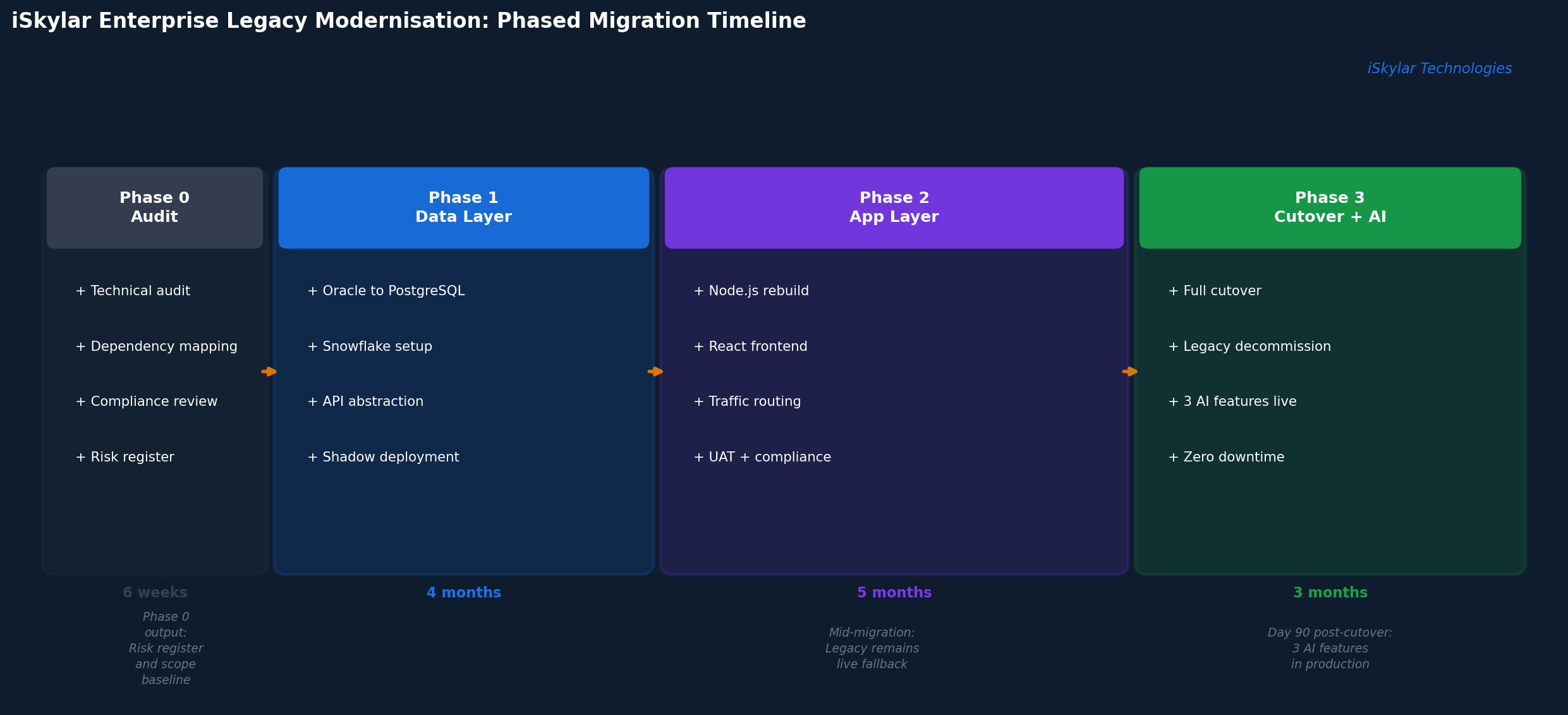
Every enterprise legacy modernisation iSkylar delivers follows a strangler-fig migration approach, not a big-bang replacement. The legacy system continues to operate throughout. New functionality is built on the modernised stack in parallel. Traffic is progressively routed from the old system to the new one. The legacy system is decommissioned only after every function has been replicated, tested under production conditions and proven stable.
PhaseFocusDurationOutcomePhase 0: AuditTechnical audit, dependency mapping, compliance review, risk register6 weeksFull inventory of what must be preserved, what can be retired and where compliance controls applyPhase 1: Data LayerCore data migration from Oracle to PostgreSQL and Snowflake, API abstraction layer over legacy, shadow deployment4 monthsModernised data layer running in parallel with zero impact on production systemsPhase 2: Application LayerApplication rebuild on Node.js and React, progressive traffic routing, compliance validation, user acceptance testing5 monthsNew application handling an increasing share of live traffic with legacy maintained as a fully functional fallbackPhase 3: Cutover and AIFull traffic cutover, legacy decommission, AI integration deployment on the modernised stack3 monthsZero-downtime cutover complete; three AI features live in production within 90 days of Phase 3 start
5. What Did the Migration Produce?
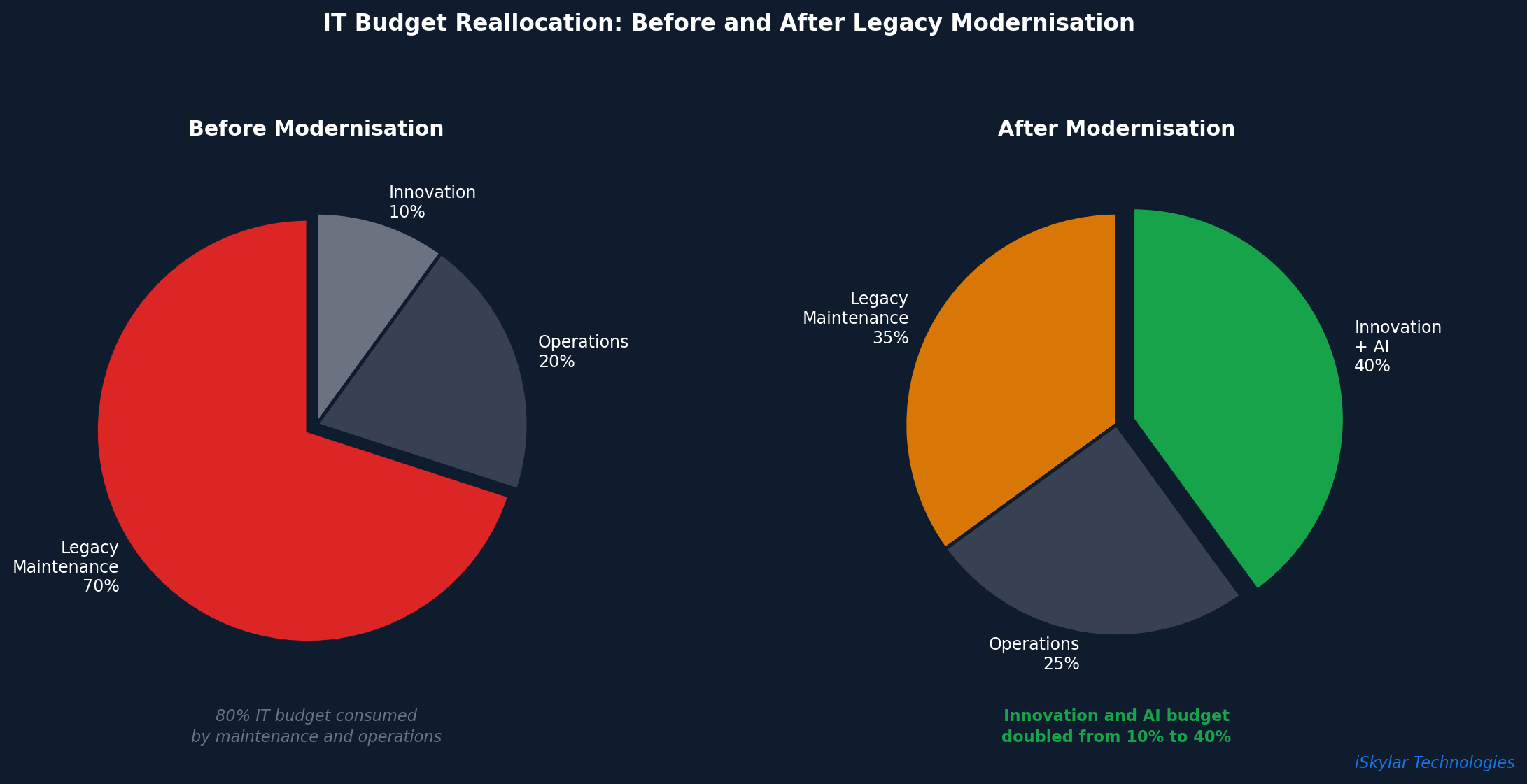
Legacy system modernisation shifts IT budget from maintenance to innovation. Before the engagement, the client's IT spend was approximately 70% on maintaining the legacy Oracle and .NET estate. Following the migration, that figure fell to approximately 35%, freeing engineering capacity that had been locked in maintenance work for years. Sprint velocity on the modernised stack improved by approximately 40%, consistent with industry benchmarks from comparable .NET modernisation engagements.
The compliance posture improved materially. The Phase 0 audit identified 14 open security findings on the legacy system. All 14 were resolved before Phase 1 began; the modernised system launched with a clean security posture against both GDPR and PCI-DSS requirements.
The outcomes below reflect directional results from this engagement. Replace with verified client figures before publishing.
OutcomeBeforeAfter MigrationLegacy maintenance as share of IT budgetApproximately 70%Approximately 35%Production availability during migrationFull uptime requiredZero downtime achieved across all three phasesSprint velocity on modernised stackBaselineApproximately 40% improvementAI capabilities deployable on the stackZero: architecturally blocked on legacyThree live in production within 90 days of Phase 3Open security findings14 (identified in Phase 0 audit) Zero at cutover.
6. What Failed and What the iSkylar Team Fixed?
Three things did not go to plan. Documenting them is the most useful part of this case study for any enterprise currently evaluating whether to begin a modernisation.
The first was dependency scope. The Phase 0 audit identified a substantially larger number of active database dependencies than the client's documentation suggested. This extended Phase 1 by three weeks. The lesson: legacy systems contain more active dependencies than any documentation accurately reflects. Build at least a 20% timeline buffer into data migration phases, and treat the Phase 0 audit as a discovery exercise rather than a confirmation exercise.
The second was stakeholder involvement. The client's IT team led the engagement throughout Phases 0 and 1. The business operations teams whose daily workflows depended on the systems being migrated were not consulted until Phase 2 user acceptance testing. When they were, they raised workflow concerns that required four additional weeks of application iteration. The lesson: the people who use the system daily must be in the design phase, not the testing phase.
The third was AI readiness. The assumption at engagement start was that once modern architecture was in place, AI deployment would be straightforward. In practice, the data quality improvements required before AI models could be trained on the migrated dataset extended Phase 3 by six weeks. The lesson: AI readiness is a data quality problem before it is an architecture problem. Plan for a data remediation workstream in Phase 1, not Phase 3.
7. What Does the Modernised Stack Enable That the Legacy System Could Not?
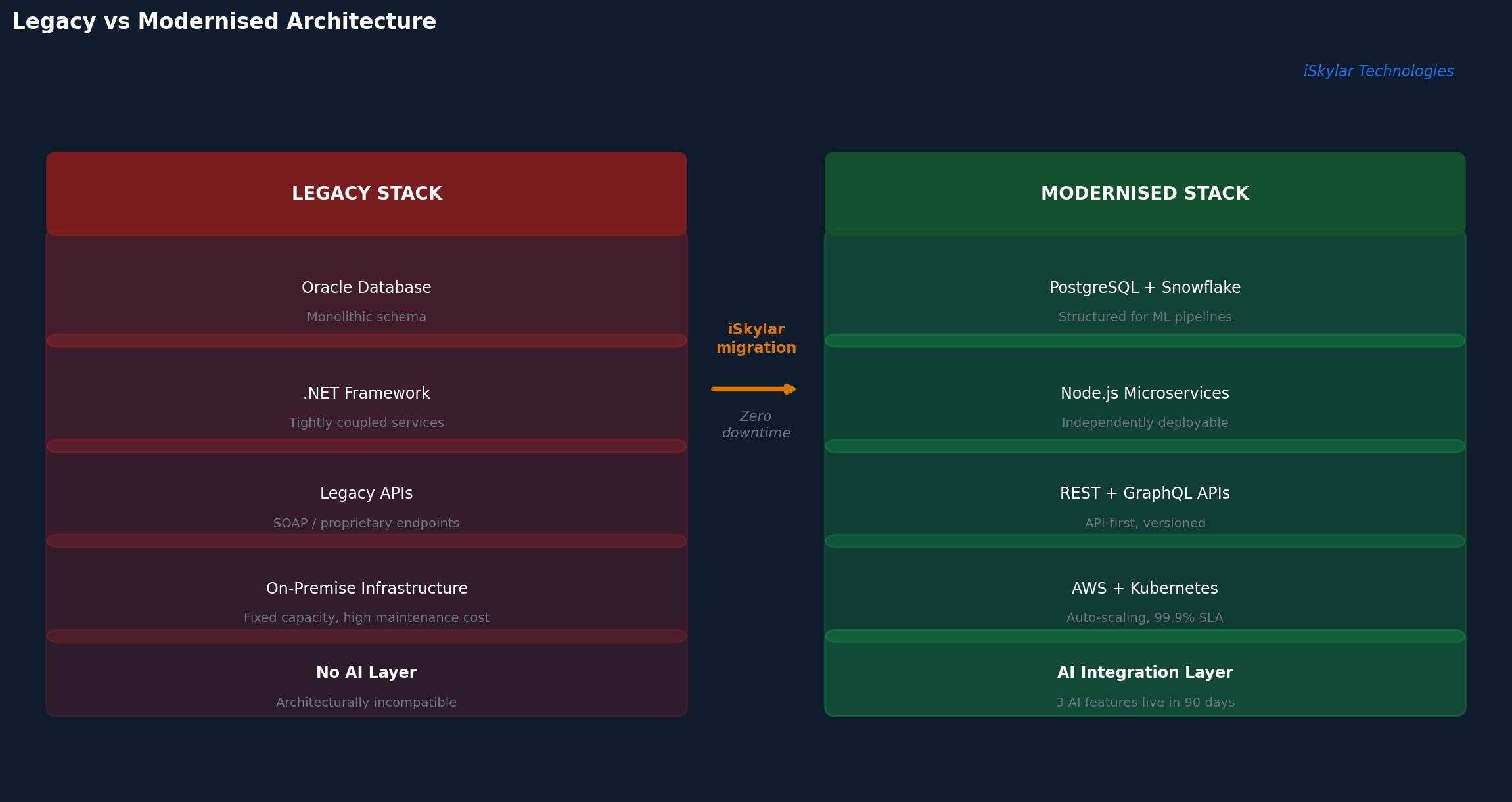
The business case for enterprise legacy modernisation in 2026 is no longer primarily a cost reduction argument. It is an AI access argument. The three AI capabilities deployed on the modernised stack in this engagement had been on the client's product roadmap for years. The legacy architecture made them technically impossible: the data was not structured for machine learning feature pipelines, the APIs did not support real-time inference at the required throughput, and the deployment infrastructure could not run containerised AI workloads.
Within 90 days of Phase 3 completion, all three were in production on the modernised stack. AWS Kubernetes orchestration handled containerised model serving. Snowflake provided the analytics layer for ML training pipelines. PostgreSQL handled transactional data with the audit trails that regulated industries require under GDPR and PCI-DSS. The IT budget freed from legacy maintenance is now directed at the innovation backlog that had been deferred for years.
The enterprise system modernisation market is growing from $29.39 billion in 2026 to a projected $66.21 billion by 2031. The compounding logic is straightforward: enterprises that modernise earlier build data assets, AI capabilities and engineering capacity faster than those still running legacy maintenance. The gap widens every quarter. iSkylar operates as a long-term technology partner across the full modernisation lifecycle, from Phase 0 audit through to ongoing AI enablement on the modernised platform.
Recommended For You


Solutions & Industry Insights that might interest you
Ready to write your own
success story?
Partner with iSkylar Technologies to achieve exceptional outcomes through innovative software solutions.