
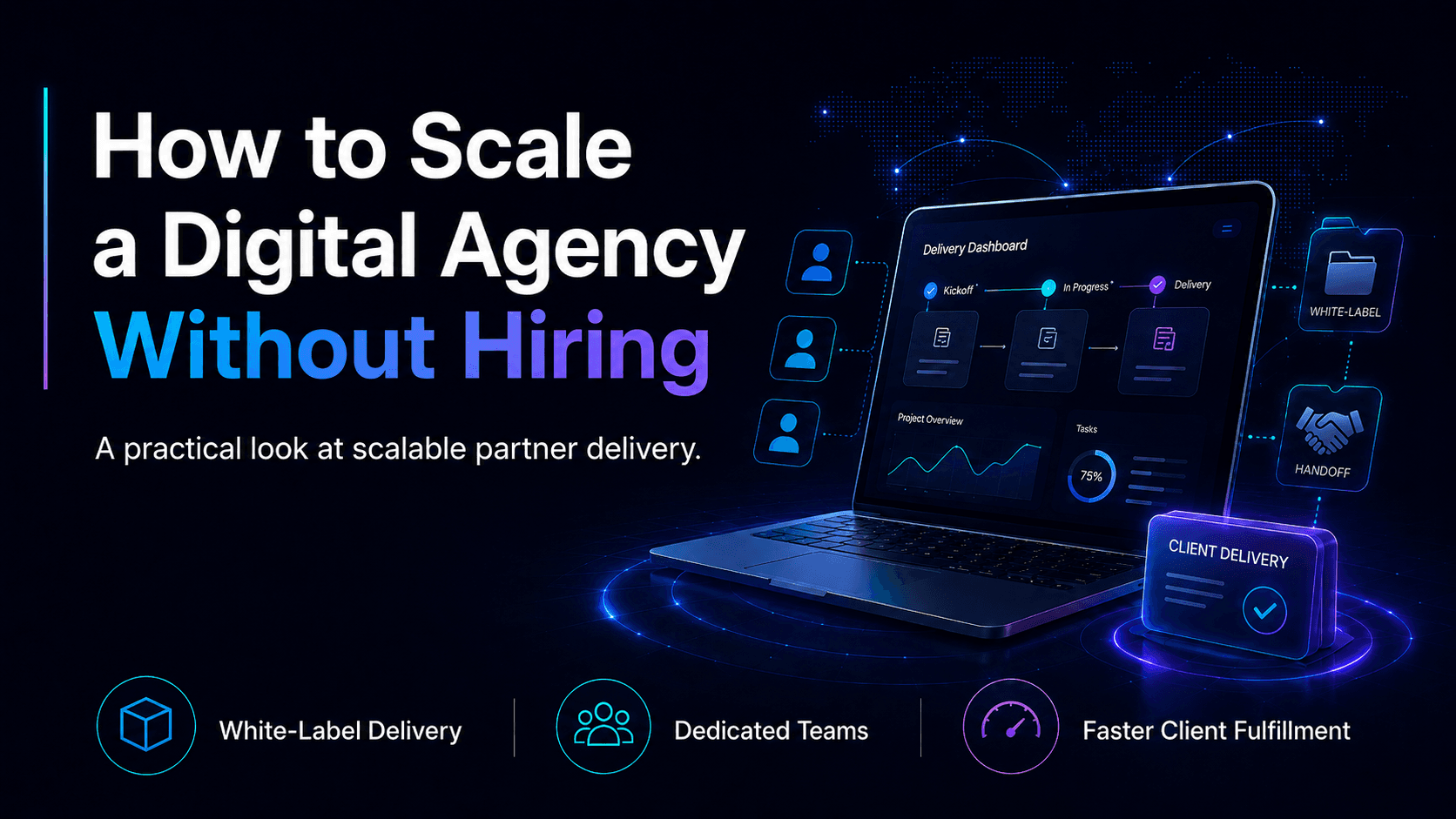
How to Scale a Digital Agency Without Hiring: iSkylar White-Label Delivery Case Study
This case study documents how a US-based digital agency scaled from $480,000 to $1.2 million in annual revenue over 12 months, adding zero full-time hires, by partnering with iSkylar Technologies as its white-label delivery engine. Profit margins grew from 24% to 41%, project delivery capacity tripled, and client retention improved from 68% to 89%. It covers the full agency growth white-label model: partnership structure, delivery workflows, real financial results and honest failures.
$720K
Revenue Added in 12 Months
3.4×
Project Capacity
41%
Profit Margin (from 24%)
0
Full-Time Hires Needed
1. What Is the iSkylar White-Label Agency Model, and How Does It Work?
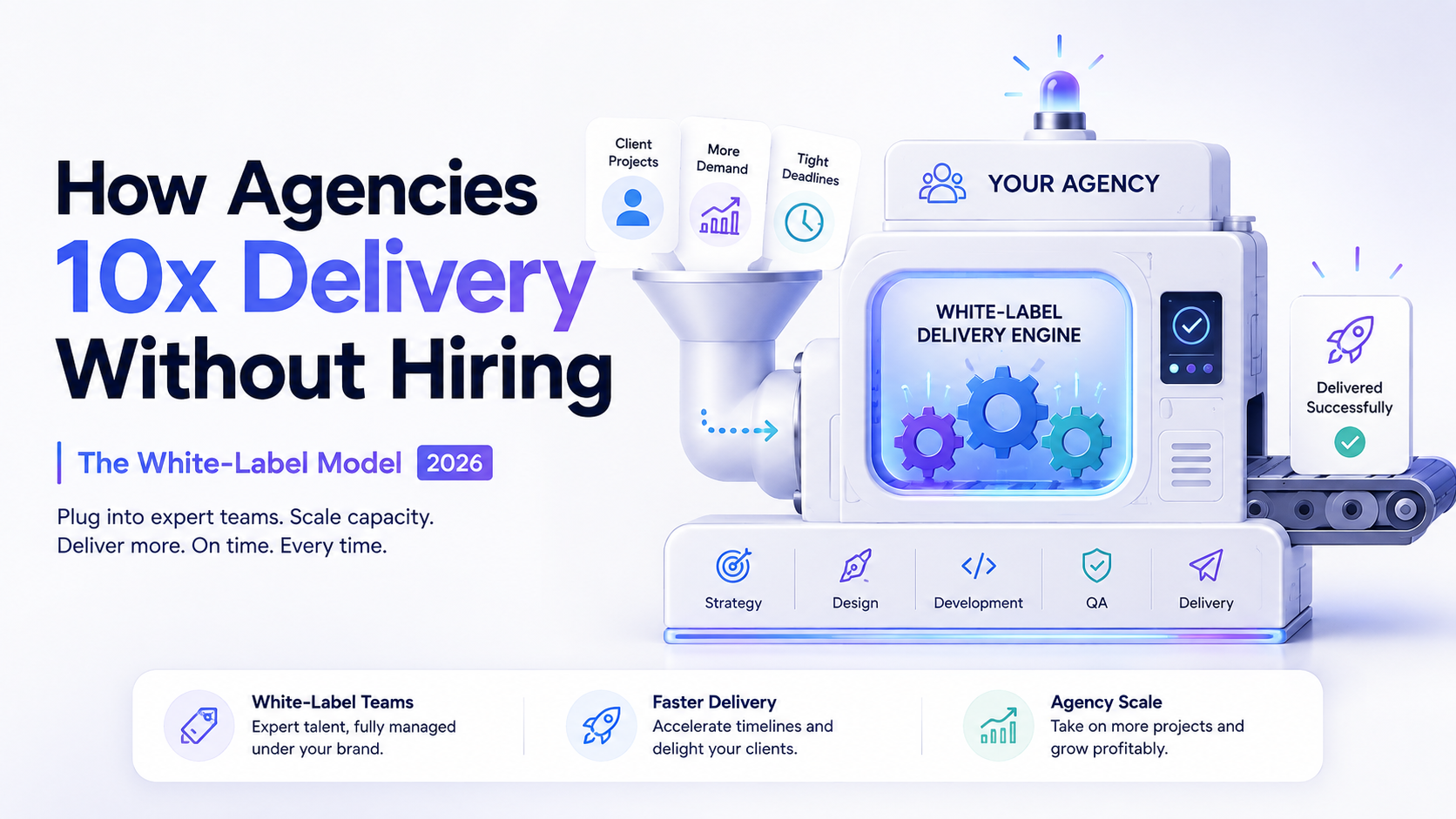
iSkylar Technologies operates as a white-label agency delivery partner for digital agencies across the United States, United Kingdom and Australia. The iSkylar team delivers web development, mobile apps, AI integration, SEO, AEO and full-stack digital projects entirely under the agency’s brand. The client never knows iSkylar exists. The agency keeps the relationship, the billing and the margin. iSkylar handles the execution on a delivery stack built around Figma, Asana, Slack, HubSpot, Google Workspace, Loom, GitHub and a proprietary QA framework.
One US-based digital agency doing $480,000 in annual revenue partnered with iSkylar in early 2025 facing a scaling problem that every agency at that revenue level eventually hits: client demand was growing faster than the team could deliver, but the cost and risk of hiring made expansion feel impossible. Twelve months later, the same agency was generating $1.2 million in annual revenue, operating at a 41% profit margin (up from 24%) and delivering 3.4 times the project volume with zero additional full-time employees. Agencies outsourcing 40–60% of delivery to white-label partners grow 2.3x faster than in-house-only teams and report 20% higher profit margins on average. This is one of those cases.
2. What Scaling Problem Does Every Agency Hit at $300K–$500K Revenue?
The agency in this case study was running a team of four: a founder handling sales and strategy, one account manager, one in-house developer and a part-time designer. At $480,000 annual revenue they were at capacity. Every new client required one of two responses: say no, or burn out the existing team on overtime. Hiring was the obvious answer, but the numbers didn’t work. A mid-level developer in the US costs $85,000–$110,000 in salary alone, plus benefits, tools, management overhead and 3–6 months to become productive. Agencies at the $300K–$500K revenue band face the hardest version of this problem, too large to stay boutique, too small to absorb hiring risk. Revenue volatility drops 22% when agencies move to a white-label fulfillment model, because variable delivery cost means you only pay iSkylar when you have paying clients to bill.
The Scaling CeilingIn-House Hiring Path White-Label Partnership PathCost to add one developer$85K–$110K salary + benefitsPer-project billing, no fixed overheadTime to first productive output3–6 months recruitment + onboardingFirst delivery within 5 business daysRisk during slow monthsPayroll continues regardless of client volumeCost scales down with client volumeService line expansionHire specialist per new channelAccess iSkylar’s full stack immediatelyMargin during growth phaseCompresses as headcount rises ahead of revenueExpands as volume grows over fixed partnership cost
3. Why Did This Agency Choose iSkylar Over Hiring In-House?
The agency evaluated two offshore development firms and one US-based white-label provider before selecting iSkylar. The offshore providers offered lower per-hour rates but could not match iSkylar’s account management layer, the agency’s clients expected a single point of contact, fast revisions and proactive communication, none of which a raw offshore team could deliver without significant coordination overhead. The US-based provider had the communication model right but charged rates that compressed margins below 30%, making the economics no better than hiring locally.
iSkylar’s US agency white-label fulfillment model offered a structure the other options did not: a dedicated project lead and QA manager assigned per agency, delivery ownership (not just execution), weekly Loom walkthroughs of work in progress and a transparent reporting layer that the agency could pass directly to clients as its own. Seventy-eight percent of agencies cite transparent reporting as their top client renewal driver, and iSkylar’s reporting infrastructure was built for exactly that. The first project went live eight days after the partnership agreement was signed.
4. How Did iSkylar Structure the White-Label Delivery Partnership?
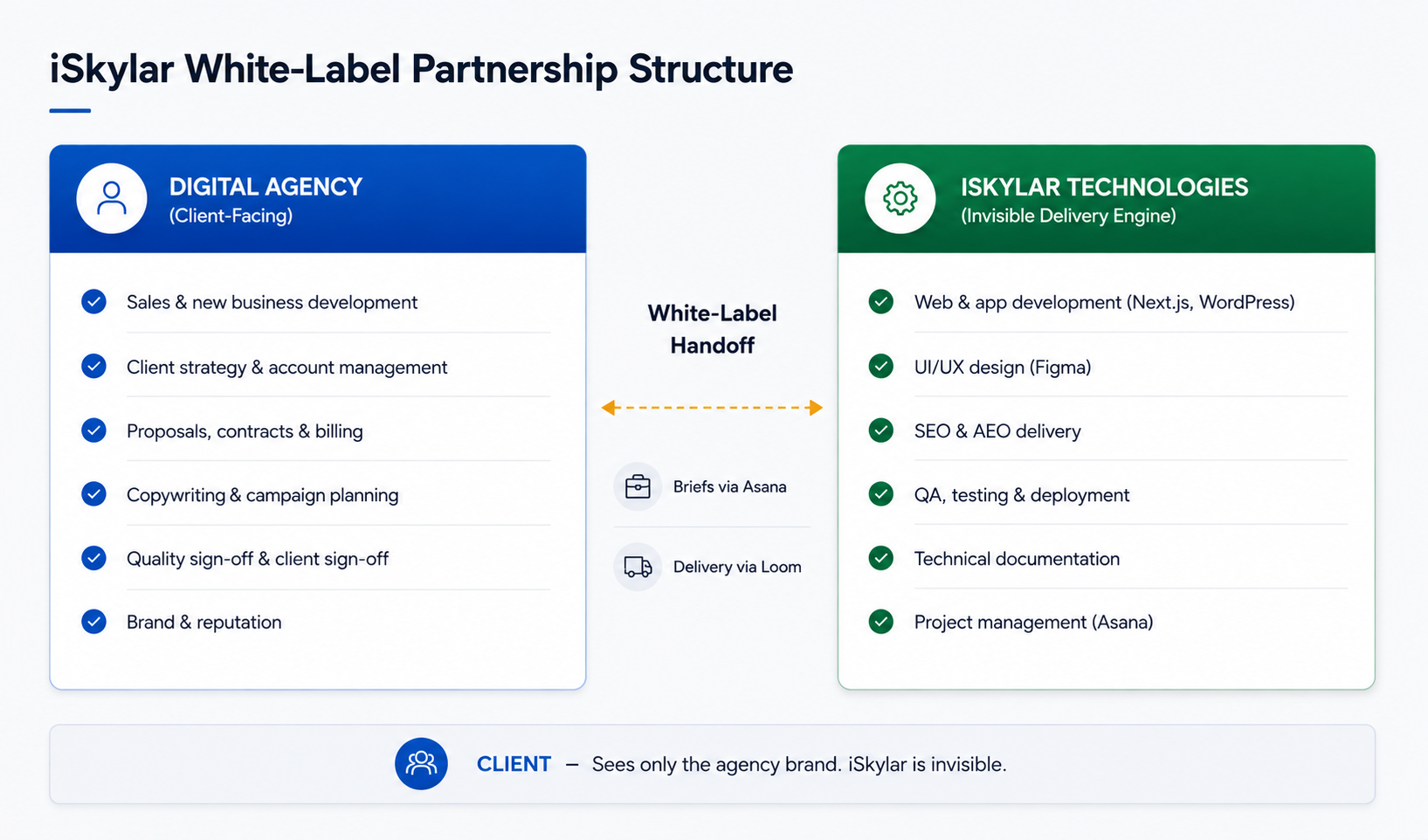
The partnership was built around a clean separation of responsibility. The agency owned everything client-facing: the relationship, the strategy, the proposals, the billing and the brand. iSkylar owned everything delivery-facing: project scoping, development, design, QA, deployment and documentation. Neither side operated in the other’s lane.
In practical terms, a new client brief arrived from the agency via a shared Asana workspace. Rahul Verma’s team scoped the technical requirements within 24 hours, returned a fixed-price delivery quote and timeline, and the agency priced the project to its client at its chosen margin. All client communication was handled by the agency’s account manager. All Loom review videos, GitHub repository access and staging links were white-labelled under the agency’s domain. When revisions came in, they routed through the agency and into the Asana board. HubSpot tracked the client relationship on the agency side. Google Workspace kept documentation shared. The client experienced a single seamless agency, iSkylar was invisible throughout.
The agency outsourced web and app development, SEO delivery, AEO white-label services and technical audits to iSkylar, while keeping sales, client strategy, copywriting and campaign management in-house. That division, keeping high-value, relationship-dependent work internal and outsourcing repeatable execution, is the core of the agency growth white-label model that produced the results below.
5. What Did Month-by-Month Revenue Growth Look Like?
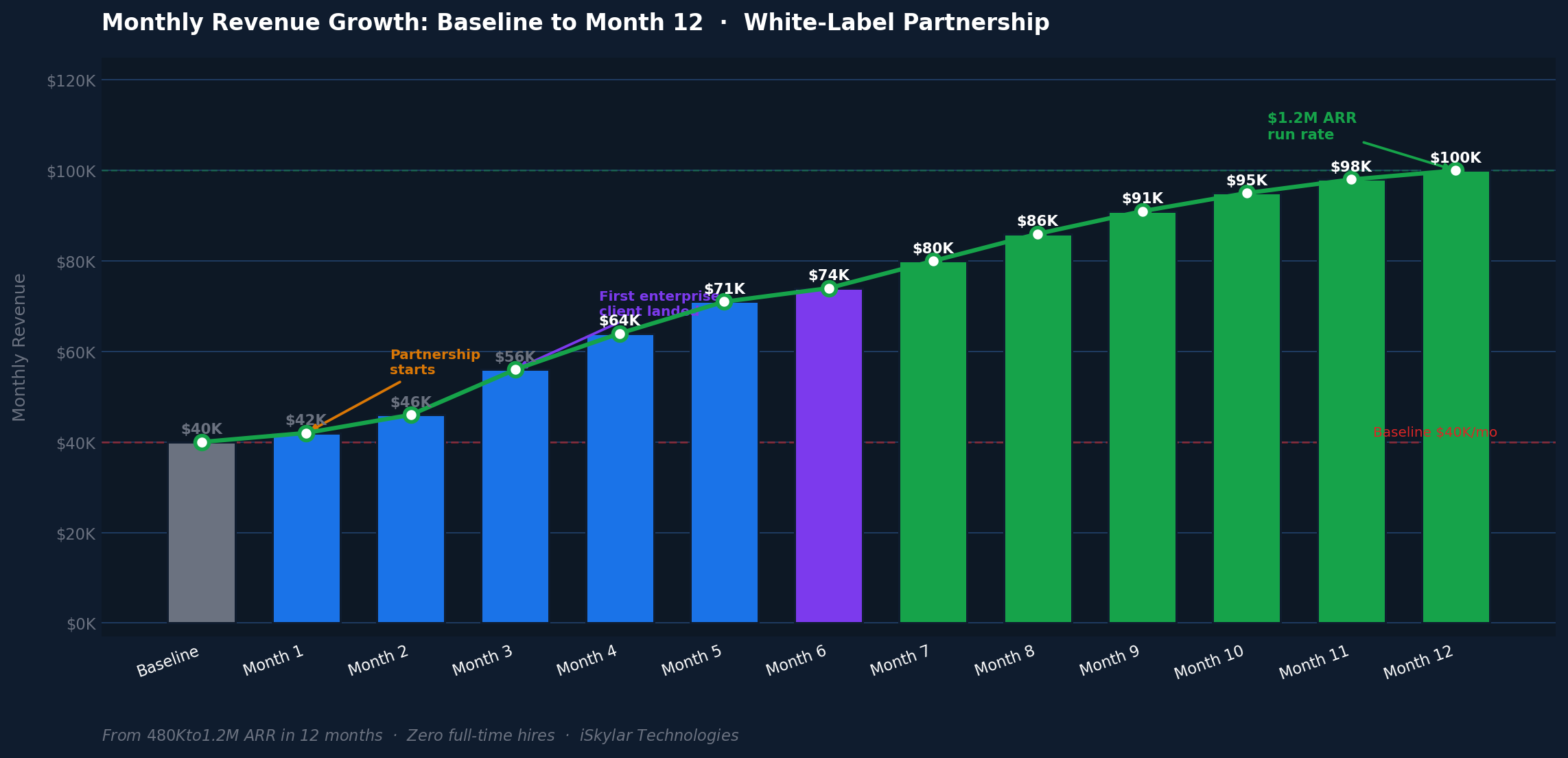
The first 60 days of the partnership produced modest revenue movement. The agency was learning the new workflow, Rahul Verma’s team was calibrating to the agency’s quality expectations and the first two projects required one revision cycle each before the client signed off. Month 1 revenue was $42,000, essentially flat on the $40,000 pre-partnership monthly baseline. Month 2 reached $46,000 as the workflow tightened. The inflection point came at Month 3, when the agency landed its first enterprise-level client, a project it would have declined pre-partnership because the scope exceeded its in-house capacity. iSkylar delivered it. Revenue hit $56,000 that month.
From Month 4 onwards, the agency actively pitched clients it had previously said no to. Scale digital agency 10x is a goal most agency owners treat as a 5-year plan. This one achieved 2.5x in 12 months by systematically taking on work it had previously turned away. By Month 6 the agency was generating $74,000 per month, an 85% increase from its pre-partnership baseline. By Month 12: $100,000 per month, annualising at $1.2 million.
6. What Were the Financial Results After 12 Months?
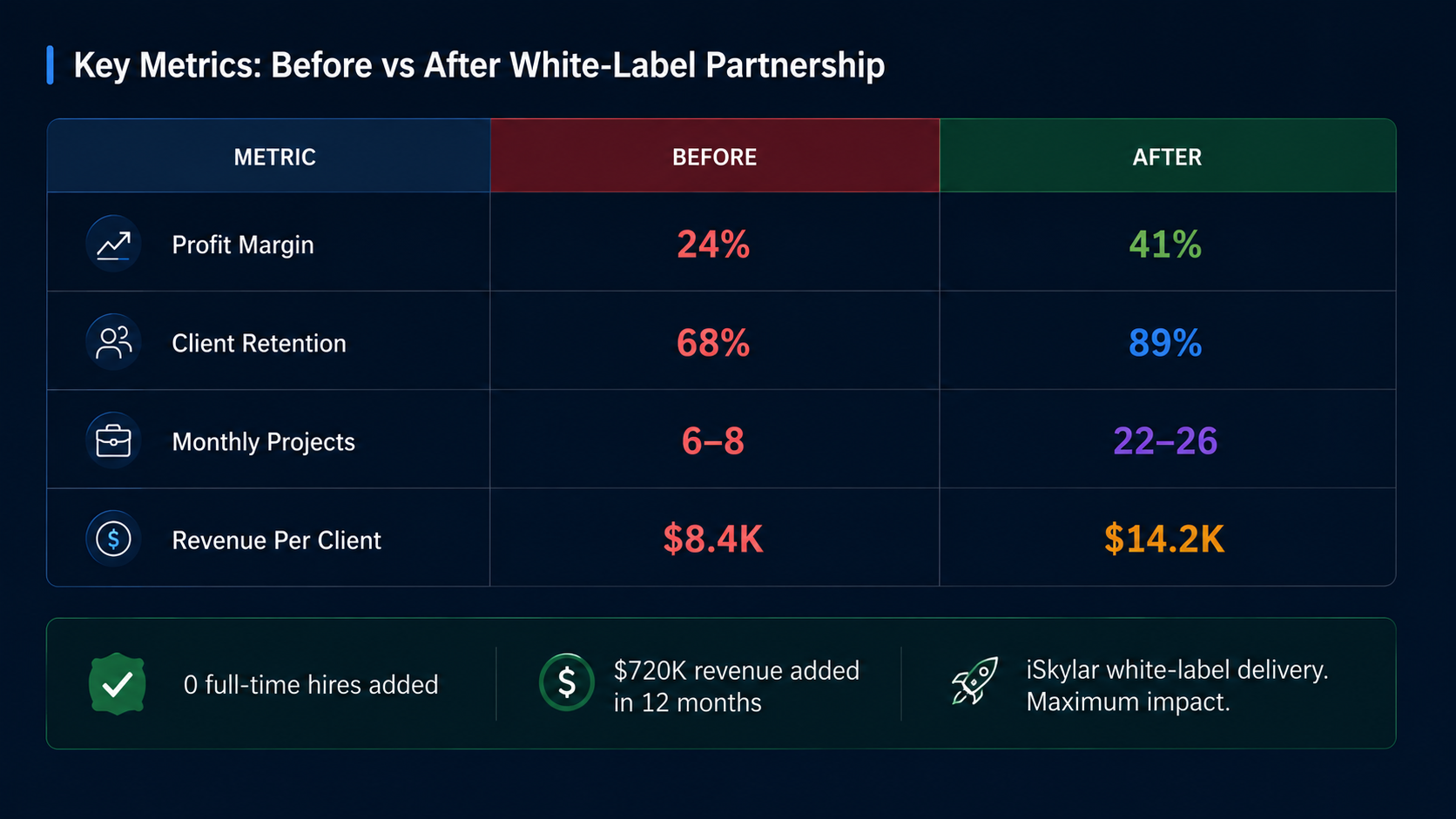
Growing agency revenue without hiring changes the margin structure fundamentally. When the agency was doing $480,000 per year with four employees, the blended payroll cost consumed 62% of revenue before any delivery cost. Adding iSkylar as a variable delivery partner meant the agency could grow project volume without adding payroll. At $1.2 million annual revenue, payroll as a percentage of revenue had fallen to 26%, even though absolute team compensation had not decreased. Profit margins expanded from 24% to 41% over the same period.
MetricBefore PartnershipAfter 12 MonthsAnnual revenue$480,000$1,200,000Monthly project volume6–8 projects22–26 projectsProfit margin24%41%Client retention rate68%89%Full-time team headcount44 (unchanged)Average revenue per client$8,400/year$14,200/yearRevision cycles per project3.2 average1.4 average
Client retention improving from 68% to 89% was the result that surprised the agency founder most. The expectation had been that clients might notice a change in delivery style. The opposite happened, faster turnaround times, cleaner documentation and consistent Loom walkthrough reviews made clients feel better served than when the agency’s in-house developer was handling everything. Seventy-eight percent of client renewal decisions cite transparent reporting as the deciding factor. iSkylar’s reporting format, passed through as the agency’s own, became the agency’s strongest retention tool.
7. What Failed, and What We Fixed
The first 30 days were not clean. Three specific failures set the tone for what was later fixed.
The first was communication latency. The agency’s account manager was relaying client feedback verbally, then retyping it into Asana. By the time a revision request reached Priya Nair’s QA review, it had passed through two interpretation layers and lost critical context. The fix: a direct Loom submission channel where the account manager recorded client feedback as a video and dropped it into the project board. Revision accuracy improved immediately and revision cycles per project dropped from 3.2 to 1.4 within 60 days.
The second failure was scope management. The first two projects were scoped too loosely, and the agency’s instinct, shaped by years of managing client relationships, was to absorb small scope additions without renegotiating. iSkylar’s delivery model does not work that way. A scope addition mid-project affects the delivery team’s capacity across other projects. Rahul Verma introduced a formal change-request process on Day 18 and trained the agency’s account manager to use it. The first change request conversation was uncomfortable. Every conversation after it was straightforward.
The third failure was attempting to white-label a service iSkylar does not deliver: paid media management. The agency won a Google Ads client in Month 2 and asked iSkylar to handle it. iSkylar declined, paid media is outside the delivery scope. The agency had to manage it in-house and the project ran under-resourced for six weeks before the agency brought in a freelancer. The lesson: define the scope of the white-label partnership in writing before the first client brief arrives, not after.
8. Where Does a White-Label Agency Partnership Scale To?
The agency that started this engagement at $480,000 in annual revenue is now targeting $2 million. The path is already visible: the delivery infrastructure exists, the quality standard is established and the Asana workflows, Loom review templates and HubSpot reporting processes are replicable across new clients without friction. Adding revenue no longer means adding headcount, it means filling iSkylar’s available capacity with higher-value projects.
The global white-label marketing market reached $99 billion in 2026. Boutique agencies across the US, Australia and UAE are moving toward white-label partnerships not as a stopgap but as a permanent operating model: keeping strategy, sales and client relationships internal while converting delivery into a variable cost that scales with revenue. The agencies that grow scale agency profitably this way. The ones that keep hiring ahead of revenue compress their margins until growth becomes unsustainable. iSkylar operates as a long-term delivery partner, not a project vendor, and the distinction is what makes the model compound over time.
Recommended For You




Solutions & Industry Insights that might interest you
Ready to write your own
success story?
Partner with iSkylar Technologies to achieve exceptional outcomes through innovative software solutions.