
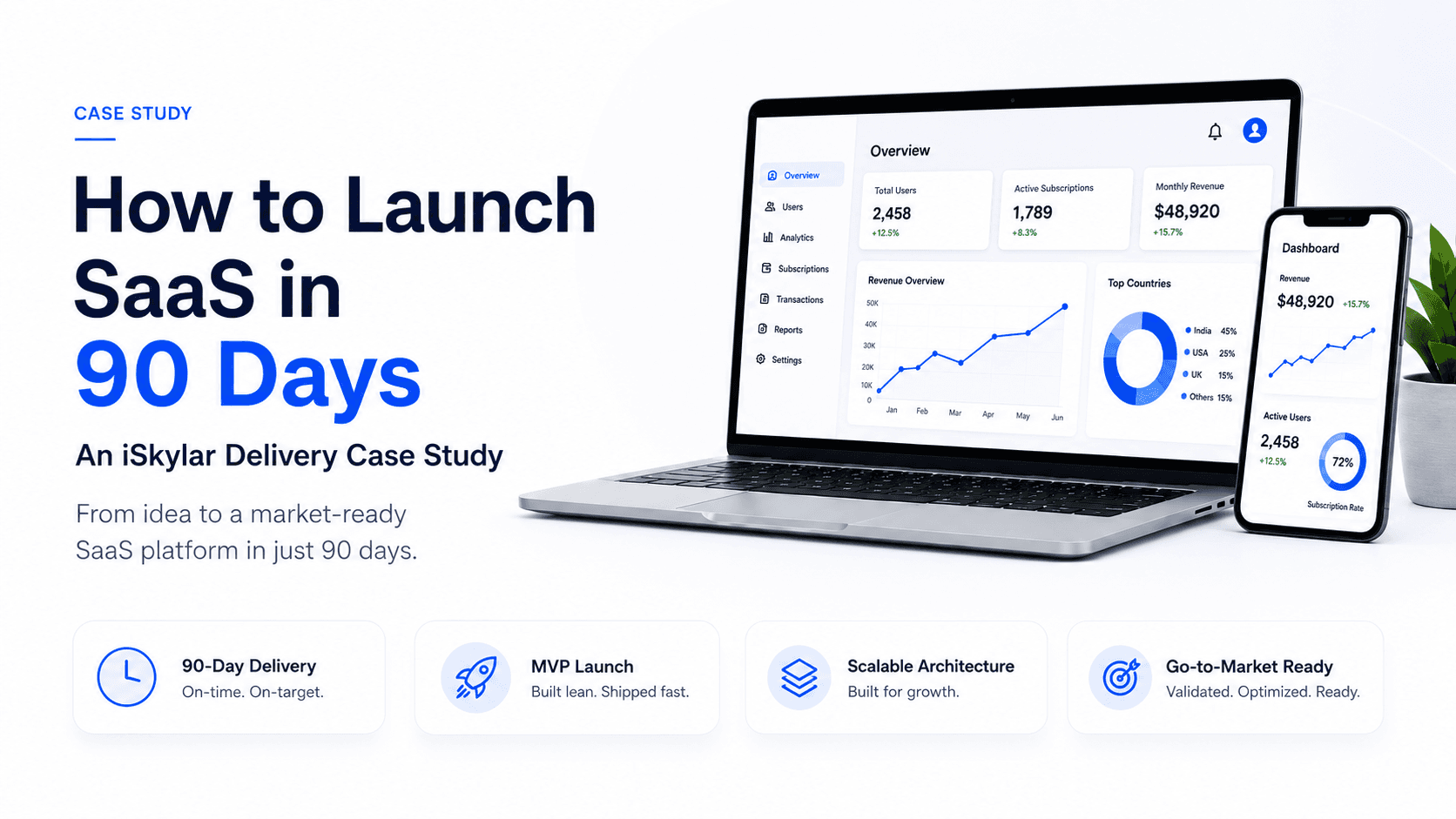
How to Launch SaaS in 90 Days: An iSkylar Delivery Case Study
This case study documents how iSkylar Technologies built a B2B SaaS product from zero to $6,800 MRR and 47 paying customers in exactly 90 days, using a fixed-scope sprint methodology on Next.js 14, Vercel, Supabase, Stripe, Clerk and OpenAI GPT-4. It covers the complete 90-day SaaS launch framework: scope decisions, sprint structure, tech stack choices, real launch metrics and lessons from what failed.
$6,800
MRR at Day 90
47
Paying Customers
31%
Trial-to-Paid Rate
$67
Customer Acquisition Cost
1. What Is the iSkylar 90-Day SaaS Launch Framework?
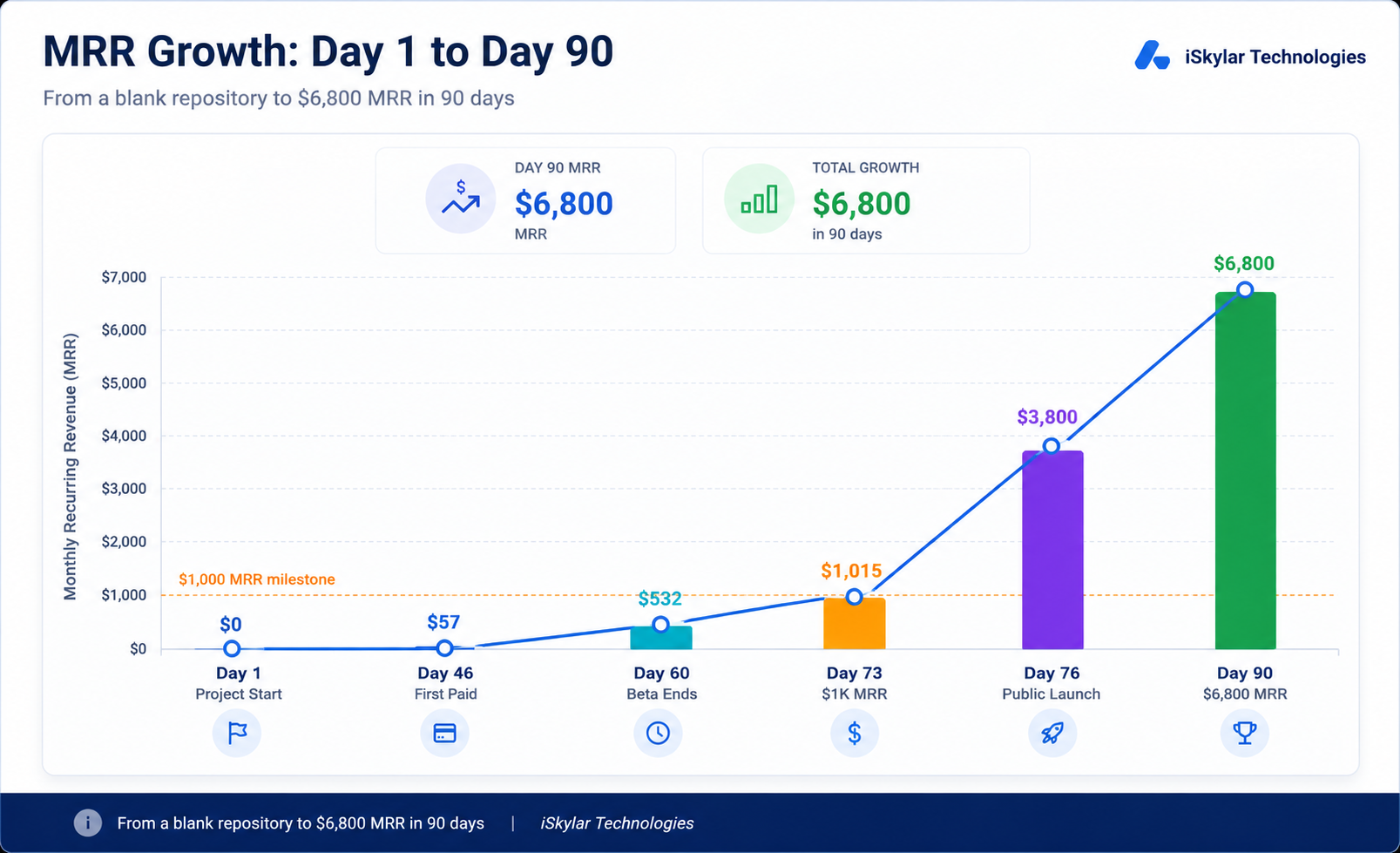
How to launch SaaS in 90 days is a question most founders treat as a planning exercise. iSkylar treats it as a delivery commitment. Led by project lead Rahul Verma and engineer Priya Nair, the iSkylar team took a bootstrapped B2B SaaS from a blank repository to $6,800 MRR and 47 paying customers in exactly 90 days, built on Next.js 14, Vercel, Supabase, Stripe, Clerk, OpenAI GPT-4, Resend and Upstash Redis. The trial-to-paid conversion rate at launch was 31%, more than double the 8–15% B2B SaaS industry average. Customer acquisition cost landed at $67 against a sector benchmark of $150–$400. Monthly churn settled to 2.8% by Month 3. Gross margin held at 84%. Time to $1,000 MRR: Day 73.
The 90-day SaaS launch framework this engagement ran on is not a template. It is a fixed-scope, milestone-driven build methodology that treats scope removal as the primary engineering discipline and forces every product decision through a single question: does this make it easier for someone to pay?
2. What Problem Does This Framework Solve, and Who Is It For?
This was a solo founder SaaS launch in the truest sense: one founder, a two-person iSkylar delivery team, a hard pre-seed funding deadline and zero room for scope negotiation. The product was a remote team visibility tool in the B2B SaaS space, priced at $19 and $49 per month with no free tier from Day 1. The founding team had no external VC backing, this was a bootstrapped SaaS case study in which every feature built had to drive revenue directly or it did not ship.
The constraint that defined everything: a $150,000 pre-seed commitment was conditional on a live product with paying users by Day 90. That single condition eliminated every conversation about nice-to-have features, speculative integrations and exploratory architecture. The iSkylar rapid MVP launch SaaS methodology exists precisely for this environment, where time to first revenue matters more than completeness, and where a disciplined kill on scope is more valuable than any individual feature.
3. Why Did the Founder Choose iSkylar?
Three development partners were evaluated. The two not selected offered flexible timelines, open scope and contracts structured to allow later renegotiation. Neither could commit to Day 90 as a hard delivery date.
Rahul Verma ran the scoping call as a constraint exercise rather than a requirements session. The opening question was not what the founder wanted to build, but what the minimum viable product needed to do for someone to pay $19 a month for it on Day 1. Everything outside that answer moved to a post-launch backlog before the call ended. A fixed-scope contract was signed that day. That approach, scope locked before architecture begins, is the foundation of iSkylar’s B2B SaaS 90-day go-to-market method, and it was the decisive factor in the selection over larger agencies with longer timelines.
4. How Do You Actually Build a SaaS in 90 Days? The Six-Sprint Breakdown
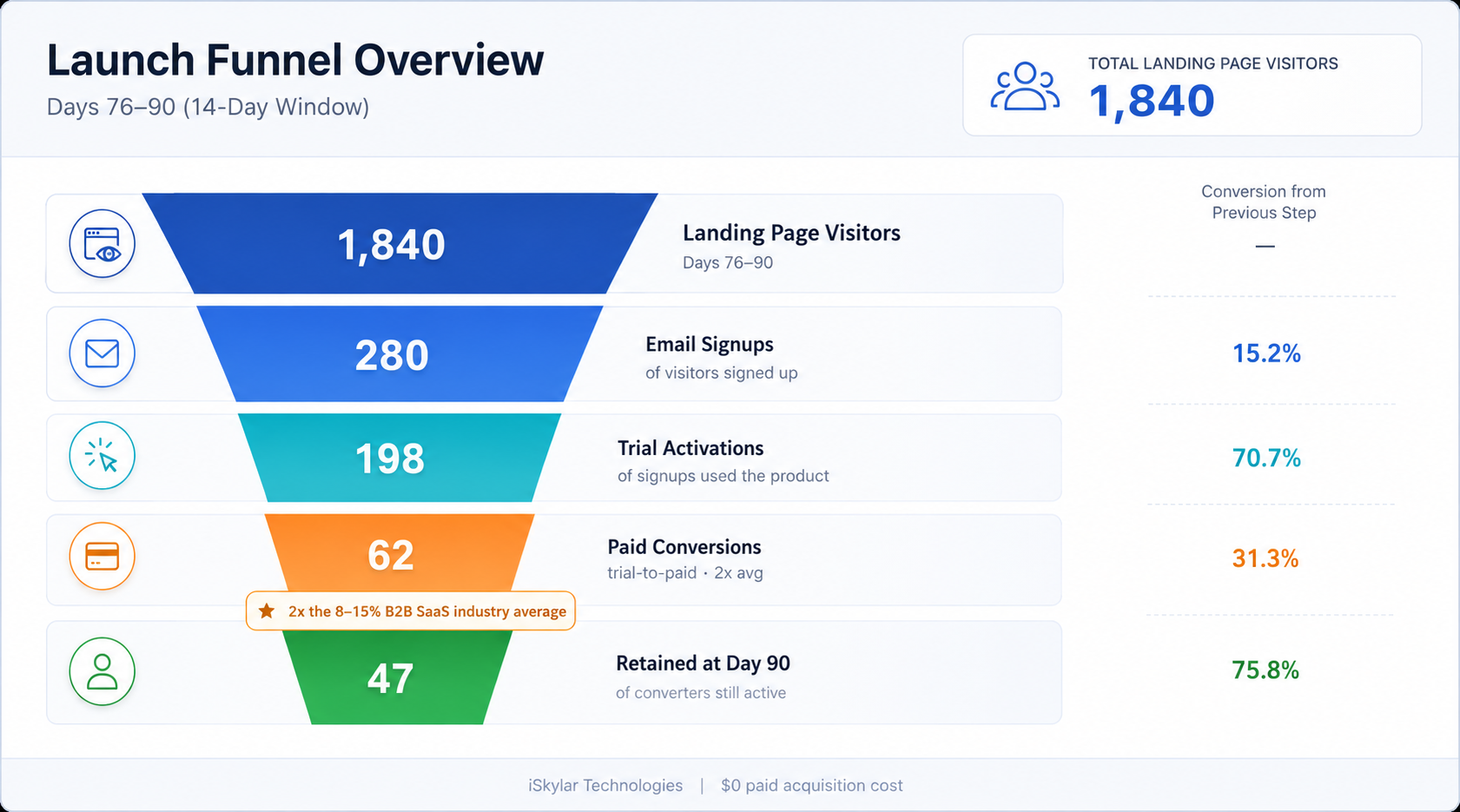
The agile SaaS launch framework iSkylar applied ran across six two-week sprints. Each sprint ended with a working demo, never a status update. Scope was locked after Sprint 1 and enforced without exception. Every feature request raised during the build went to a post-launch backlog and was not opened until Day 90.
Sprint 1 (Days 1–14): Requirement analysis, eight user interviews, database schema on Supabase, Figma wireframes and Clerk authentication baseline. Twenty-eight features were cut in the first 72 hours. A voice standup feature or,iginally planned as a core differentiator, was killed on Day 6 after none of the eight interviewees expressed a need for it.
Sprint 2 (Days 15–30): Core update feed, workspace management and real-time sync built and live in staging. Supabase was chosen over PlanetScale: Postgres row-level security removed the need for a custom data-access layer entirely, saving an estimated two weeks of engineering time.
Sprint 3 (Days 31–45): OpenAI GPT-4 Turbo summary engine, automatic blocker detection and Slack push integration. The product pivoted mid-sprint from a scheduled daily digest to on-demand pull after beta user feedback: teams wanted to pull their summary, not receive it on a schedule they did not control.
Sprint 4 (Days 46–60): Stripe subscription billing live with $19 and $49 monthly plans. Beta opened to twelve users. Three paid on Day 46. Initial pricing of $9 per month produced zero upgrade urgency, the price was raised to $19 before the beta ended.
Sprint 5 (Days 61–75): Marketing site deployed on Vercel, three-email onboarding sequence built with Resend and React Email, analytics and rate limiting via Upstash Redis. $1,000 MRR reached on Day 73 with 23 paying customers.
Sprint 6 (Days 76–90): Public launch via direct outreach to six niche Slack communities. A Product Hunt launch had been tested at Day 45 and returned 12 upvotes, insufficient for a 45-day beta with no existing audience. Direct community outreach produced 280 signups in 14 days at zero acquisition cost. Day 90: $6,800 MRR, 47 paying customers, pre-seed commitment confirmed.
5. What Does the Tech Stack Look Like, and Why Each Choice?
Every tool was selected against one criterion: does it eliminate an entire layer of engineering complexity rather than just solving a single problem? Next.js 14 App Router server components removed approximately half the planned API endpoints before they were written. Vercel gave zero-configuration deployment, no DevOps overhead for the post-handoff founding team. Supabase delivered Postgres, real-time subscriptions and row-level security as a single managed service. Clerk handled multi-tenant workspace authentication in under four hours of integration time. Stripe managed subscription billing with the most reliable webhook handling in the market. OpenAI GPT-4 Turbo powered the AI summary and blocker detection engine with structured output support that made parsing consistent and predictable from day one. Resend with React Email built the full three-email onboarding sequence in three hours. Upstash Redis handled rate limiting on a per-request model that matched variable AI API call volume at launch without overprovisioning.
Total infrastructure cost across 90 days: $425. Gross margin at Day 90: 84%.
6. What Results Did the First 90 Days Produce?
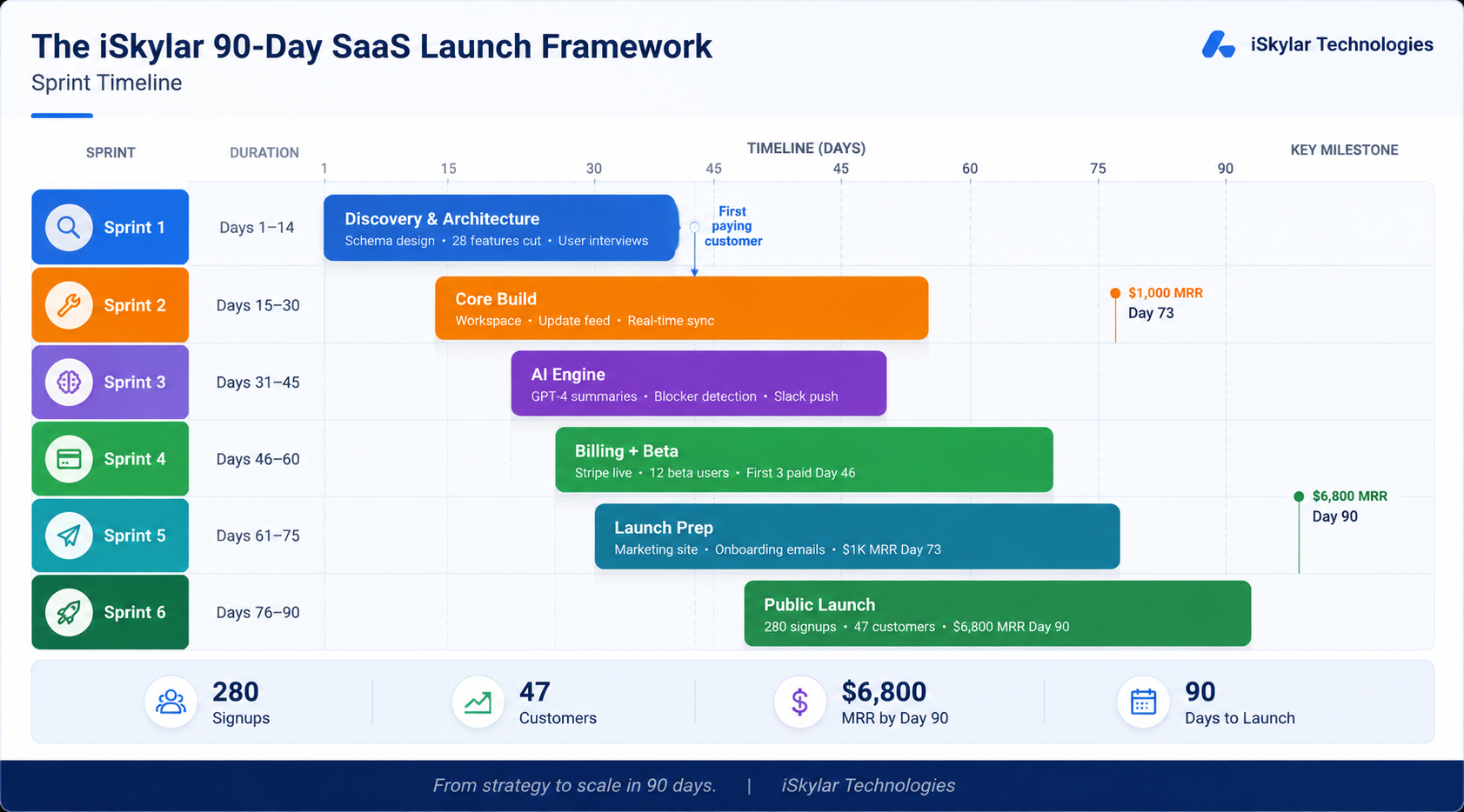
The public launch ran from Day 76 to Day 90. The go-to-market was entirely organic: direct founder outreach to six Slack communities where the target audience was active, each message sharing a founder story and a single real metric rather than a product pitch. 280 people signed up in 14 days at $0 paid acquisition cost. Of those, 198 activated, a 70.7% activation rate against a 40–60% industry average. Of those who activated, 62 converted to paid subscriptions, a trial-to-paid rate of 31.3% against the 8–15% B2B SaaS benchmark.
OutcomeBefore LaunchAt Day 90Monthly recurring revenue$0$6,800Paying customers047Trial-to-paid conversionNo product31% vs 8–15% averageCustomer acquisition costNo product$67 vs $150–$400 benchmarkMonthly churn at Month 3No product2.8% vs 5–8% SMB SaaS averageInfrastructure cost (90 days)N/A$425 total.
Early cohort churn ran at 24.2% in Month 1, consistent with a product in its first weeks. By Month 2 it had dropped to 12.1%, and by Month 3 to 2.8%, well below the 5–8% SMB SaaS average. The AI summary feature was the primary retention driver: once teams experienced automated blocker detection as part of their daily workflow, cancellation rates fell sharply and stayed low.
7. Where Does the Product Go After Day 90?
The architecture Priya Nair designed was built to extend without rebuilding. Each new integration connects to an established API layer. Each new AI behaviour is a prompt configuration change, not a re-engineering of the core engine. Those decisions, made in Sprint 1 and invisible to the end user, are why post-launch development velocity stays high and feature cost stays predictable.
SaaS launch without sustained external funding requires the product to fund its own growth from Day 91 onwards. With $6,800 MRR and proven retention mechanics, the roadmap moved immediately into native integrations with Linear and Jira to open engineering-heavy teams as a second ICP, a weekly AI leadership digest for non-daily active users, and custom prompt configuration at the workspace level as an enterprise upsell tier. iSkylar continues as the engineering partner on a monthly fixed-scope retainer, applying the same sprint methodology to each subsequent feature that carried the product to Day 90.
Recommended For You







Ready to write your own
success story?
Partner with iSkylar Technologies to achieve exceptional outcomes through innovative software solutions.