
How Agencies 10X Delivery Without Hiring: White-Label Model 2026
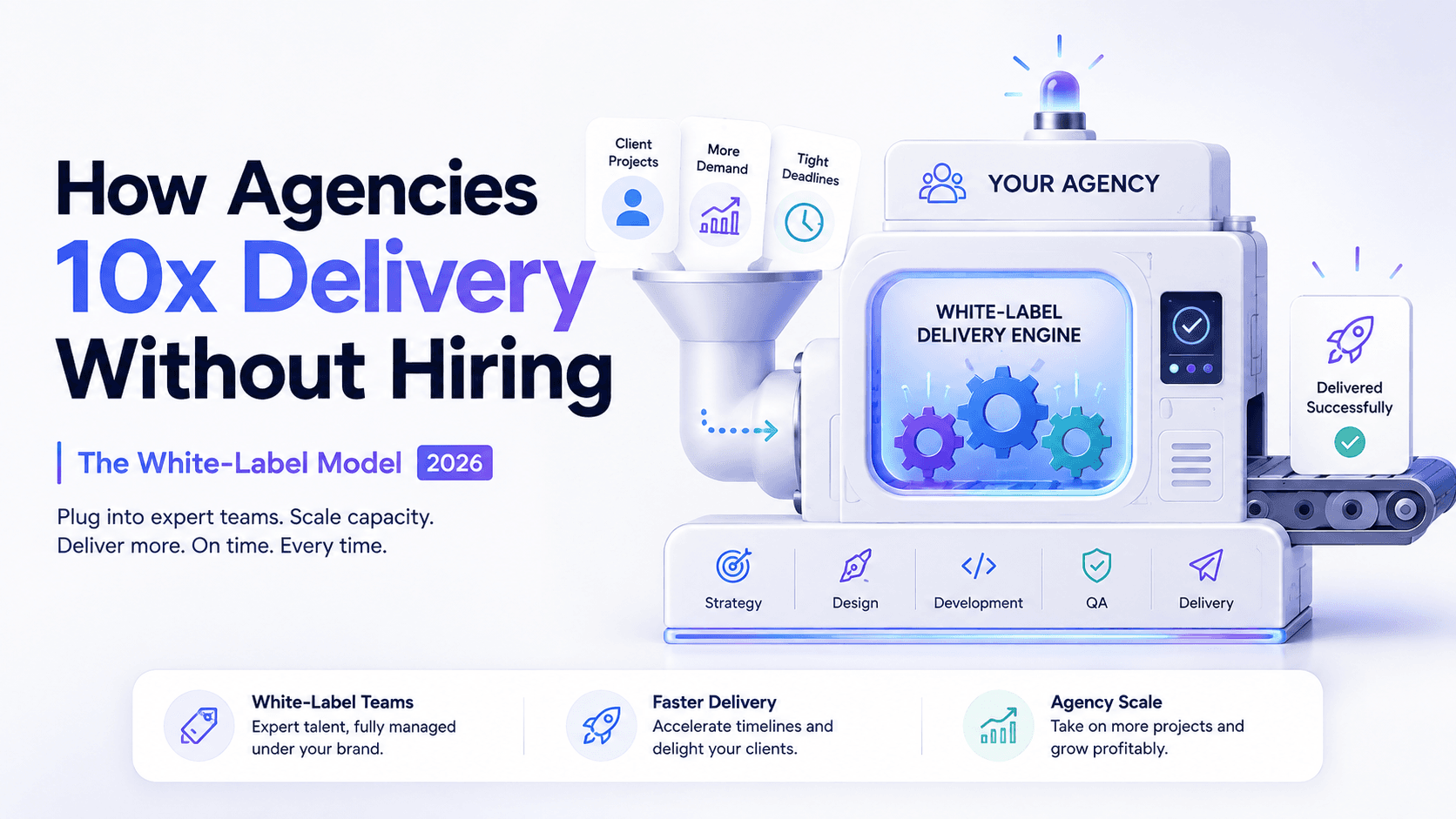
Agencies can 10x delivery capacity without adding headcount by routing 40–60% of development work through a white-label partner. Agencies that outsource in that 40–60% range grow roughly 2.3x faster and earn about 20% higher margins than peers who insist on doing everything in-house.
Harsh Singh
PRINCIPAL ARCHITECT11 MIN READ
The Agency Capacity Problem Nobody Solves by Hiring
Every growing agency hits the same wall. Sales is closing more work than delivery can absorb. The obvious fix (hire more developers) is also the slowest and riskiest one available in 2026.
The labor market is not cooperating. 72% of employers report difficulty hiring the talent they need, and for the first time, AI skills have overtaken traditional engineering and IT as the hardest capability to find globally (ManpowerGroup, 2026 Talent Shortage Survey). For an agency already stretched thin, opening a new req is not a quick fix. It is a multi-month bet against a market where the exact skills you need are the scarcest ones on the board.
That is why the fastest-growing agencies in 2026 are not the ones hiring the most. They are the ones who have quietly rebuilt their delivery model around white-label partnerships (extending their team's capacity on demand instead of racing to hire into a shortage.
What Is the White-Label Partnership Model?
White-label software development is an arrangement where a development partner builds the work (websites, apps, features, full products) entirely behind your agency's brand. The partner never appears in client meetings, never shows up in code comments, and never touches invoices. Your client experiences one agency: yours.
This is different from telling a client you outsource. In a white-label partnership, the client does not know a third party is involved at all. Your agency owns the relationship, the pricing, the QA, and the delivery. The partner is invisible infrastructure (the same way a private-label manufacturer builds the product but the retailer's name goes on the box.
The Data: Why White-Label Agencies Outgrow Their Peers
White-label development services are no longer a niche workaround. They are the default operating model for agencies serious about growth. The numbers make the case better than any pitch:
Agency adoption of white-label services: 73% of agencies now use white-label services, 60% outsource PPC campaigns
Growth rate, agencies outsourcing 40-60% of delivery: 2.3x faster growth than peers who keep delivery fully in-house
Margin difference, same cohort: 20% higher margins than agencies doing everything internally
Client retention: White-label services are tied to 42% higher client retention
White-label marketing industry size: Projected to reach $99.19 billion by 2026
Global IT services outsourcing market: $807.9B in 2025, projected to exceed $1.2 trillion by 2030 (8.6% CAGR)
The retention number deserves a second look. A 42% lift in client retention is not a delivery-speed story. It is a revenue-stability story. Clients do not leave agencies that consistently ship on time. White-label capacity is what makes "consistently" possible once your pipeline outgrows your headcount.
How Much Should an Agency Outsource? The 40-60% Rule
The data is specific: agencies that outsource 40-60% of delivery work, keeping 40-60% internal, see the fastest growth and the best margins. That ratio is not arbitrary. It is the point where an agency gets real capacity relief without losing control of quality, culture, or the client relationship.
Under 20%: Marginal capacity relief (does not move growth or margin numbers meaningfully)
40-60% (sweet spot): 2.3x faster growth, 20% higher margins (the data-backed range)
Over 80%: Risk of losing quality control and client-facing consistency without a strong PM layer
Below that range, an agency is still headcount-constrained in practice. Above it, an agency risks becoming a reseller with no delivery muscle of its own. The 40-60% band keeps your team owning strategy, QA, and the client relationship, while a white-label partner absorbs the overflow that would otherwise mean turning work away.
How Much Margin Do Agencies Lose With White-Label? (None, If Structured Right)
This is the objection every agency owner raises first, and it is the easiest one to answer with numbers. Structured correctly, white-label development protects margin. It does not erode it.
Developer cost basis: In-house (full salary plus 25-35% benefits load plus tooling) vs White-Label (wholesale partner rate, pay-per-project or retainer)
Typical agency margin kept: In-house (varies, fixed cost regardless of utilization) vs White-Label (60-70% gross margin on the resold project)
Cost when idle between projects: In-house (still paying salary and overhead) vs White-Label (zero, you only pay for active delivery)
Recruiting and onboarding cost: In-house (real and recurring) vs White-Label (not applicable, partner team is already built)
The margin math works because you are not reselling at cost. You are pricing for the value you deliver: project management, QA, client relationship, and accountability. Agencies commonly bill clients at 2-3x what they pay a white-label partner and still land at 60-70% gross margin, well above what an idle in-house developer costs between projects.
The Cost of Turning Work Away
Every agency owner has had the conversation: a good client brings a project that is bigger than current capacity, and the honest answer is 'we cannot take it right now.' That is not a one-off. Across a year, agencies operating at capacity ceiling routinely decline well over 2 million in potential revenue. Work that goes to a competitor instead, often permanently, because the client needed an answer that week, not next quarter.
The pattern is consistent: a capacity ceiling does not just cap this quarter's revenue. It caps which clients you can say yes to at all, and repeat business is exactly what the 42% retention lift above is measuring.
Agency Growth Strategies: Building the White-Label Partnership Model
Extending your team through outsourcing is not a one-time vendor purchase. It is an operating model. Agencies that get the most out of white-label partnerships build it the same way:
Scope the 40-60% first. Decide which project types route externally (overflow, specialist tech stacks, capacity spikes) before you look for a partner, not after.
Treat the NDA as non-negotiable. Identity protection, no direct client contact, and full IP assignment to your agency on payment are baseline, not bonus terms.
Run a pilot project first. One real, smaller build tells you more about a partner's communication and code quality than any sales call.
Price for value, not for the partner's rate. Your margin comes from project management, QA, and the client relationship (not from marking up an hourly rate).
Keep a dedicated PM layer. A partner with its own project management between you and the developers is what makes 40-60% outsourcing manageable at scale.
How Long Does It Take to Find a White-Label Partner?
Evaluation (2-4 weeks): Vendor review, technical capability check, NDA, reference calls, pilot project scoping
Onboarding (1 week): Brand guidelines, brief templates, communication setup, staging environment access
Full delivery capacity (7-10 days from kickoff): Partner team actively absorbing overflow work under your brand
Total time from 'we need capacity' to 'capacity is live': roughly 3-5 weeks. Compare that to the 2-6 month cycle of sourcing, interviewing, hiring, and onboarding a single in-house developer into a market where 72% of employers are already struggling to fill the same roles.
White-Label vs In-House Development: The Honest Comparison
Time to added capacity: White-Label (3-5 weeks) vs In-House (2-6 months in 72%-shortage market)
Cost when idle: White-Label (none, pay per project or retainer) vs In-House (full salary plus benefits regardless of utilization)
Scalability: White-Label (flexes up or down with project volume) vs In-House (fixed until you hire or lay off again)
Technical range: White-Label (broad, multi-stack team on demand) vs In-House (limited to who you hired)
Client-facing risk: White-Label (low, if NDA and brand controls are solid) vs In-House (low, but recruiting risk sits upfront)
Best for: White-Label (overflow, spikes, and 40-60% of steady delivery) vs In-House (core strategic work and long-term IP ownership)
How iSkylar Powers White-Label Delivery for Agencies
iSkylar Technologies works as the invisible development partner behind digital agencies and IT consultancies across the US, UK, Australia, Canada, and the UAE. We build under strict NDA, deliver every project under your brand, and never make contact with your clients. The same operational discipline the data above shows separates agencies that scale from agencies that stall.
Our team covers custom software, web and mobile development, AI integration, and full-stack delivery, so you can say yes to a wider range of client work without adding a single line to your payroll. Agencies typically onboard in about a week and have live capacity within 7-10 days.
If your agency is turning down work because delivery is at capacity, talk to iSkylar Technologies about a white-label partnership built around your brand, your margins, and your client relationships.
WRITTEN BY
Harsh Singh
Senior Technical Content writer having 10 years of experience
Frequently Asked Questions
Can agencies 10x delivery without hiring?
What percent of delivery can agencies safely outsource?
How much margin do agencies lose with white-label?
How long does it take to find a white-label partner?
Further Reading





Stay at the forefront of innovation.
innovation.
Join our inner circle of industry leaders and get exclusive insights delivered to your inbox every Thursday morning.
WE RESPECT YOUR PRIVACY. NO SPAM, EVER.