
Digital Marketing Trends 2026: What's Actually Working Now
Harsh
PRINCIPAL ARCHITECT11 MIN READ
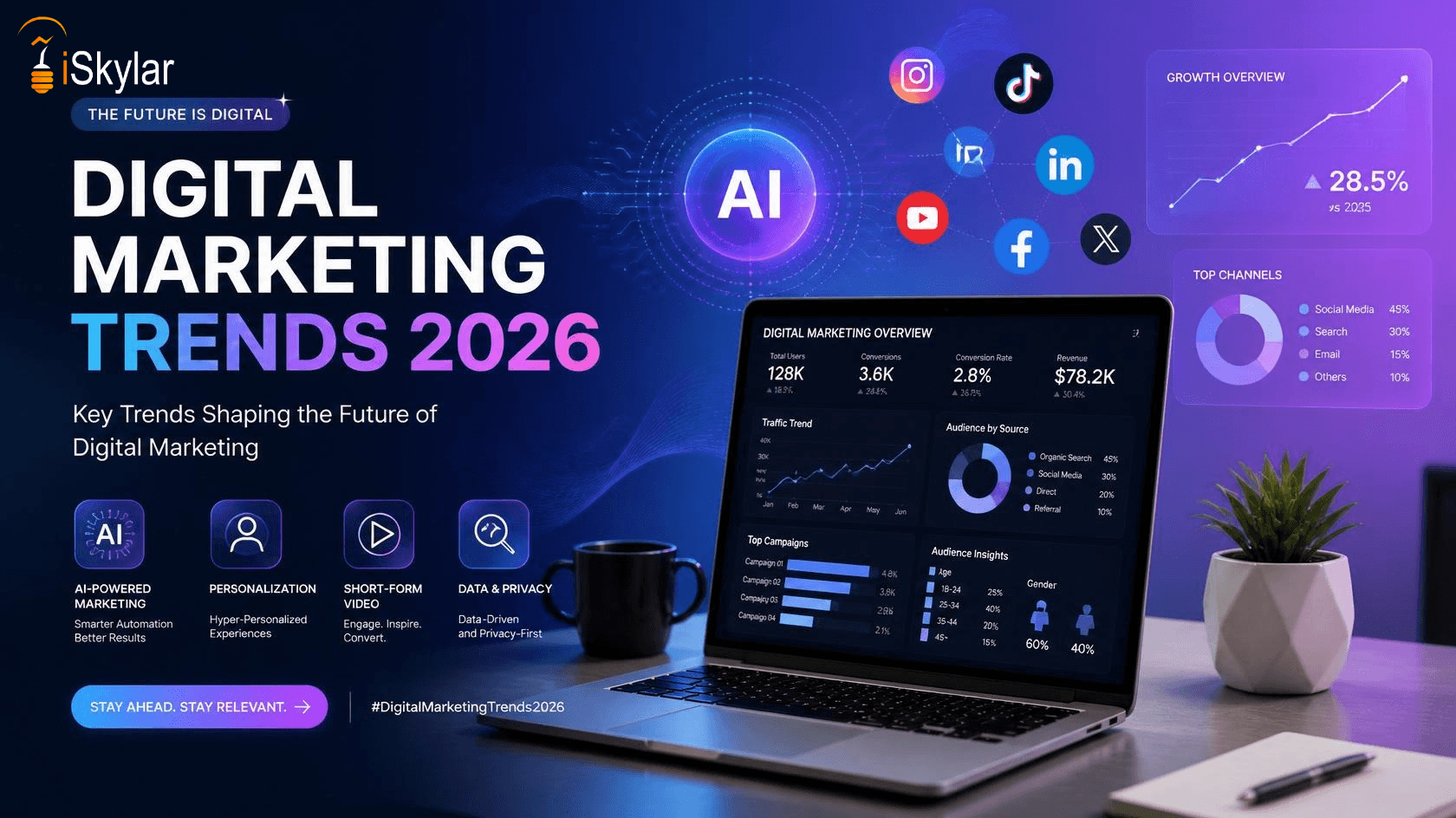
In 2026, digital marketing is being reshaped by five converging forces: AI-powered search with 89% of brand queries now triggering Google AI Overviews the rise of Answer Engine Optimization (AEO) and Generative Engine Optimization (GEO), first-party data replacing third-party cookies, social commerce exceeding $2.1 trillion in GMV, and agentic AI automating full campaign workflows. Brands that adapt now will dominate the next cycle.
The top digital marketing trends in 2026 represent the most fundamental shift the industry has seen in a decade. AI-generated answers now intercept search traffic before users ever reach a brand's website. Social platforms have matured into complete retail ecosystems. And privacy legislation has permanently closed the door on third-party cookie targeting forcing a rebuild of how marketers reach, understand, and convert audiences.
This guide breaks down the ten trends actually moving the needle in 2026, grounded in research published by Gartner, Goodfirms, Deloitte Digital, HubSpot, and Conductor. Whether you're running campaigns for an enterprise, an IT services agency, or a funded startup, these are the shifts to build into your strategy immediately.
Jump to a section:
• Trend 1 : AI Overviews & the AEO/GEO Imperative
• Trend 2 : Agentic AI Campaign Automation
• Trend 3 : First-Party Data as Business Infrastructure
• Trend 4 : Hyper-Personalization at Scale
• Trend 5 : Social Commerce Dominance
• Trend 6 : E-E-A-T as an AEO Ranking Signal
• Trend 7 : Short-Form Video & the Creator Economy
• Trend 8 : Cross-Channel Attribution & MMM
• Trend 9 : AR/VR Enters Mainstream Marketing
• Trend 10 : Authentic Content in an AI-Saturated World
Trend 1: AI Overviews & the Collapse of Click-Through The AEO and GEO Imperative
If there is one trend that has restructured digital marketing more than anything else in 2026, it is the collapse of the traditional search click. Google's AI Overviews now appear in approximately 89% of brand search results, and zero-click searches account for nearly 60% of all queries meaning most users get their answer directly on the SERP without visiting any external website.
~60% of Google searches in 2026 end without a click up from under 50% in 2024
89% of brand queries now trigger a Google AI Overview (Good firms, 2026)
58% CTR drop for top-ranking content when AI Overviews are present (Ahrefs, 2026)
2.5B prompts processed daily by ChatGPT 65% classified as search intent
This has given rise to two new disciplines alongside traditional SEO: Answer Engine Optimization (AEO) and Generative Engine Optimization (GEO).
What is AEO (Answer Engine Optimization)?
AEO is the practice of structuring content so AI-powered search systems Google's AI Overviews, ChatGPT, Perplexity can extract, surface, and cite your brand when answering relevant queries. It prioritizes direct answers, FAQ schema markup, plain-language phrasing, and E-E-A-T signals. Adobe research found AI-driven referrals to websites surged more than tenfold between July 2024 and February 2025. [2]
What is GEO (Generative Engine Optimization)?
GEO focuses on getting your brand cited inside AI-generated responses from large language models. Where AEO is primarily an on-page discipline (structure, schema, directness), GEO also requires building external brand authority: mentions, backlinks, reviews, and industry citations that function as trust signals for AI systems. In practice, both disciplines overlap heavily and both are now essential components of a modern AI search optimization strategy. [3]
For B2B IT and custom software development brands like iSkylar, the implication is stark: ranking #1 is no longer sufficient. You need to be cited. AI platforms drove over 1.1 billion referral visits in 2025 and that number is accelerating.
✓ Actionable Takeaway: Restructure high-traffic blog posts and service pages to open with a direct, 40–60-word answer. Add FAQ schema (JSON-LD) to every informational page. Track AI citations using HubSpot AEO or Conductor alongside traditional ranking data.
Trend 2: Agentic AI Marketing Campaigns That Run Themselves
Artificial intelligence has moved beyond content generation and simple automation. In 2026, agentic AI systems autonomous agents capable of making multi-step decisions and executing complex workflows without constant human oversight are beginning to operate entire campaign functions. The global digital ad market is expected to reach $1 trillion in 2026, with a significant portion of that efficiency gain driven by autonomous optimization.
31% of marketing leaders want AI predictive models to forecast performance before campaigns go live (Smartly, 2026)
Marketing teams are using AI agents to analyze behavioural signals, generate content variations, route leads through personalized sequences, and optimize bids in real time. The shift fundamentally changes the marketer's role: execution is increasingly delegated to intelligent systems, while the premium skill becomes strategy, interpretation, and judgment knowing how to direct AI systems and catch what they miss.
Insight-based content marketing is emerging as a direct output of this shift. Instead of guessing what to write, teams use data from AI/ML solutions search intent signals, behavioural analytics, engagement metrics to guide content creation with evidence. Predictive analytics now identifies shifts in audience sentiment or keyword interest weeks before competitors can react.
✓ Actionable Takeaway: Audit your martech stack for agentic capabilities. Tools like n8n, Make, and HubSpot's Breeze AI Suite can automate multi-step campaign workflows. Start with lead routing and content personalization before extending to bid optimization.
Trend 3: First-Party Data is Now Business Infrastructure, Not a Marketing Nice-to-Have
The deprecation of third-party cookies combined with GDPR, CCPA, and their 2025–2026 successors has pushed first-party data from strategic priority to survival requirement. In 2026, 87% of marketers are using first-party data as their primary audience targeting source and companies that deploy it effectively see 25% higher conversion rates on average. [4]
87% of marketers now use first-party data as their primary audience targeting source
2.9× revenue lift for businesses using first-party data vs. other sources (Google/BCG)
$10.3B projected global CDP market size by 2026, growing at 34% CAGR (Fortune Business Insights)
52% of marketing teams still don't own their data strategy — a major competitive gap (Supermetrics, 2026)
First-party data-driven advertising is projected to account for over 70% of digital ad spend by 2026. Yet despite the urgency, most organisations have not yet closed the gap between data collection and data activation. Companies with a unified first-party data strategy report up to 35% better campaign performance but 59% of marketers cite data silos as their biggest obstacle.
CDPs are the infrastructure play enabling this transition. Brands are investing in consent management platforms, loyalty programs, and behavioural tracking to build owned data repositories that power enterprise AI integration across personalization, segmentation, and cross-channel attribution without third-party signal dependency.
Importantly, 66% of US consumers say their trust in a brand increases when the company is transparent about how personal data is used. First-party data done well is therefore not just a targeting asset it is a trust-building mechanism.
✓ Actionable Takeaway: Prioritize email capture, gated content, and loyalty touchpoints. Implement a CDP if you haven't yet. Establish a public-facing data transparency page. The brands with unified first-party data pipelines active today will have an insurmountable targeting advantage by 2027.
Trend 4: Hyper-Personalization From Segment-of-One to Full Lifecycle
Personalization has been a marketing buzzword for years. 2026 is the year it becomes technically feasible at scale and commercially non-negotiable. Research shows 75% of consumers are more likely to purchase from brands delivering personalised experiences and AI has finally made true individualization achievable without an enterprise-scale engineering investment.
The new standard is not name-in-the-subject-line personalization. Leading brands are delivering individualised content recommendations, dynamic pricing, and adaptive landing pages based on real-time behavioural signals, purchase history, and contextual data. Multi-channel personalization engines stitch together signals from web, email, social, and CRM to create unified customer profiles that inform every touchpoint.
The companies winning at personalization in 2026 have solved the data infrastructure problem (see Trend 3) and are using AI-powered business intelligence to activate that data across the customer lifecycle not just at the point of purchase, but through discovery, nurture, conversion, and retention.
✓ Actionable Takeaway: Map your ICP segments against your content library and identify where generic messaging is losing you at high-intent moments. Even basic behavioural triggers exit intent, page depth, return visit, email click path can lift conversion rates measurably without a full AI infrastructure build.
Trend 5: Social Commerce Platforms Have Become the Storefront
Social commerce crossed from emerging channel to dominant retail format in 2026. It now accounts for 22% of total e-commerce sales globally and is growing at a 21% CAGR significantly outpacing traditional e-commerce at 14%. Social platforms are functioning as digital malls, and brands without native shop integrations are ceding revenue to competitors who do.
$2.1T+ global social commerce GMV platforms are now complete retail ecosystems
21% CAGR for social commerce vs. 14% for traditional e-commerce
70% of social commerce platforms now offer shoppable posts as a core native feature
3.6B projected global social commerce users by 2025, and growing
The purchase journey has compressed dramatically. Consumers are moving from discovery to transaction inside the same app session, often influenced by a creator recommendation or a community post. Shoppable video integrating the conversion funnel directly into content is becoming the primary revenue format on TikTok Shop, Instagram Shopping, and YouTube Shopping.
Connected TV is also maturing from a top-of-funnel brand tool into a direct-action channel. Shoppable video formats on streaming platforms are turning high-attention viewing moments into immediate purchase triggers. This convergence of content and commerce is the defining commercial shift of 2026.
For IT services and software development companies, the social commerce playbook is less about product listings and more about educational content that creates demand: thought leadership that surfaces your brand in discovery, with social proof that validates at the consideration stage.
✓ Actionable Takeaway: Build creator partnerships focused on educational and demonstration content, not promotional posts. Social content and community recommendations now drive initial brand discovery with search used primarily for subsequent validation. Reverse your traditional funnel assumptions accordingly.
Trend 6: E-E-A-T Now a Critical AEO Signal, Not Just an SEO Factor
Google's E-E-A-T framework (Experience, Expertise, Authoritativeness, Trustworthiness) has become even more critical in 2026 as AI-generated content floods the web. With teams able to produce hundreds of blog posts per week using AI tools, the differentiating signal for both search rankings and AI Overviews citation is genuine subject matter expertise and Google's systems are measurably better at detecting it than they were 12 months ago.
Critically, E-E-A-T is now also an AEO factor. When Google's AI Overview system selects which sources to cite, it draws heavily on E-E-A-T signals: named authors with verifiable credentials, first-hand experience evidence in the content itself, external citations from credible sources, and technical accuracy that goes beyond what a generic AI generation pass produces. Your author signals directly affect whether your content gets included in AI answers.
The proliferation of fake digital content a 2026 reality identified in Deloitte Digital's marketing trends report has placed a premium on trust and authenticity. Brands that invest in original research, expert authorship, and consistent fact-sourcing are positioned significantly better on both traditional SERPs and in AI-generated answer surfaces. [5]
✓ Actionable Takeaway: Add structured author bios with schema markup to every content piece. Create a dedicated author profile page (e.g., /author/Harsh) linked from every article. Publish original data or primary research that attracts external citations. Name your sources visibly and link out to credible references both reader trust and AI systems reward it.
Trend 7: Short-Form Video & the Creator Economy Discovery Has Moved
Short-form video remains the highest-engagement content format across platforms in 2026 but the strategic context has changed. Brands are moving beyond polished brand content toward co-created content with micro- and nano-creators who bring authentic audience relationships and niche expertise that brand accounts simply cannot replicate.
The creator economy has fundamentally reshaped how consumers discover brands. Deloitte Digital's 2026 marketing trends research shows that social content, creator recommendations, and online communities now influence how consumers first discover new brands with search used primarily for subsequent validation, not initial discovery. This is a fundamental reversal of the traditional marketing funnel.
Gartner identifies rising creator influence alongside AI-powered personalization and short-form video dominance as the three defining forces in digital marketing this year. Brands building systematic creator programs with clear briefs, performance tracking, and long-term relationship structures are significantly outperforming those running one-off sponsored posts. [6]
For B2B software and staff augmentation brands, the highest-performing creator content is educational and technical: demo walkthroughs, expert commentary, behind-the-scenes process content formats that build credibility in the ICP's professional network.
✓ Actionable Takeaway: Identify 3–5 technical practitioners or industry consultants in your ICP's vertical who have engaged followings on LinkedIn or YouTube. Co-create educational content rather than sponsored promotions it generates both discovery and E-E-A-T signals.
Trend 8: Cross-Channel Attribution & Marketing Mix Modelling Get an AI Upgrade
The fragmentation of ad channels combined with signal loss from privacy changes has created a measurement crisis. Last-click attribution the default model for most marketing teams for a decade actively misleads by systematically undervaluing upper-funnel touchpoints and over-crediting the final converting channel.
Marketing Mix Modelling (MMM) a statistical approach correlating marketing spend with business outcomes across all channels is experiencing a significant revival, now supercharged with AI and real-time data ingestion. Cross-channel measurement is no longer a luxury; it is a strategic necessity as customer journeys span organic search, paid social, CTV, creator content, email, and direct across multiple devices.
60%+ of e-commerce shoppers use multiple devices in a single purchasing journey
31% of marketers want pre-launch AI predictive performance modelling (Smartly, 2026)
Predictive analytics plays a growing role in pre-campaign planning. By identifying shifts in audience sentiment and keyword demand early, teams can pivot spending ahead of competitors rather than reacting after the fact.
For iSkylar clients, this is directly relevant to our automated executive reporting solutions which translate multi-channel attribution data into board-ready dashboards that connect marketing activity to pipeline and revenue outcomes.
✓ Actionable Takeaway: Enforce UTM discipline across all campaigns immediately. Begin tracking AI visibility metrics (brand citations in AI Overviews, share of voice in generative answers) alongside traditional KPIs. Move to at minimum a linear or time-decay multi-touch model if MMM is not yet feasible.
Trend 9: AR and VR Cross Into Mainstream Marketing
Augmented Reality and Virtual Reality have crossed the line from experimental to mainstream marketing channel in 2026. AR-powered product visualization letting customers see how furniture fits in their room, how a software UI will behave, or how a product looks in-context is reducing purchase friction and measurably improving conversion rates.
In B2B contexts, immersive product demos and virtual experience environments are replacing static sales decks. Software companies in particular are using interactive demo environments to let prospects experience product value before committing to a sales conversation a format proven to compress the B2B decision cycle.
40% of social commerce platforms now offer AR try-on features as a conversion optimization tool. The underlying technology WebAR, lightweight 3D rendering, device-agnostic deployment has matured to the point where brands can deliver these experiences without specialist hardware requirements.
For software and platform modernization engagements, the B2B AR equivalent is an interactive AI demo that lets prospects experience the value of a solution in a live sandbox a format iSkylar has built specifically into its sales methodology for enterprise AI integration clients.
✓ Actionable Takeaway: If you sell complex software or services, invest in interactive demo environments. The ROI on letting prospects self-explore your solution before a sales conversation is measurably higher than any deck or case study for B2B buyers.
Trend 10: Authentic, Human-Centered Content The Counter trend to AI Saturation
Perhaps the most counterintuitive trend of 2026 is the rising premium on human authenticity precisely because AI-generated content has become ubiquitous. As the web fills with competent-but-generic AI output, content demonstrating genuine human perspective, original experience, and intellectual honesty is standing out dramatically.
This manifests across multiple channels: the growth of personal newsletters and owned media, increased investment in original research and thought leadership, strong ROI from live events and in-person experiences, and the success of creator voices that feel direct and unfiltered. Even AI-enthusiastic consumers, according to Gartner's 2026 research, hesitate to let digital agents make autonomous purchase decisions they still want human judgment in the loop for anything that matters.
Deloitte Digital's 2026 marketing report identifies this shift toward authentic, trust-first content as one of five major forces reshaping the discipline. The content bar has not just been raised by AI it has been fundamentally redefined. Volume is no longer a competitive differentiator. Perspective is.
This is why iSkylar's content strategy emphasizes original case studies, named expert authors, and primary client outcome data rather than topic-quantity publishing. Authentic content compounds it attracts backlinks, generates AEO citations, and builds the E-E-A-T profile that algorithmic content cannot.
✓ Actionable Takeaway: Identify 2–3 internal subject matter experts who can contribute genuine perspectives to your content program. First-person opinion pieces, original data reports, and documented case studies with real client outcomes will consistently outperform high-volume AI-drafted content in both search visibility and audience trust.
Frequently Asked Questions :
Digital Marketing Trends 2026
Q: What are the top digital marketing trends in 2026?
Ans : The top digital marketing trends in 2026 are: AI-powered search and the rise of Answer Engine Optimization (AEO) and Generative Engine Optimization (GEO), agentic AI automating campaign workflows, first-party data replacing third-party cookies as the foundation of audience targeting, hyper-personalization at scale, social commerce growth, E-E-A-T signals mattering for AI citation eligibility, and authentic human-centered content standing out against AI noise.
Q: What is the difference between AEO and GEO in 2026?
Ans: AEO (Answer Engine Optimization) focuses on structuring content to directly answer specific questions so AI-powered search systems like Google's AI Overviews can extract and cite it. GEO (Generative Engine Optimization) goes further it focuses on getting your brand cited inside AI-generated responses from tools like Chat GPT and Perplexity by building external brand authority through mentions, backlinks, and industry citations. Both are now essential components of a modern digital marketing strategy.
Q: How is AI changing digital marketing in 2026?
Ans: AI is transforming digital marketing at every layer in 2026: it powers search through AI Overviews that intercept clicks before users reach websites; it personalizes content and ad targeting at scale; it automates multi-step campaign workflows via agentic AI systems; and it drives predictive analytics that helps teams allocate budgets more accurately. AI has also changed the content game making it easier to produce volume but raising the bar for differentiated, expert-driven content that earns AI citations.
Q: What is first-party data and why does it matter in 2026?
A: First-party data is information collected directly from your customers through your own website, app, CRM, loyalty programs, and owned channels. In 2026, it matters because third-party cookies have been deprecated, privacy regulations like GDPR and CCPA have tightened, and brands can no longer rely on external data providers for audience targeting. Businesses using first-party data report a 2.9× revenue lift compared to those using other data sources (Google/BCG research).
Q: What is social commerce and how significant is it in 2026?
A: Social commerce is the ability for consumers to discover and purchase products directly inside social media platforms without leaving the app. In 2026, social commerce accounts for 22% of total global e-commerce sales, growing at a 21% compound annual growth rate significantly faster than traditional e-commerce at 14%. Platforms like TikTok Shop, Instagram Shopping, and YouTube Shopping have made in-app purchasing seamless, and shoppable video is now a primary revenue driver for brands with strong creator partnerships.
Q: How do I optimize content for Google's AI Overviews in 2026?
A: To appear in Google AI Overviews, open every content piece with a direct, concise answer of 40–60 words to the primary question. Use plain, declarative language. Add FAQ schema markup (JSON-LD) to structured Q&A content. Build E-E-A-T signals by naming real authors with verifiable credentials, citing credible external sources, and publishing content that reflects genuine subject matter expertise. Track AI citation frequency using tools like HubSpot AEO or Conductor.
Q: What is E-E-A-T and why does it matter for AEO?
A: E-E-A-T stands for Experience, Expertise, Authoritativeness, and Trustworthiness Google's quality framework for evaluating content. In 2026, E-E-A-T is not just a traditional SEO ranking factor; it directly determines whether your content is selected as a source for AI Overview citations. Named authors with credentials, first-hand experience signals, external references, and accurate, in-depth content all contribute to a stronger E-E-A-T profile — and therefore better visibility in AI-generated search answers.
References & Sources
[1] Goodfirms 2026 AI SEO & Zero-Click Search Survey
[2] Adobe Research AI-Driven Referral Traffic Surge (2024–2025)
[3] Jasper GEO vs AEO vs SEO Definitive Guide 2026 —
[4] Omnibound First-Party Data Statistics 2026 (52+ Data Points)
[5] Deloitte Digital Marketing Trends 2026
[6] Gartner Future of Marketing 2026
[7] Smartly 7th Annual Digital Advertising Trends Report 2026
[8] Conductor AEO/GEO Benchmarks Report 2026
[9] HubSpot Answer Engine Optimization Trends & AI Visibility Metrics
[10] Click Vision Zero Click Search Statistics 2026
[11] ALM Corp Digital Marketing Statistics 2026
WRITTEN BY
Harsh
7 years in AI Enabled B2B Marketing
Further Reading


Stay at the forefront of innovation.
innovation.
Join our inner circle of industry leaders and get exclusive insights delivered to your inbox every Thursday morning.
WE RESPECT YOUR PRIVACY. NO SPAM, EVER.