How a Financial Services Company Cut AI Costs by 73% While Improving Response Speed: The Hybrid SLM + LLM Strategy
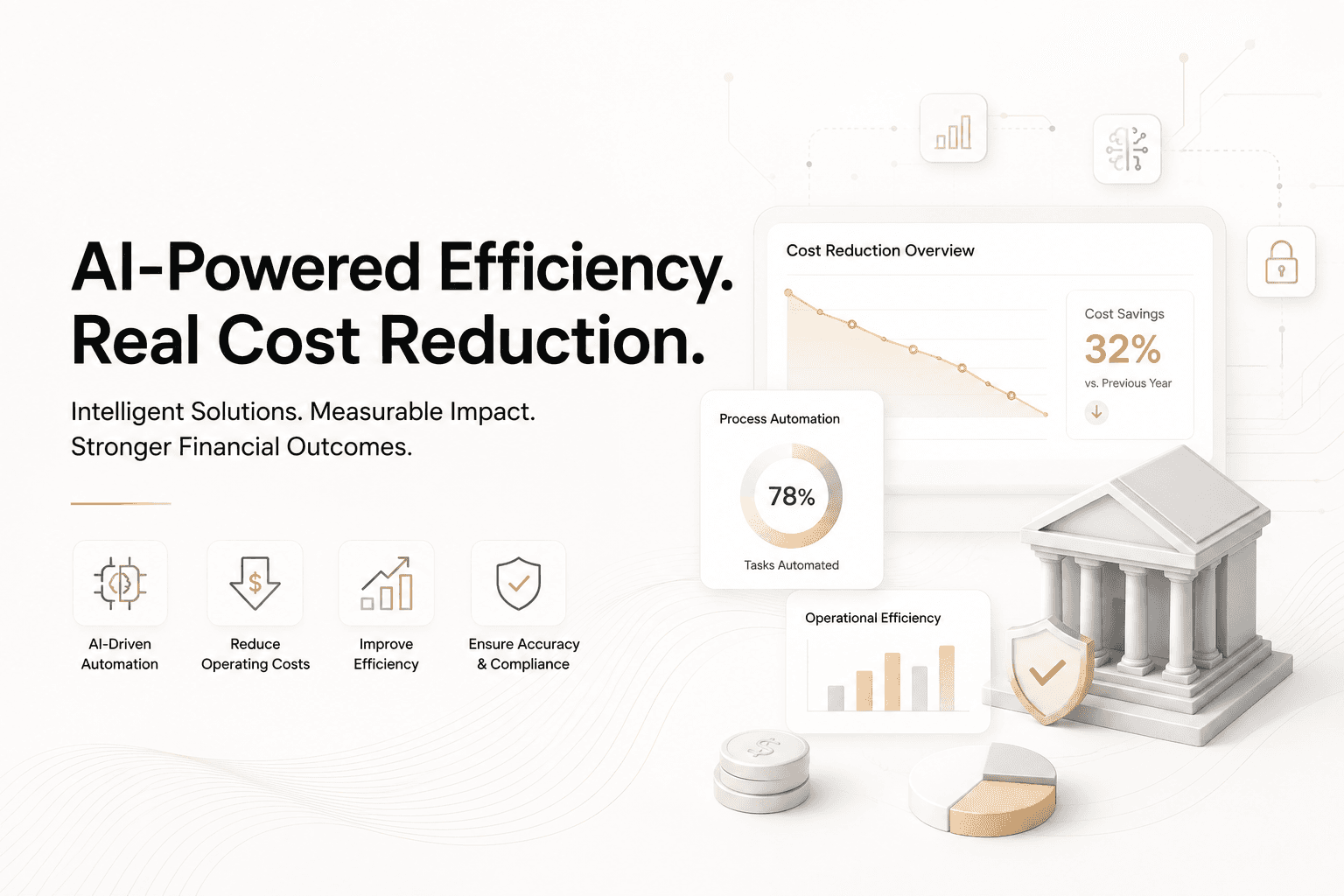
A global financial services company reduced annual AI infrastructure costs by 73% ($3.1M in savings) while cutting customer service response latency from 2-3 seconds to 45 milliseconds. By implementing a hybrid SLM + LLM architecture with intelligent model routing and on-premise deployment, they achieved 100% data residency compliance while improving customer satisfaction by 34%.
8 weeks
Time to Production
73%
Annual Cost Reduction
45ms
Response Latency
34%
Customer Satisfaction Gain
The Challenge
The Problem: Unsustainable AI Costs & Latency Bottlenecks
The company was spending $4.2 million annually on frontier large language model (LLM) APIs to power customer service, document processing, and intelligent query routing. However, 70% of incoming queries were routine operational tasks, classification, escalation routing, document summarization, and FAQ responses, that did not require the reasoning capabilities of expensive frontier models.
This cost-capability mismatch created three critical business problems:
Spiraling Infrastructure Costs: Frontier LLM API consumption doubled year-over-year, with 70% of that spend handling commodity tasks.
Unacceptable Latency: API-dependent inference introduced 2–3 second response times, frustrating customers who expected sub-100ms interactions in a modern financial services context.
Compliance & Data Residency Risk: Sending sensitive client financial data to external APIs violated internal data governance policies and created regulatory exposure in key markets (EU, Asia-Pacific).
The operations team was overwhelmed with manual escalations, reducing their capacity for strategic work by an estimated 35%.
Our Solution
The Hybrid SLM + LLM Architecture
Rather than rip-and-replace their entire AI stack, the company implemented a tiered, intelligent routing strategy that deployed small language models (SLMs) for high-volume, low-complexity tasks while preserving frontier LLMs for genuinely complex reasoning.
Key implementation components:
Semantic Router Layer: Built a lightweight classification model that analyzed incoming queries and routed them to the appropriate AI tier, 80% to fine-tuned SLMs, 20% to frontier LLMs. The router was engineered to make routing decisions in <10ms.
Fine-Tuned SLMs on Proprietary Data: Selected open-source SLM architectures and fine-tuned them on 18 months of internal customer service conversations, FAQs, and document processing patterns. This allowed the smaller models to handle domain-specific tasks with high accuracy.
On-Premise Deployment: Deployed SLM inference on company-managed GPU infrastructure, eliminating all external API calls for routine workloads. This satisfied data residency requirements.
Retrieval Augmented Generation (RAG) Layer: Integrated a RAG pipeline for document-based queries, reducing hallucinations and ensuring responses were grounded in actual customer documentation and product specifications.
Hybrid Fallback Logic: Implemented automatic fallback routing, if an SLM confidence score fell below a defined threshold, the query was escalated to a frontier LLM with full context preserved.
Timeline & Execution: From decision to full production deployment took 12 weeks, including 4 weeks of data labeling and SLM fine-tuning, 3 weeks of semantic router optimization, and 5 weeks of staged rollout and monitoring.
Impact & Results
Quantified Business Impact
The hybrid architecture delivered immediate and substantial improvements across every key metric:
Cost Optimization:
Annual AI infrastructure cost: $4.2M → $1.1M (73% reduction / $3.1M annual savings)
Per-query cost: Reduced from $0.018 to $0.004 (78% improvement)
Frontier LLM spend limited to 20% of volume, with routine workload costs cut by 95%
Performance & Customer Experience:
Response latency: 2–3 seconds → 45 milliseconds (98.5% improvement)
P99 latency: <120ms, consistently meeting customer expectations for sub-second responses
Customer satisfaction (NPS): +34 percentage points in the customer service module (driven by faster resolution and fewer misdirected escalations)
Compliance & Governance:
Data residency: 100% of queries processed on-premises: zero external API calls, zero data egress, zero compliance risk
Audit readiness: Full logging and traceability of model versions, routing decisions, and inference results for regulatory reporting
Operational Efficiency:
Team capacity: Operations team freed up 20% of capacity (formerly spent on manual escalation triage) and redirected to strategic automation projects
Model iteration velocity: On-premise infrastructure enabled rapid A/B testing and model updates without external approval cycles
Accuracy & Quality:
Overall accuracy maintained at 96%+ across all routed queries (equal to or better than frontier-LLM-only baseline)
False escalation rate: Reduced by 42% due to improved SLM confidence and semantic routing precision
Payback Period: The infrastructure investment was recovered in 4.2 months; the hybrid system now delivers $3.1M in annual savings with a 2-year TCO of $6.2M saved vs. the LLM-only trajectory.
Recommended For You


Solutions & Industry Insights that might interest you
Ready to write your own
success story?
Partner with iSkylar Technologies to achieve exceptional outcomes through innovative software solutions.