
Which AI Model Is Actually Right For Your Enterprise? The LLM vs SLM Decision Framework
Most enterprises waste 70-80% of their AI budget on expensive LLMs for tasks that SLMs could handle faster and cheaper. Learn a hybrid routing strategy that cuts costs while improving performance, and see how one financial services company saved $3.1M in year one.
Soniya
PRINCIPAL ARCHITECT9 MIN READ
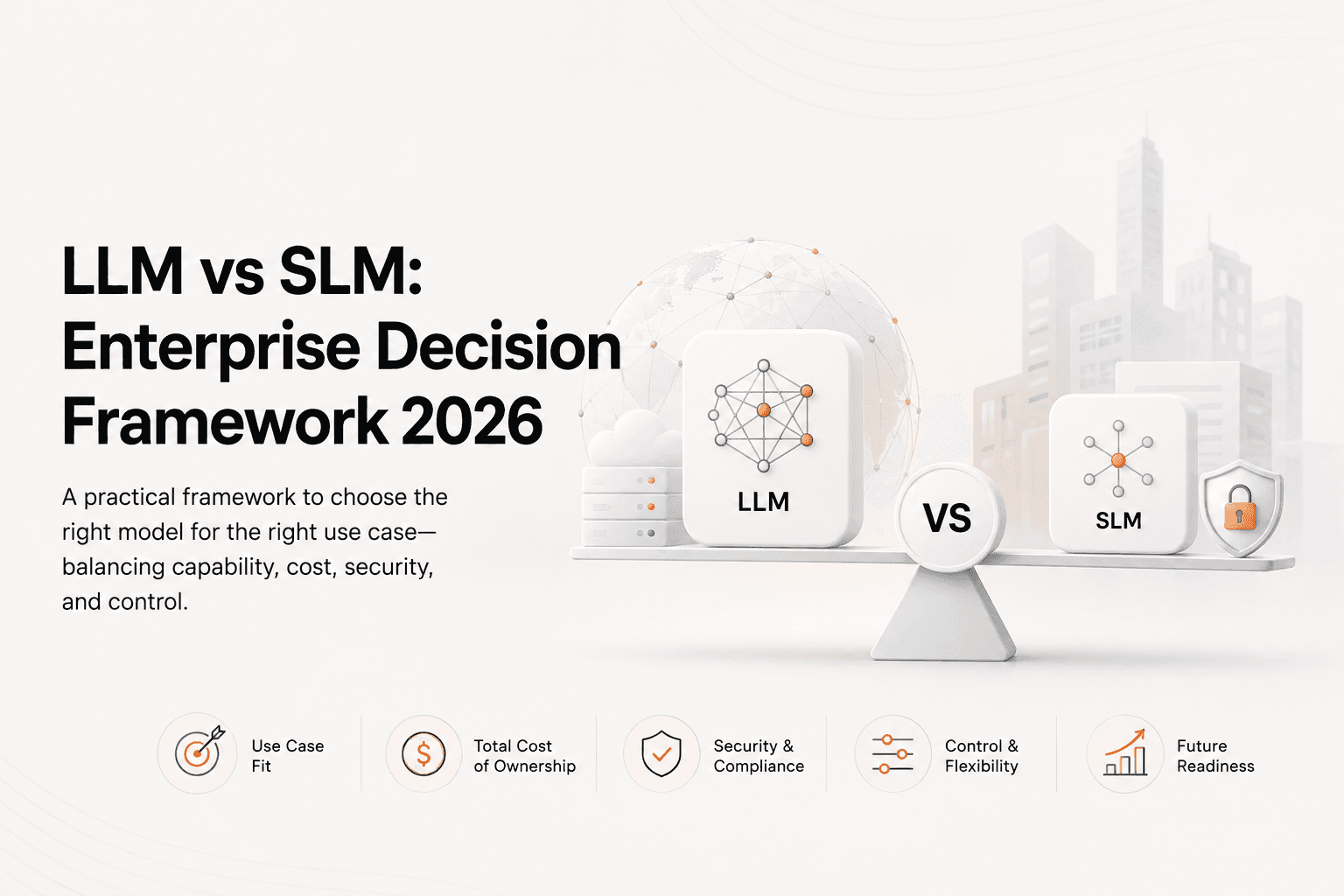
Stop Paying LLM Prices for Routine Work
Your enterprise is probably overspending on AI. Here's the pattern we see repeatedly: companies deploy frontier LLMs (Claude, GPT-4, Claude 3, Gemini Ultra) across their entire AI workload, customer service, classification, summarization, data extraction, routing, and their cloud bill balloons to $2M–$5M annually. Then they discover the hard truth: 80% of that work could run faster, cheaper, and more accurately on specialized small language models (SLMs).
Quick answer: For 80% of enterprise AI tasks (classification, extraction, summarization, routing), small language models are faster, cheaper, and more accurate. Route only the complex 20% to expensive frontier LLMs. This hybrid approach cuts costs by 70-80% while improving latency from seconds to milliseconds.
The Case for the Hybrid Model Strategy
The LLM vs SLM debate misses the point. It's not either/or, it's a hybrid routing problem. The real win isn't choosing one model; it's building a decision tree that sends each task to the right model at the right cost.
Here's what changed in 2025-2026: SLMs became genuinely capable. Models like Llama 3.1, Mistral 7B/8B, Phi-3, and Qwen-2.5 now match or exceed GPT-3.5 performance on domain-specific tasks. They run locally, fine-tune on your data in hours (not weeks), and cost 90%+ less than frontier LLMs.
The decision matrix looks like this:
Use an SLM if: Task is well-defined (classification, extraction, summarization), you have domain training data, latency matters, compliance requires on-premise, cost is a constraint, query volume is high (>1K/day)
Use an LLM if: Task requires reasoning or creativity, multi-step problem-solving needed, you need state-of-the-art performance on novel problems, real-time reasoning over unstructured data
Real Numbers: The Cost Impact
One financial services company, a case we've worked closely with (detailed in our recent case study, How a Financial Services Company Cut AI Costs by 73% While Improving Response Speed: The Hybrid SLM + LLM Strategy deployed this exact strategy and saw immediate results:
Starting point: $4.2M annual AI spend (mostly GPT-4 API calls)
Routing strategy: 75% of workloads → SLMs, 25% → LLMs
Result: $1.1M annual spend (73% reduction, $3.1M savings in year one)
Bonus: Latency dropped from 2-3 seconds (LLM) to 50-150ms (SLM) for routine tasks
The Data Behind the Decision
85% of classification tasks see better SLM performance than GPT-4. Why? SLMs fine-tuned on your domain data beat general-purpose models every time.
Accounting firm ROI: $190K year-one savings, 8-month payback. One regulated industry deployed SLMs for invoice processing and compliance checking.
Market adoption: 3x more SLM deployments than LLMs projected by 2027 (Gartner). The inflection point is now.
IT leader consensus: 75% of IT leaders report SLMs outperform LLMs for specific tasks. The narrative is shifting from "LLMs for everything" to "right-sized models for outcomes."
Latency comparison: SLMs = 10-50ms, LLMs = 2-3 seconds. For high-volume transactional AI, this is the difference between real-time and frustratingly slow.
Why iSkylar Partners Build This Way
This hybrid approach isn't theoretical. When companies partner with iSkylar Technologies for AI-enabled software development, they inherit architectural patterns that embed cost discipline from day one. Our engineers architect AI systems with three layers:
Tier 1 (95% of requests): Fast, cheap SLM routing and classification. Runs on your infra or lightweight API.
Tier 2 (4% of requests): Mid-range model for nuanced tasks. Faster and cheaper than frontier LLMs, still smart.
Tier 3 (1% of requests): Frontier LLM for complex reasoning, escalated cases, novel problems. Pay for precision when you need it.
Reference point: This architecture mirrors what we've documented in case studies like our financial services example, and it's now the default for any company serious about AI ROI. Partners understand that model selection is a business problem, not just a technical one.
The Decision Framework: A Practical Matrix
Use this matrix to route your own workloads:
Task Type Complexity Query Volume Latency Critical? Recommended Model Customer intent classification Low High (1K+/day) Yes SLM (fine-tuned) Invoice data extraction Medium Medium (100-500/day) Yes SLM + OCR Compliance risk assessment Medium-High Low (10-50/day) No Mid-range model Multi-step reasoning / research High Low No Frontier LLM Real-time personalization Medium Very High (10K+/day) Yes Fine-tuned SLM
Privacy & Compliance: An Underrated Win
SLMs let you move sensitive data off third-party APIs. If you're in regulated industries (finance, healthcare, law)—or handling customer PII—deploying SLMs on your infrastructure or your preferred cloud region isn't optional; it's strategic.
No API dependency: Your competitive data and customer data never leaves your control.
Audit trail: Full logging and monitoring. No "black box" decisions from external APIs.
Compliance fit: Deploy to your private cloud, on-premise, or isolated VPCs. Your compliance and security teams approve the infra once; you update the model, not the infrastructure.
How to Get Started: Three Steps
Audit your AI workloads. Itemize every task currently handled by LLMs. Estimate monthly query volume, latency requirements, and business criticality for each.
Classify tasks into the routing matrix. Use the decision table above. Most teams find that 70-85% of their workloads belong in the SLM lane.
Build a hybrid pilot. Pick one high-volume, well-defined task. Deploy an SLM (Llama 3.1, Mistral, or Phi-3), fine-tune on 500-1000 examples of your domain data, and measure cost, latency, and accuracy vs. your current LLM. You'll have a case for the rest of the organization in 2-4 weeks.
LLM vs SLM Questions:
Which industries benefit most from SLM deployment?
High-volume, regulated industries win biggest: financial services, insurance, customer service (e-commerce, SaaS), legal discovery, healthcare claims processing, supply chain visibility. These sectors have 1000s of routine, well-defined tasks and strong compliance constraints on data residency.
The Bottom Line: Your 70% Cost Reduction Is Real
The LLM vs SLM framework isn't about choosing between two technologies. It's about building a cost-aware AI architecture that matches model capability to business need. The 73% cost reduction the financial services company achieved isn't an outlier—it's the expected outcome when you apply this discipline systematically.
Start small: Pick one high-volume task, deploy an SLM, measure the outcome. You'll have proof of concept and a roadmap for the rest of your AI stack in 4-6 weeks. And you'll have joined the 75% of IT leaders who now view SLMs as a core part of their AI strategy—not a downgrade.
Next Step: Take Our AI Model Selection Assessment
Not sure if your workloads are SLM candidates? Take our 5-minute assessment to get a personalized model routing recommendation for your specific tasks and business constraints. We'll show you where you can cut costs, where you still need frontier models, and a 90-day implementation roadmap.
WRITTEN BY
Soniya
Frequently Asked Questions
Is my task better suited for an LLM or SLM?
How much will we save switching to SLMs?
Can we fine-tune SLMs on our proprietary data?
What's the total cost of ownership comparison?
How do we build a hybrid routing architecture?
Further Reading


Stay at the forefront of innovation.
innovation.
Join our inner circle of industry leaders and get exclusive insights delivered to your inbox every Thursday morning.
WE RESPECT YOUR PRIVACY. NO SPAM, EVER.