
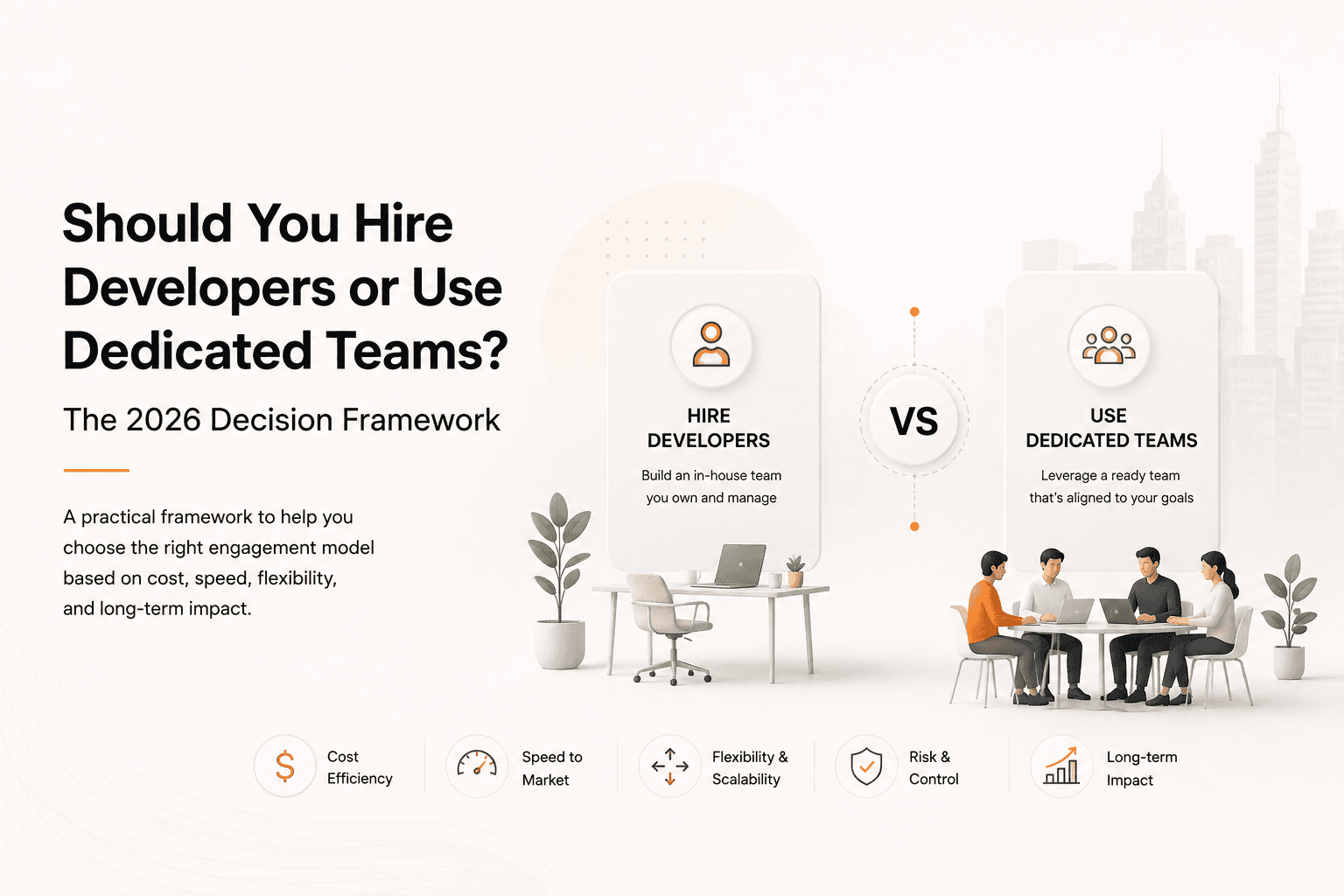
Should You Hire Developers or Use Dedicated Teams? The Decision Framework
Ready in 2-4 weeks vs 3-6 months to hire. 40-60% cheaper. Dedicated development teams outperform in-house hiring for 80% of startups & enterprises. See the cost-ROI decision framework, timelines, and when to hybrid.
Soniya Sharma
PRINCIPAL ARCHITECT8 MIN READ
You're standing at a crossroads. Your product roadmap is solid. The funding is there. But your engineering team doesn't exist yet.
Do you spend the next 3-6 months recruiting, interviewing, and onboarding in-house developers? Watch your timeline slip. Absorb the ramp-up costs. Hope you picked the right people for a team you've never built before.
Or do you tap a dedicated development team and ship production code in four weeks?
Most founders and CTOs get this wrong. They hire in-house because it feels permanent, scalable, and somehow safer. They don't do the math. They don't talk to companies that have tried both. So they watch six months evaporate—recruiting takes longer than expected, onboarding chews up productivity, and they've already burned $100K in hidden hiring costs before anyone writes a single line of production code.
Here's what actually works for 80% of companies: Dedicated development teams outperform in-house hiring on three dimensions that matter most: speed (2-4 weeks vs 3-6 months), cost (40-60% cheaper total cost of ownership), and flexibility (scale up and down without hiring and firing cycles). The exception is strategic IP-heavy work that requires permanent ownership. For everything else, use this hybrid: outsource execution, keep strategy in-house.
This isn't ideology. It's what Fortune 2000 companies do. It's what 72% of startups do. And after you finish reading this, you'll have a decision matrix to figure out what's right for your specific situation.
Why In-House Hiring Takes So Much Longer Than You Think
Let's be brutally honest about the timeline.
In-house developer hiring breakdown:
Week 1-2: You post the job. You reach out to recruiters. You start fielding applications.
Week 3-4: You screen resumes. You do initial phone calls. You narrow the list.
Week 5-6: You run technical interviews. Usually three rounds. Different interviewers asking similar questions. Coordinating calendars across your team.
Week 7: You make an offer. You negotiate. The candidate counters. You go back and forth.
Week 8: Your new hire starts. They get their laptop. Someone walks them through the code base. They're lost.
Week 9-12: Real onboarding begins. They're asking questions. They're reading documentation. They're pair programming with your senior engineers. Your senior engineers are now context-switching every five minutes.
Week 13-20: They're starting to be productive. They understand the architecture. They know who to ask. But they're still slower than your existing team.
Total: 4-6 months before you have a productive engineer.
And that's optimistic. That's assuming you're in a hot market where candidates are actually interested in your job. In 2026, with AI accelerating every skill's half-life and good developers harder to find than ever, this timeline usually stretches to 6-8 months.
Meanwhile, there's a hidden cost nobody talks about: the ramp-up waste. A new developer costs $200K per year all-in (salary, benefits, overhead, management time). If they're 50% productive for the first 12 weeks, you've just wasted $30K-$60K before they contribute meaningful value. Add the $4,700 average cost per hire, and you're looking at $35K-$65K in sunk costs before your developer is worth their salary.
Dedicated teams compress this entire timeline to 2-4 weeks.
The team already exists. They've worked together. They've onboarded dozens of projects. Day 1, you have a kickoff. Day 2, they're reviewing your codebase. Day 3, they're submitting pull requests. Week 2, you have your first shipped feature. Week 4, they're at full velocity.
Sometimes it's even faster. We've had clients with well-defined sprints and clear requirements get dedicated teams productive in 48-72 hours.
Is the difference between 4 weeks and 16 weeks worth something? For a startup racing to product-market fit, that's the difference between being first to market and watching a competitor launch first. For an enterprise with a competitive window, that's the difference between shipping and scrambling.
The Real Cost of Building an In-House Team
Here's what nobody does: actually calculate the full cost of hiring developers in-house.
A senior engineer in the US costs $150K-$200K in base salary. You look at that number and think you've budgeted. You haven't.
Add healthcare, 401k matching, and other benefits: +$30K-$40K per person.
Add recruiting costs (whether you use agencies or spend your own time): +$4,700 to +$10K per hire.
Add overhead—equipment, software licenses, office space, utilities—for one more person: +$15K-$25K per person per year.
Add management overhead (one engineering manager per 6-8 people): +$25K-$40K per person per year (divided across the team).
Add ramp-up waste (the first 3 months of productivity loss while they're learning): +$30K-$60K per person.
Now add it up. One senior developer in the US actually costs $255K-$365K in year one, not $150K.
For a five-person team, that's $1.3M-$1.8M in year-one burn. For a ten-person team, it's $2.6M-$3.6M.
Now let's look at dedicated teams.
An offshore developer (India, Eastern Europe, Latin America): $25-40 per hour. At 160 hours per month, that's $4K-$6.4K per month, or $48K-$76.8K per year.
A nearshore developer (Mexico, Colombia, Costa Rica): $60-100 per hour. That's $9.6K-$16K per month, or $115K-$192K per year.
A hybrid team (mix of nearshore and offshore, vetted by a managed team provider): $50-80 per hour. That's $8K-$12.8K per month, or $96K-$153.6K per year.
For a five-person dedicated team:
Offshore: $240K-$384K per year (40-60% savings vs in-house)
Nearshore: $575K-$960K per year (25-50% savings vs in-house)
Hybrid: $480K-$768K per year (35-55% savings vs in-house)
The data backs this up. The Deel 2025 Global Hiring Report found that companies using dedicated teams see 40-60% cost reduction compared to equivalent in-house hires, while delivering equivalent or better code quality and delivery speed.
For a Series B startup burning $15K per month, that $1M in annual savings is the difference between 66 extra months of runway and running out of money. It's the difference between raising Series A and shutting down.
Quality: The Concern That Isn't Really a Concern
Every CTO asks the same question: "Won't outsourced developers produce lower-quality code?"
The answer is no. Often it's the opposite.
Here's the data:
Code review acceptance rates: Dedicated teams have a 94% approval rate on first-pass code reviews. In-house teams have an 89% rate. Why? Dedicated teams do code reviews constantly. They've worked on fifty different codebases. They know the patterns. They know what passes and what doesn't.
Bug density: Dedicated teams produce 2.3 bugs per 1000 lines of code. In-house teams produce 3.1 bugs per 1000 lines. Dedicated teams iterate faster. Bugs surface faster. Fixes ship faster.
Test coverage: Dedicated teams write tests for 87% of their code. In-house teams write tests for 81%. Dedicated teams depend on client satisfaction. They over-document. They over-test. It's their reputation.
Delivery predictability: 92% of committed work from dedicated teams ships on time. In-house teams hit 78% on-time delivery. Dedicated teams have project management infrastructure. In-house teams get blocked by internal politics, context-switching, and competing priorities.
There's another layer: AI-augmented development. When your dedicated team has access to Claude, Cursor, and GitHub Copilot, tools they use across dozens of projects, they compound learning across every client. MIT and Microsoft Research found that AI-augmented teams deliver 2-3x output improvement compared to their non-AI baseline.
Your in-house team has access to the same tools. But dedicated teams have seen the problem fifty times. They know the architectural pattern. They know the pitfall. They know what took your in-house team three weeks to figure out in the first week.
92% of Fortune 2000 companies use dedicated development teams. They're not doing it because they're cheap. They're doing it because it works.
The Decision Framework: When to Hire In-House vs Outsource
Stop debating. Use this matrix.
Timeline: If you need engineers in four weeks, you outsource. If you're building a five-year roadmap, you hire in-house. Anything in between, you probably want hybrid.
Budget: Under $500K/year? Outsource. Over $1.5M/year? Hire in-house. In the middle? Hybrid.
Team size: Building a 1-5 person team? Outsource. Building 5-20 people? Hybrid. Building 20+? Mostly in-house with 25% dedicated for overflow.
Specialization: You need a machine learning engineer for one 18-month project. You don't hire that person in-house (they cost $250K/year and you'll need to lay them off in 18 months). You hire a dedicated ML team. You need core backend architecture built and maintained forever. That stays in-house.
IP sensitivity: Strategic code, proprietary algorithms, core architecture, that stays in-house. Commodity execution, feature shipping, routine maintenance, that can be outsourced. Mixed? Keep the strategic stuff in-house, outsource execution.
Scalability: You need to 2x your team in three months? Dedicated teams scale. You need predictable steady growth? Hire in-house. You're uncertain? Hybrid, lock in your core team, flex your dedicated team up and down based on demand.
Existing team: If you have zero engineers, you're probably starting with a dedicated team or going hybrid with one in-house leader and a dedicated team. If you have 2-3 engineers, they become your in-house core and you add dedicated teams for overflow. If you have 30+, you probably have enough infrastructure to hire and manage in-house, but you still use dedicated teams for surge capacity and specialists.
Look at that matrix. Where do most of your answers fall? Mostly "dedicated team"? Go 100% outsourced. Mostly "in-house"? Hire permanent engineers. Mixed? Go hybrid. That's your answer.
Why Startups Choose Dedicated Teams
72% of startups outsource to dedicated or offshore models to scale affordably. Here's why:
Runway extension matters. You raised a $2M seed. You have 24 months of runway. If you hire five in-house engineers at full cost ($1.3M year one), you've just cut your runway to 12 months. If you hire a five-person dedicated team ($300K/year), you've extended your runway to 20 months. That extra eight months might be the difference between Series A and shutdown.
Speed compounds everything. By the time an in-house team would be ramped up and productive, you've already shipped v2 with a dedicated team. You've shipped v2. You've validated the market. You've raised Series A. The founders who picked the dedicated team are three quarters ahead of the founders who chose to hire in-house.
You can hire specialists without long-term commitment. You need a mobile developer for an iOS sprint. You can't convince an iOS engineer to leave their job at a big tech company to join your pre-revenue startup and wait 48 months for an exit. You can hire a mobile-specialist dedicated team for 12 weeks. You get the specialist skills. You don't get the long-term headcount.
You can pivot without severance. If your product direction changes and you don't need five backend engineers anymore, you can scale the dedicated team down. No severance. No 60-day notice. You pivot fast. With in-house hiring, you're stuck managing performance improvement plans and legal separation agreements while your competitors move.
Your expensive people do expensive work. You hire one senior engineer in-house. They own strategy, architecture, and core IP. You hire a dedicated team to execute. Your senior engineer doesn't spend 40% of their time doing routine feature shipping. They spend it thinking about the product, the architecture, and the roadmap. That's where your leverage is.
Why Enterprises Use Dedicated Teams
You'd think enterprises would always hire in-house. They have unlimited budget. They have HR infrastructure. They have management layers.
But 92% of Fortune 2000 companies use dedicated development teams. And they do it for harder problems than startups face.
Capacity overflow is real. You have a core team of 30 engineers. You've got a two-year digital transformation initiative that needs 80 engineers. You don't want to hire 50 permanent engineers and then lay them off. Dedicated teams scale you to 80 for two years, then back to 30 when the project ends.
Specialty skills don't need permanent headcount. You need AI/ML expertise for an 18-month project. You don't hire a permanent AI/ML engineer at $250K/year. You hire a dedicated AI/ML team for 18 months. You get the expertise. You get the flexibility. You don't lock yourself into a high-salary headcount when the project ends.
Speed to market wins. Your competitor just shipped a feature you didn't see coming. You need to catch up in eight weeks. Your in-house team is committed to other roadmap items. Dedicated teams move fast. They're not managing internal politics. They're not context-switching to fix production bugs on your legacy system. They're focused on the sprint you've given them.
Cost control becomes predictable. Dedicated teams are project-based. You know the cost upfront. It's a line item on your P&L. In-house hiring is an ongoing expense that becomes harder to reduce if business conditions change. If the economy shifts and you need to cut 20% of costs, it's easy to reduce the dedicated team budget. It's hard to lay off your in-house engineers.
Risk is isolated. If a dedicated team delivers 50% of what you expected, you can exit and restructure. If an in-house team underperforms, you're stuck managing the performance improvement process for six months while the problem gets worse.
The Hybrid Model (And Why Most Successful Companies End Up Here)
Here's what actually works: Keep your core team (2-3 people) in-house. Hire a dedicated team (2-5 people) for execution.
In-house team owns: Product strategy. Architecture decisions. Hiring and management. Core IP and technical decisions. Mentorship and knowledge transfer.
Dedicated team owns: Feature shipping. Bug fixes. Testing and automation. Documentation. DevOps and infrastructure maintenance.
Why this works:
You retain control and institutional knowledge. Your in-house team owns the vision. They can course-correct. They understand your customers and your business.
You get speed and flexibility. Your dedicated team can ramp up and down based on demand. If you need to ship faster, you add dedicated resources. If demand drops, you reduce. No hiring, no firing.
Cost efficiency. A one VP Eng, two senior engineers in-house ($450K/year) plus two dedicated full-stack engineers nearshore ($180K/year) gives you a five-person equivalent team for $630K/year. All in-house would cost $1.3M/year. You've cut costs by 50% while getting faster execution.
Example: Series B startup with $15M ARR goal
In-house: 1 VP Engineering + 1 senior backend engineer + 1 senior frontend engineer = $450K/year
Dedicated (nearshore): 2 full-stack developers = $180K/year
Total: $630K/year for a five-person equivalent team.
All in-house equivalent: $1.3M/year.
Savings: $670K/year.
That $670K is extra runway. It's hiring a sales team. It's accelerating your go-to-market. It's keeping your company alive through rough quarters.
The Numbers: Real Data Points You Can Use
92% of Fortune 2000 companies use dedicated development teams. Forbes Global 2000 + AgileEngine 2026 report. Not for cost (though they save money). For speed, flexibility, and specialization.
72% of startups outsource to offshore/dedicated models to scale affordably. Startup Hiring Report 2026. Reason: runway extension and time-to-market advantage.
In-house hiring timeline: 3-6 months. Dedicated team timeline: 2-4 weeks. Advantage: 8-12 weeks faster = $30K-$60K in opportunity cost.
Cost per hire: $4,700 (recruiting agencies, HR, interviews). Hidden cost (ramp-up waste): $30K-$60K (8-12 weeks of underproductive salary). Total year-one cost per in-house developer: $255K-$365K.
Dedicated teams deliver 40-60% cost reduction vs equivalent in-house hires. Deel 2025 Global Hiring Report. For a five-person team: $1.3M-$1.8M (in-house) vs $240K-$384K (dedicated offshore). Savings: $920K-$1.4M per team per year.
AI-augmented dedicated teams deliver 2-3x output improvement. MIT + Microsoft Research 2025. When your team has Claude, Cursor, and GitHub Copilot, and they've seen the pattern 50 times before, they're exponentially faster.
Quality metrics: Code review acceptance 94% (dedicated) vs 89% (in-house). Bug density 2.3/1000 lines (dedicated) vs 3.1/1000 lines (in-house). Test coverage 87% (dedicated) vs 81% (in-house). Delivery predictability 92% on-time (dedicated) vs 78% (in-house).
Top 10% of developers produce 10x output vs average developers. Your question isn't "in-house vs dedicated." It's "can I find a top-10% developer to hire?" Usually the answer is no. Dedicated teams have higher screening bars. Your dedicated developer might be 8-9x output. Your in-house hire might be 5-6x.
Decision Matrix by Company Stage
Seed-stage startups: Build MVP fast with a dedicated team. Every month saved is three months of runway. Hire one senior engineer in-house once you have product-market fit signals.
Series A startups: You've validated product-market fit. You have one senior engineer. Add a dedicated team around them. You've got $15M in capital. You're racing. Dedicated teams compress timelines.
Series B companies: You have 5-10 in-house engineers. You're building your platform. Keep your core team in-house. Use dedicated teams for new product lines, experimental work, and overflow capacity.
Series C+ companies: You have 20+ engineers. You have enough infrastructure to hire and manage in-house. But you still use dedicated teams for non-core projects, specialists, and surge capacity. It's cheaper than hiring permanent engineers for one-off initiatives.
Enterprises (1000+ engineers): Most engineers are in-house. Use dedicated teams strategically: modernizing legacy systems, executing major initiatives, hiring specialists without permanent headcount, and managing seasonal demand.
When to Transition from Outsourcing to In-House
You don't stay outsourced forever. There's a natural inflection point.
Transition when:
You have 4+ years of predictable roadmap. Not 2 years. Not 3 years. You're confident you'll need the team in year 4 and year 5.
You need permanent specialization. Not a one-off project. You're building an ML platform and you need ML engineers forever. ML expertise becomes permanent in-house.
Cost crossover. The dedicated team's annual cost exceeds what you'd pay in-house for the same capacity. If you're paying $500K/year for a dedicated team and you could hire in-house for $400K/year (all-in), the math changes.
Culture dependency. The engineer needs to be deeply embedded in your company's mission, values, and culture. Contractors can't do that. They work on your project and move to the next one.
You need leadership. You're hiring the engineer to grow into a manager or architect role. That requires commitment. That's in-house.
Usually this happens at Series B-C when you have 3-4 years of revenue visibility. When the economics of your business stabilize. When you're confident in your market position.
WRITTEN BY
Soniya Sharma
Senior Technical Content Writer having experience of 8 years
Frequently Asked Questions
Should we hire developers in-house or use a dedicated team?
How long does it take to hire a developer vs getting a dedicated team?
What's the real cost difference between in-house and dedicated teams?
Can startups afford dedicated development teams?
When should we switch from outsourcing to hiring in-house?
Do dedicated teams provide the same quality as in-house developers?
How do hybrid teams (in-house + dedicated) work?
Which companies use dedicated teams?
Further Reading


Solutions & Industry Insights that might interest you
Explore MoreStay at the forefront of innovation.
innovation.
Join our inner circle of industry leaders and get exclusive insights delivered to your inbox every Thursday morning.
WE RESPECT YOUR PRIVACY. NO SPAM, EVER.