
40% of Enterprise Apps Will Have AI Agents by End 2026: What That Means for You
Gartner: 40% of enterprise apps embed AI agents by end 2026, up from less than 5% in 2025. Customer service agents reach ROI in 3.4 months. Here is what the adoption data, the production gap and the deployment reality mean for enterprise IT in 2026.
Harsh Singh Rajawat
PRINCIPAL ARCHITECT8 MIN READ
1. What Is Actually Changing in Enterprise Applications in 2026?
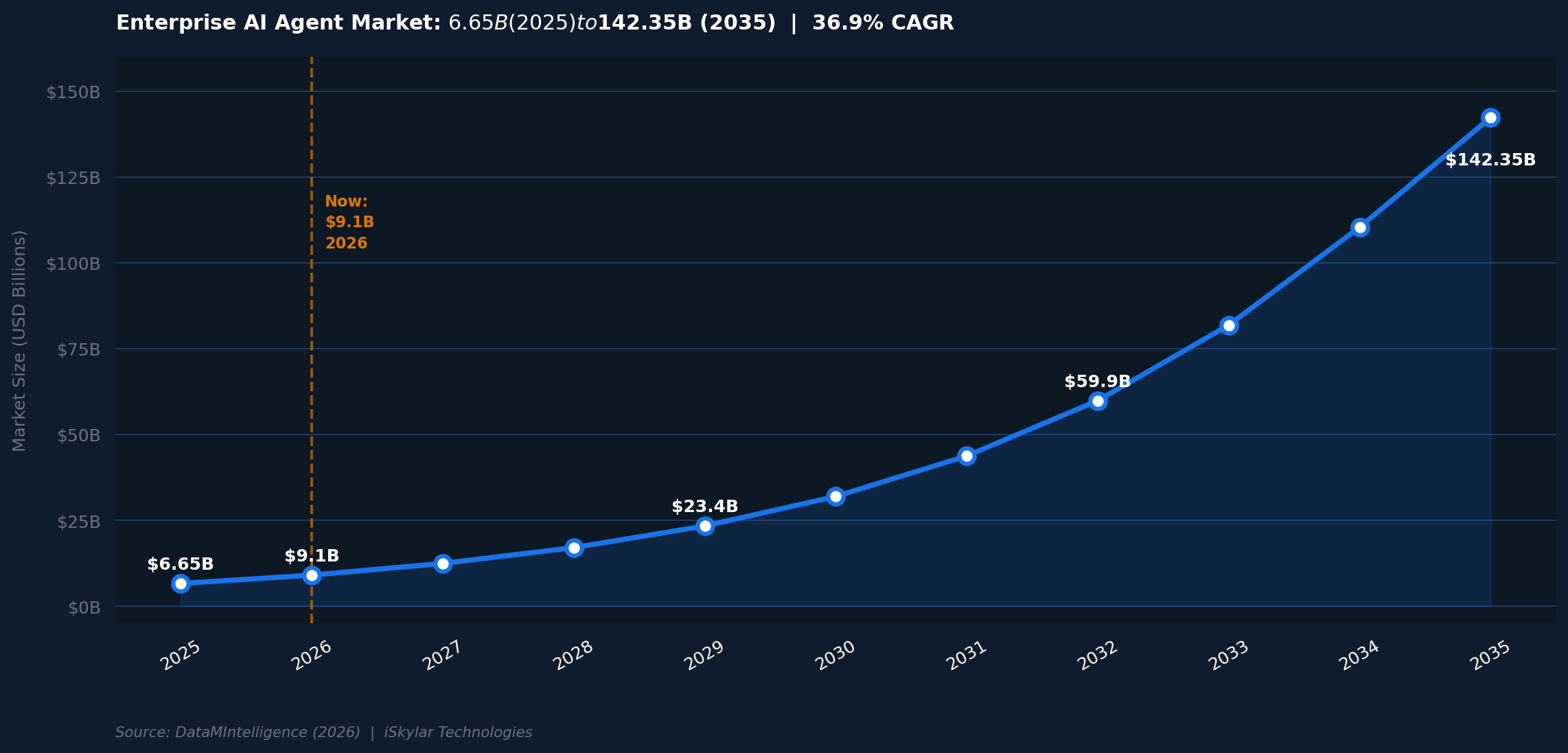
By end of 2026, 40% of enterprise applications will embed task-specific AI agents, up from less than 5% in 2025 (Gartner). 80% of enterprise apps shipped in Q1 2026 already include at least one AI agent, up from 33% in 2024. The enterprise AI agent market reached $6.65 billion in 2025 and is projected to reach $142.35 billion by 2035 at a 36.9% compound annual growth rate (DataMIntelligence). 97% of executives report deploying AI agents in the past year, and 52% of employees are already using them in daily workflows (WRITER). The question is no longer whether to deploy agents, but which workflows justify the operating overhead.
The framing that agents replace enterprise software is wrong. What is happening is this: agents are embedding into existing applications as automation layers within workflows. A CRM does not become an AI agent; it ships with an agent that handles follow-up sequencing. An ERP does not get replaced; it gains an agent that closes routine purchase orders without human input. Your software estate in 2027 will include agents whether you plan for them or not. The decision is whether you govern that adoption proactively or discover it retrospectively.
2. Which Enterprise Functions Are Deploying AI Agents First?
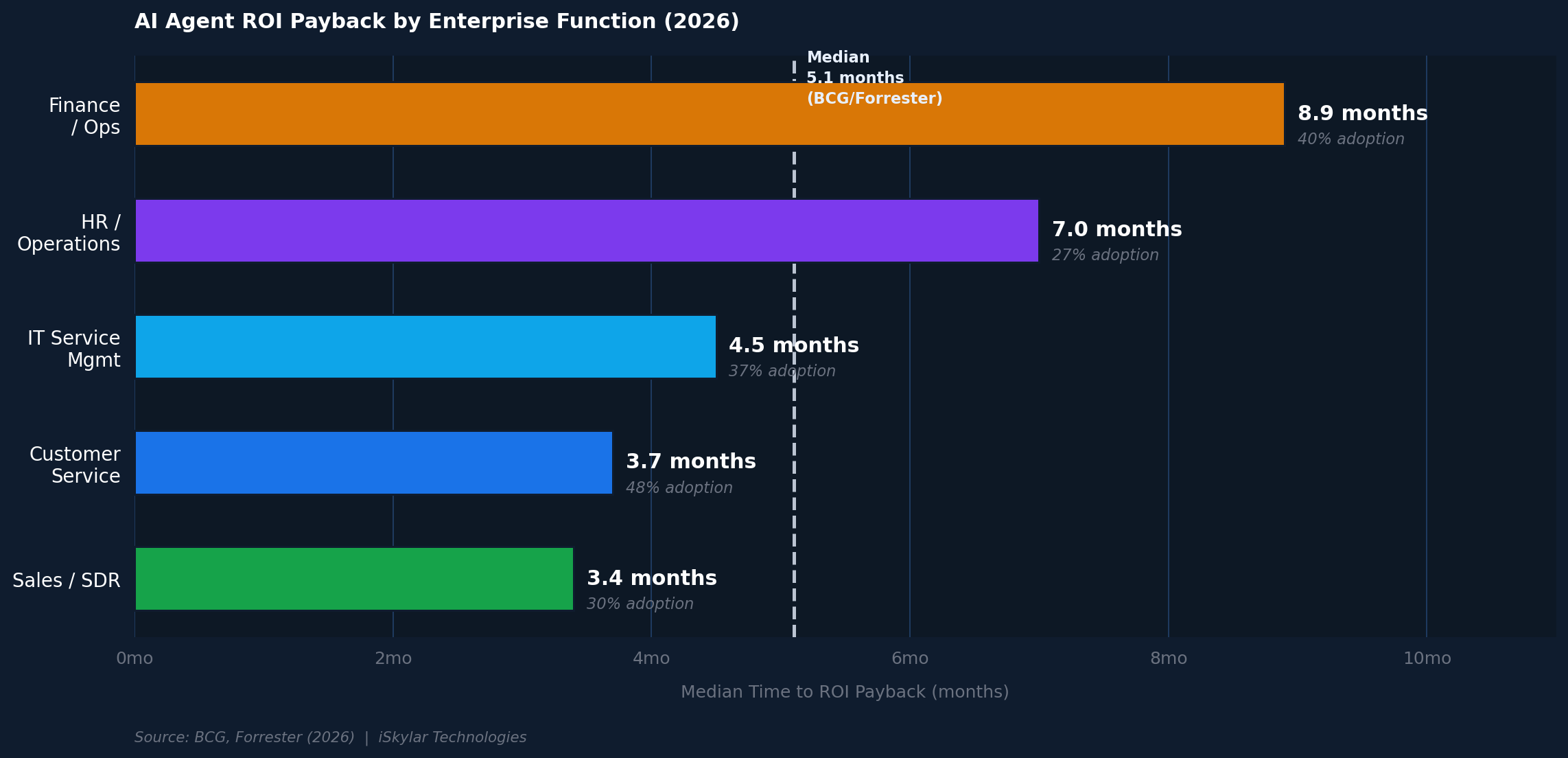
Adoption is not uniform across enterprise functions. Telecoms and retail lead on volume: telecom sector adoption sits at 48%, retail and consumer goods at 47% (Turion). Finance and operations show the highest ROI clarity. JPMorgan has more than 450 AI agent use cases in production across trading, compliance and client services. The median time-to-value across enterprise agent deployments is 5.1 months (BCG/Forrester 2026), though this varies significantly by function.
FunctionAdoption RateTime to ValueROI ProfilePrimary BarrierCustomer Service47–48%3–4 monthsHigh: volume reduction is immediate and measurableGovernance, handoff designFinance / Ops 40%8–9 monthsHighest per-action savings once liveData preparation, audit trailsIT Service Mgmt35–40%4–5 monthsClear: ticket volume reductionIntegration complexitySales / SDR30%3.4 monthsMedium: pipeline impactTuning, human oversightHR / Operations25–30%6–8 monthsMediumCompliance, sensitivity
Gartner projects that autonomous agents will resolve 80% of common customer service issues by 2029. Customer service is the entry function for most enterprise agent programmes because the volume of repetitive interactions makes ROI immediately visible and measurable.
3. What Does Real ROI from Enterprise AI Agents Look Like?
The numbers from production deployments in 2025 and 2026 are specific enough to model against your own operations. AtlantiCare deployed a clinical documentation agent that reduced clinician documentation time by 42%, saving 66 minutes per clinician per day, with an 80% staff adoption rate. One Fortune 500 company reduced its internal reporting process from 15 days to 35 minutes per report, with cost per report falling from $2,200 to $9. Enterprises with AI agents in production report a 95% reduction in data query time on workflows where agents have replaced manual data retrieval.
ROI payback by function from BCG and Forrester 2026 analysis: SDR and sales agents reach payback in 3.4 months. Customer service agents typically follow within 3 to 4 months on high-volume deployments. Finance and operations agents take a median 8.9 months to configure, validate and reach payback, after which the cost-per-action savings compound quarterly with no additional input required.
4. Why Are 88% of Enterprise AI Agent Pilots Never Reaching Production?
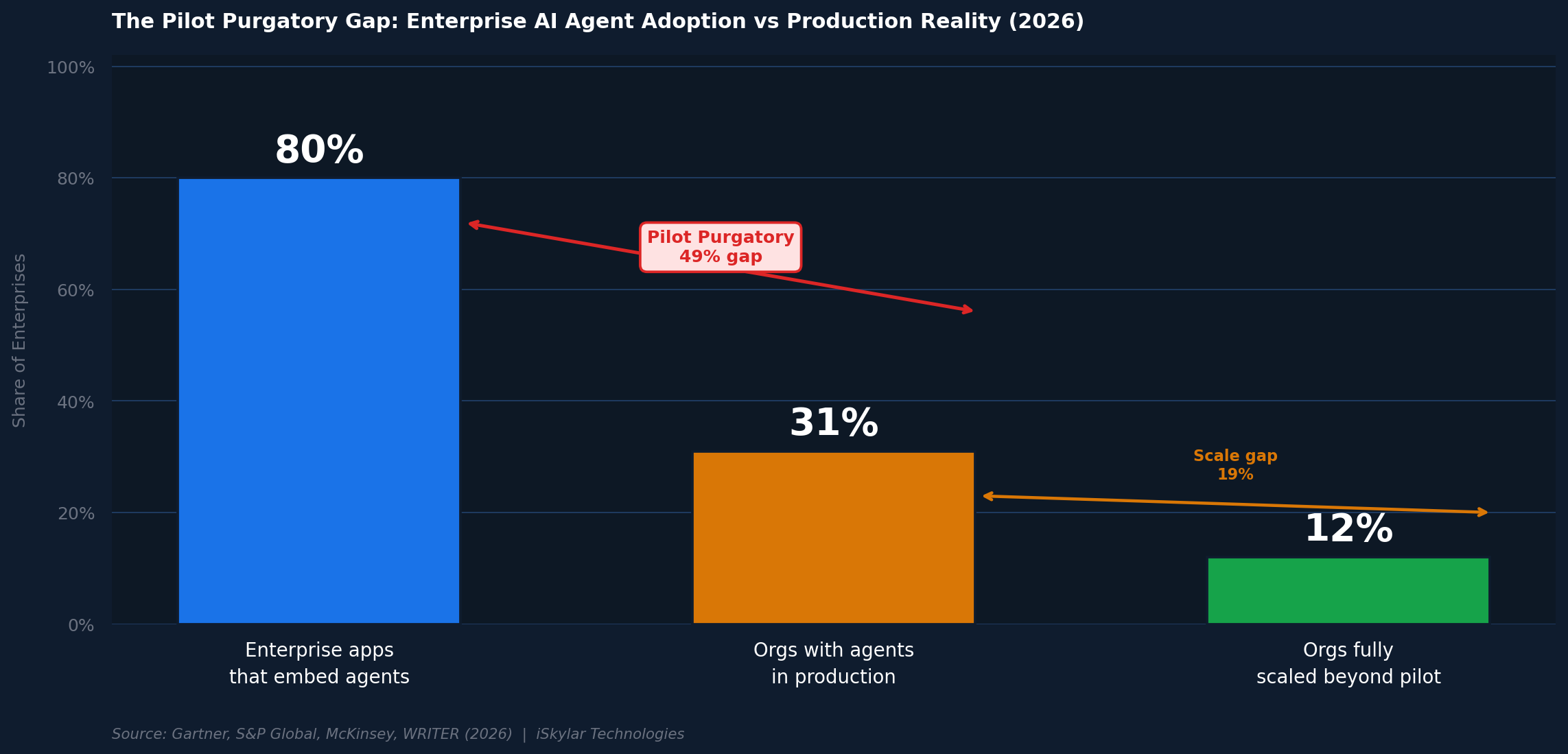
This is the defining problem of enterprise AI adoption in 2026. 80% of enterprise apps embed agents. Only 31% have agents in production. Nearly two thirds of organisations remain stuck in the pilot stage as of mid-2026 (Gartner). 88% of AI agent pilots never ship to production. 79% of executives cite challenges deploying AI agents at scale despite high levels of investment (WRITER). The failure is not technical. The barriers are governance, change management and workflow redesign.
The failure pattern is consistent. A pilot succeeds in a controlled environment. When the time comes to deploy at production scale, three problems surface simultaneously: the organisation has not defined a governance framework for agent decisions and escalations; the workflow the agent operates in has not been redesigned for automated handoffs; and the employees whose roles change have not been prepared for the change. Any one of these stalls deployment. All three appearing together, which they typically do, produces the pilot purgatory dynamic that the 88% figure reflects.
The organisations that move through this gap treat agent deployment as an infrastructure project with change management built in from the outset, not as a technology proof of concept with a production plan to be added later. That sequencing distinction is the difference between the 31% that have agents in production and the 69% that do not.
5. Will AI Agents Replace Enterprise Software?
No. The accurate model is agents as embedded automation layers, not replacements. Your CRM, ERP, ITSM and finance platforms remain the systems of record. An agent within a customer service platform handles tier-one queries autonomously and escalates tier-two to a human. An agent within an ERP closes routine purchase orders below a threshold without triggering approval workflows. The underlying system does not change. The human time required to operate it does.
The build-or-buy question follows from this. For generic functions such as customer service routing or IT ticket triage, pre-built agent solutions reach production faster and with lower governance risk. For workflows proprietary to your business, a specific approval chain, a compliance validation process, or a proprietary reporting methodology, custom-built agents integrated to your architecture and data produce better long-term outcomes than adapting a generic solution to your context.
6. What Should Your Enterprise Do Before End 2026?
Start with one workflow, not a platform. The enterprises producing the clearest ROI in 2026 identified one high-volume, rules-based workflow where defined logic could replace a human, built an agent for that workflow, validated it in production, and extended from there. Agent programmes that begin with platform-level ambitions take 18 to 24 months to reach the same point as a targeted single-workflow deployment.
Define governance before you deploy. The 88% pilot failure rate is overwhelmingly a governance failure, not a technical one. Define what decisions agents can make autonomously, what triggers escalation to a human, how agent actions are logged for audit purposes and who owns the agent as a product. Without those definitions, production deployment stalls every time.
Build for compliance from the design phase. Regulated industries operating under GDPR, HIPAA or PCI-DSS face constraints on automated decision-making. An agent built with compliance controls from day one is deployable. An agent retrofitted for compliance after a pilot typically is not.
iSkylar builds enterprise AI agents from requirement analysis through to production deployment, with governance frameworks, compliance integration and change management built into the engagement from the outset. The organisations iSkylar works with move from pilot to production consistent with the 5.1-month BCG and Forrester median, because deployment blockers are resolved in the design phase rather than discovered after the pilot succeeds.
WRITTEN BY
Harsh Singh Rajawat
Senior Technical Content Writer Having experience of 11 years
Further Reading


Solutions & Industry Insights that might interest you
Explore MoreStay at the forefront of innovation.
innovation.
Join our inner circle of industry leaders and get exclusive insights delivered to your inbox every Thursday morning.
WE RESPECT YOUR PRIVACY. NO SPAM, EVER.