AI CRM vs Traditional CRM vs Agentic CRM: Which One Does Your Business Need in 2027?
A traditional CRM records, an AI CRM predicts, and an agentic CRM acts. Learn the difference, see which one fits your business, what an agentic CRM costs, and how to add AI agents to the CRM you already use.

Chitranshu
PRINCIPAL ARCHITECT9 MIN READ

In AI CRM vs traditional CRM vs agentic CRM, a traditional CRM stores data, an AI CRM predicts and suggests, and an agentic CRM uses AI agents that act. iSkylar adds AI agents to existing CRMs or builds AI-native CRMs for growing and enterprise teams worldwide. A custom workflow agent typically costs $25,000 to $100,000.
Every CRM vendor now calls itself "AI-powered." Salesforce talks about agents, HubSpot about Breeze, Microsoft about Copilot. For a buyer, the labels blur together, and the question that matters gets lost: what will this CRM actually do for us without someone clicking a button?
That question now has real money behind it. Salesforce's own 2026 Agentic Enterprise Index found activated agents per organization rose nearly 3x in a year, and its customer service agents resolved about 7 in 10 chats without human help. Gartner predicts that by 2029 agentic AI will autonomously resolve 80% of common customer service issues, cutting operational costs by 30%.
This guide explains the difference between a traditional CRM, an AI CRM and an agentic CRM in plain language, so you can decide which one your business needs in 2027. For deeper comparisons, see our guides to AI CRM vs traditional CRM and rule-based automation vs AI agents.
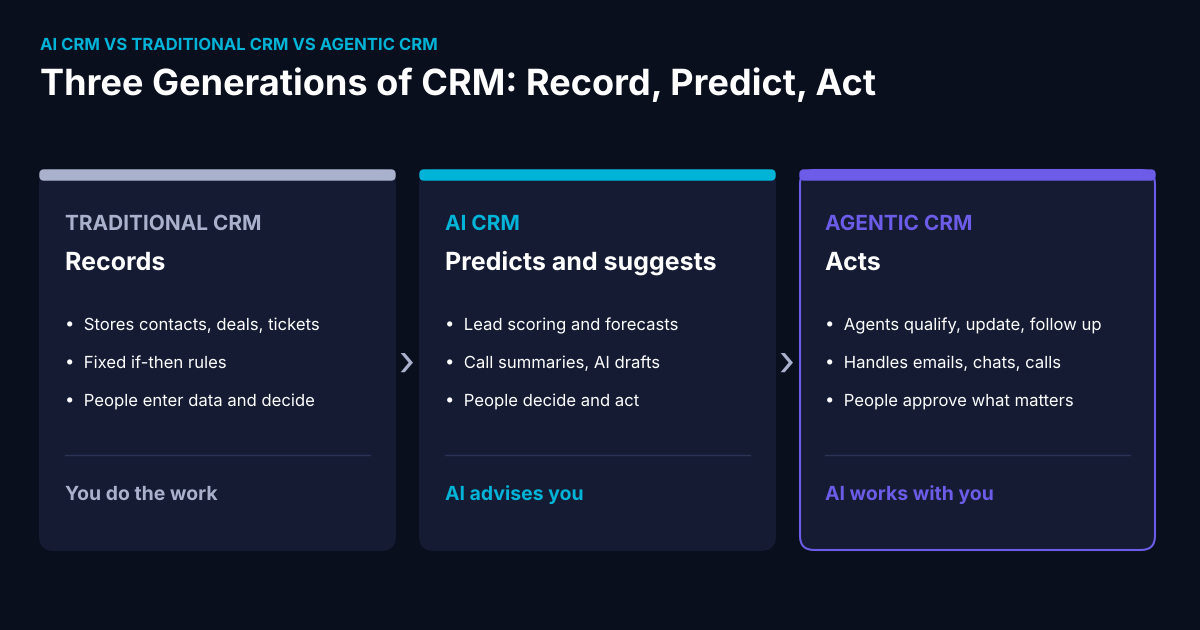
The three generations of CRM: record, predict, act.
What Is an Agentic CRM?
An agentic CRM is a CRM where AI agents carry out work, not just suggest it. The agents read customer data, decide the next step within rules you set, and act: qualifying a lead, updating a record, drafting and sending a follow-up, or resolving a support case, with a person approving anything important.
In simple words, "agentic" means able to act on its own toward a goal. A traditional CRM waits for you. An AI CRM advises you. An agentic CRM works alongside you. If AI agents are new to you, our guide to agentic AI for business explains how they work.
AI CRM vs Traditional CRM vs Agentic CRM: What's the Difference?
The difference is how much work the CRM does on its own. Traditional CRMs record, AI CRMs predict and recommend, and agentic CRMs take action. That's the core of agentic CRM vs AI CRM: one advises, the other does.
Traditional CRM | AI CRM | Agentic CRM | |
Core job | Store contacts, deals and activity | Score, forecast and suggest next steps | Complete multi-step work across systems |
Automation | Fixed rules and workflows | Rules plus AI suggestions | Goal-driven agents with guardrails |
Who acts | People | People, guided by AI | Agents, approved by people |
Handles messy inputs | No | Partly | Yes: emails, calls, documents |
Data quality needed | Basic | Good | High, plus clear permissions |
Best for | Small teams with simple pipelines | Teams that want better prioritization | High-volume sales, service and operations |
What Is an AI-Native CRM?
If you're asking what is AI native CRM, the short answer: an AI-native CRM is built from the ground up for AI to read, decide and act inside it, rather than having AI added to an older system. Its data is structured for AI, its actions are exposed through APIs agents can call, and every agent action is logged and permissioned.
An example of AI native in CRM: a system where an agent can see an inbound email, match it to the right account, check open deals, draft a reply in your tone and book a meeting, all through the same APIs your app uses. Many established CRMs are moving this way by adding agent layers, while newer AI-native CRM platforms start there. The same design principles apply beyond CRM, as covered in our guide to integrating AI with legacy systems.
Will CRM Be Replaced by AI?
No. AI is changing what a CRM does, not removing the need for one. Agents still need a reliable record of customers, deals and history to work from. What's disappearing is manual data entry and copy-paste work, not the CRM itself.
The bigger shift is on the buyer side. Forrester predicts that in 2027, AI agents will influence 75% of B2B purchase decisions. Your customers' agents will be researching and comparing vendors, and your CRM needs agents of its own to keep up.
Which Type of CRM Does Your Business Need?
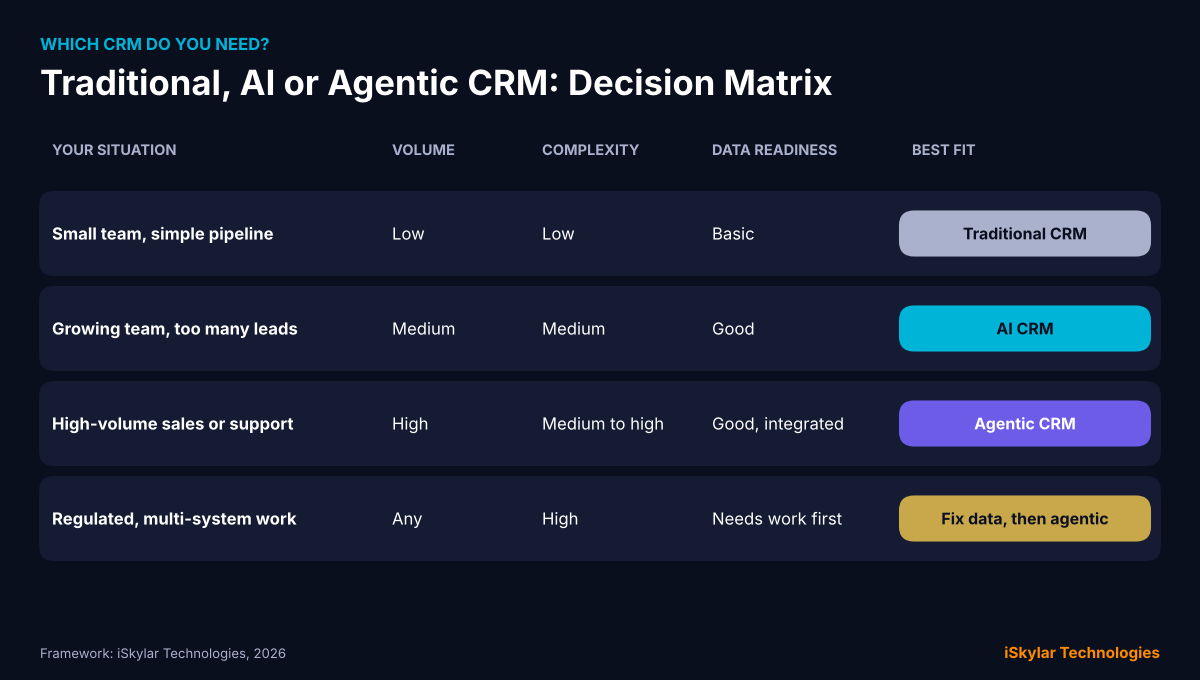
Match the CRM to your volume, complexity and data readiness, not to the vendor's marketing. Use this matrix as a starting point.
Which CRM fits your business: traditional, AI or agentic.
Your situation | Lead or ticket volume | Process complexity | Data readiness | Best fit |
Small team, simple pipeline | Low | Low | Basic | Traditional CRM |
Growing team, too many leads to prioritize | Medium | Medium | Good | AI CRM |
High-volume sales or support | High | Medium to high | Good, with clean integrations | Agentic CRM |
Regulated or complex multi-system workflows | Any | High | Needs work first | Agentic CRM, after a data and integration fix |
Not sure whether your existing automations should stay as rules or move to agents? Our guide to rule-based automation vs AI agents in CRM walks through it workflow by workflow.
Should You Add AI Agents to Your CRM or Build a New One?
Most businesses should add agents to the CRM they already use. Rebuilding only makes sense when the current CRM can't expose its data and actions to agents, or when licensing costs grow faster than value.
Add agents to your existing CRM: fastest route, keeps your team's habits, works with Salesforce, HubSpot, Zoho, Dynamics and others through their APIs
Use the vendor's built-in agents: quickest to switch on, but usage-based pricing can climb and you're limited to that vendor's ecosystem
Build a custom AI-native CRM: right for unusual workflows, strict data requirements or when the CRM is part of your own product
Our ChatGPT integration services and agentic AI services cover the first path; our custom software development team covers the third.
How Much Does an Agentic CRM Cost?
A single custom AI workflow agent typically costs $25,000 to $100,000 to build, and multi-agent systems cost well above that. Vendor-built agents are usually priced per conversation, per action or by credits on top of seat licences, so costs rise with usage.
Starter | Growth | Enterprise | |
What you get | One agent, such as lead qualification or support triage, on your existing CRM | Connected agents across sales and service with CRM, email and calendar integrations | Multi-agent system across departments, or a custom AI-native CRM |
Typical build cost | From $25,000 | Up to $100,000 | Well above $100,000 |
Recommended path | 30 to 60 day pilot with human approval | Pilot one team, then expand | Phased rollout, one process at a time |
Build costs are industry ranges for custom AI workflow agents, not fixed quotes. Running costs depend heavily on which models you use; see our LLM vs SLM decision framework. For a first estimate, try the iSkylar cost calculator.
What Rules Apply to AI Agents in a CRM?
CRM agents handle personal data and speak to customers, so the rules are stricter than for internal tools.
EU and UK: GDPR and UK GDPR govern customer data and automated decisions about people. The EU AI Act's transparency duties have applied since 2 August 2026, so customers must be told when they're talking to an AI. See our EU AI Act 2027 engineering checklist.
United States: state privacy laws such as California's CCPA/CPRA cover customer data, and outbound agents must follow CAN-SPAM for email and TCPA rules for calls and texts.
UAE and Saudi Arabia: the Personal Data Protection Laws (PDPL) govern how customer data is collected, stored and transferred.
Canada and Australia: PIPEDA and the Australian Privacy Act set similar rules for customer data.
This is general guidance, not legal advice.
Proof: What an AI Sales Agent Did for Vengo AI
iSkylar built Vengo AI's 24/7 AI sales agent platform, which engages website visitors, qualifies leads through natural conversation and books meetings, with CRM integrations that pass every qualified lead through with full conversation context. The results: 3x more qualified leads, an average visitor response time under 60 seconds and a 30% lift in lead-to-meeting conversion.
For voice, our Tallk AI voice-first digital sales rep drove 300% more conversions.
Choose the CRM That Does the Work You Need Done
You don't need the most advanced CRM. You need the one that removes the work slowing your team down. For most growing businesses, that means adding one agent to the CRM you already have, proving it, then expanding.
Talk to iSkylar about adding AI agents to your CRM. We'll review your current setup, pick the workflow with the fastest payback and scope a pilot.
Plan your agentic CRM with iSkylar →

WRITTEN BY
Chitranshu
Chitranshu is the Founder and Head of Marketing & Growth at iSkylar Technologies, an AI-first software development company. He writes about AI adoption, AI agents and how businesses modernize their CRM and sales operations.
Frequently Asked Questions
What is an agentic CRM?
What is the difference between AI CRM and agentic CRM?
What is an AI-native CRM?
Will CRM be replaced by AI?
Can ChatGPT make a CRM?
Should I add AI agents to my existing CRM or build a new one?
How much does an agentic CRM cost?
Is an agentic CRM safe for customer data?
Further Reading

Stay at the forefront of innovation.
innovation.
Join our inner circle of industry leaders and get exclusive insights delivered to your inbox every Thursday morning.
WE RESPECT YOUR PRIVACY. NO SPAM, EVER.