Fine-Tuning vs RAG vs Prompt Engineering in 2027: Which to Choose and What It Costs
Should you write better prompts, connect your data with RAG, or fine-tune a model? This 2027 guide compares all three on accuracy, cost, data privacy and speed, explains how OpenAI's fine-tuning shutdown changes the choice, and gives a simple framework to decide.

Chitranshu
PRINCIPAL ARCHITECT12 MIN READ
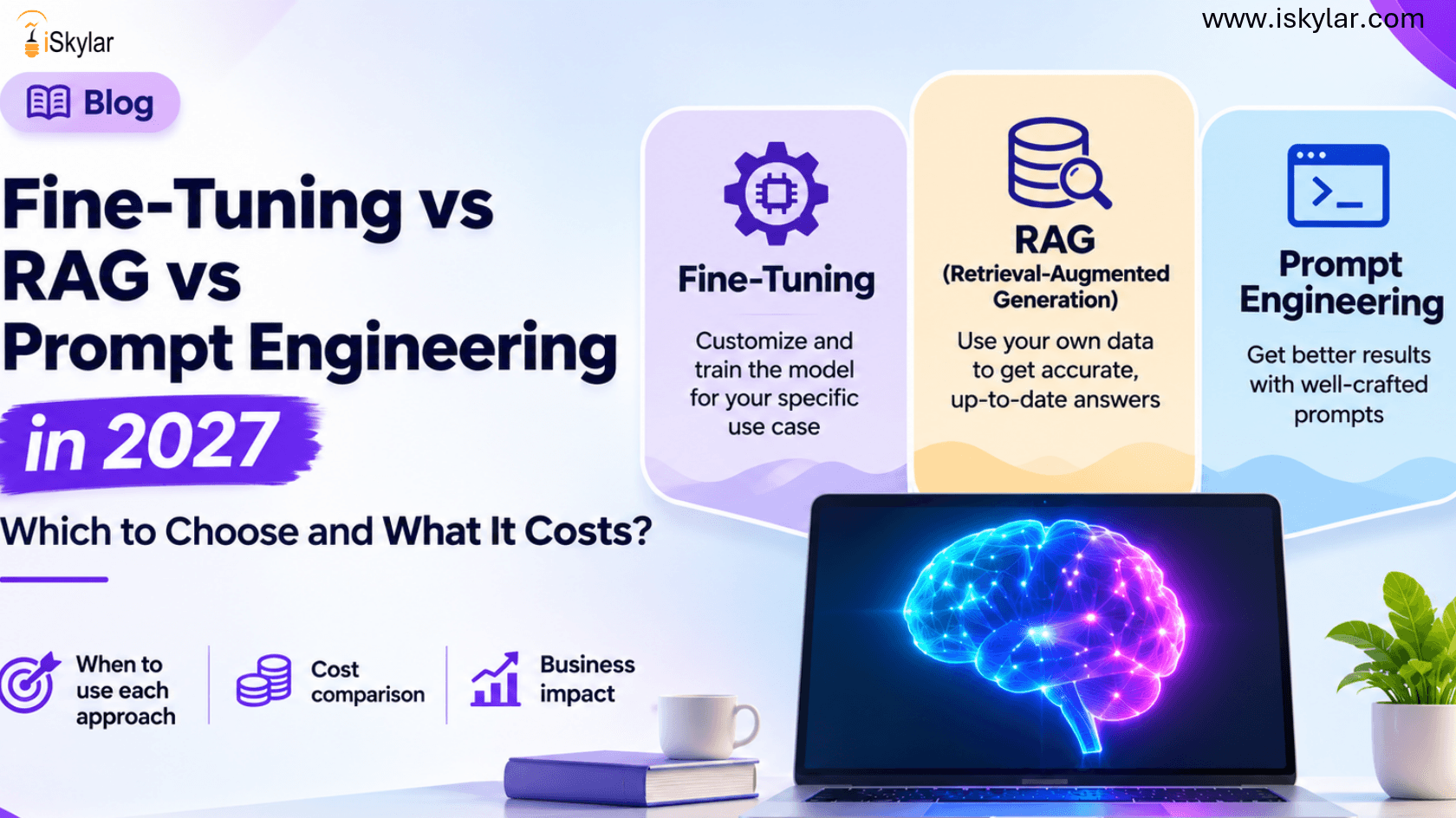
Quick answer: In 2027, start with prompt (context) engineering, add RAG when the model needs your private or changing data, and fine-tune only when you need a fixed format, tone or narrow skill at lower cost per call. Prompt engineering projects run about $2.9K to $9.6K, RAG builds $7.7K to $58K, and fine-tuning projects $9.6K to $58K, with enterprise work above that. Most production systems combine RAG with good prompting; fine-tuning is the specialist tool, not the default.
Last updated: November 23, 2026
Every AI project hits the same fork in the road. The model is smart, but it does not know your products, your policies or your tone. Do you write better instructions, connect it to your documents, or train it on your data? Pick wrong and you can spend three months and $50K on a fine-tune that a two-week RAG build would have beaten.
This guide explains fine-tuning vs RAG vs prompt engineering for 2027 in plain terms: what each one does, what it costs, what changed in 2026, and how teams in the USA, UK, UAE, Saudi Arabia, Canada and Australia should choose. If you already know you need retrieval, our RAG knowledge assistant architecture and cost guide goes deeper on that build.
What is the difference between prompt engineering, RAG and fine-tuning?
All three change what a large language model (LLM) produces. They work at different layers:
- Prompt engineering (now often called context engineering) changes the instructions, examples and context you send with each request. The model itself does not change.
- Retrieval-augmented generation (RAG) searches your documents or databases at question time and passes the most relevant passages to the model, so answers are grounded in your current data and can cite sources.
- Fine-tuning trains the model further on your examples, so new behaviour is stored in the model weights. It changes how the model responds, not what it can look up.
| Factor | Prompt engineering | RAG | Fine-tuning |
|---|---|---|---|
| Best for | Task framing, format, quick wins | Private, large or frequently changing knowledge | Consistent style, strict output format, narrow skills, smaller cheaper models |
| Data needed | A few good examples | Your documents, databases or APIs | Hundreds to thousands of high-quality labelled examples |
| Time to first result | Days | 3 to 10 weeks | 4 to 12 weeks including data preparation |
| Keeps data fresh | Only what you paste in | Yes, update the index | No, retrain to update |
| Source citations | No | Yes | No |
| Hallucination control | Moderate | Strong when retrieval is good | Weak for facts, strong for format |
| Deleting personal data | Easy | Easy (remove from index) | Hard (baked into weights) |
| Typical build cost (2027) | $2.9K to $9.6K | $7.7K to $58K | $9.6K to $58K |
What changed in 2026 that affects your 2027 decision?
Four shifts make older comparison articles out of date:
- OpenAI is closing self-serve fine-tuning. According to OpenAI's deprecations page, organisations that had never fine-tuned lost access on May 7, 2026, inactive organisations lost it on July 2, 2026, and from January 6, 2027 existing customers can no longer create new fine-tuning jobs. Existing fine-tuned models keep serving until their base model is retired. In 2027, "fine-tuning" mostly means LoRA training on open-weight models (Llama, Qwen, Mistral, Falcon, Jais) through providers such as Together AI and Fireworks, or on your own GPUs.
- Prompt engineering became context engineering. Anthropic described context engineering in September 2025 as "the natural progression of prompt engineering": deciding which instructions, tools, memory and retrieved data enter the context window on each step. Automated prompt optimisation also matured. The GEPA method (ICLR 2026) beat reinforcement-learning fine-tuning (GRPO) by 6% on average, and by up to 20%, using up to 35 times fewer rollouts.
- Long context did not kill RAG. Models now accept hundreds of thousands of tokens, and an a16z CIO survey found some enterprises "dump it into a long context and get almost equivalent results." But Chroma's 2025 "Context Rot" study across 18 models showed reliability falls as inputs grow, and long prompts cost more on every call. Retrieval is still the cheaper way to work with large libraries.
- MCP joined the toolkit. The Model Context Protocol lets models pull live data from your systems through tools. It complements RAG for structured, real-time data. See our MCP for business guide.
Market data backs the "prompt first, RAG second" order. Menlo Ventures' 2025 State of Generative AI in the Enterprise report (enterprise spend reached $37B in 2025) found prompt design is the dominant technique, RAG is second, and fine-tuning remains niche.
When should you use prompt engineering first?
Almost always. Strong prompting is the baseline every other method builds on, and many projects never need more. Use it alone when:
- The task relies on general knowledge the model already has (drafting, summarising, classifying, translating).
- The context you need fits comfortably in a few pages.
- You are still validating whether the use case is worth funding.
Good 2027 practice means a system prompt with clear role, rules and output schema, 3 to 10 worked examples, structured outputs (JSON schemas), prompt caching to cut cost, and an evaluation set of 50 to 200 real questions so you can measure each change rather than guess.
When is RAG the right choice?
Choose RAG when answers depend on information the model was never trained on or that changes often:
- Customer support over product manuals, policies and help-centre articles
- Internal knowledge assistants for HR, legal, sales or engineering
- Regulated answers that need citations (finance, healthcare, insurance)
- Anything with per-user permissions, where people may only see their own documents
AWS's prescriptive guidance recommends starting with RAG for question answering over documents, noting that fine-tuned models "do not provide a reference to the source" and carry higher hallucination risk for facts. RAG's weak spot: tasks that need the whole document at once, such as summarising a 200-page contract, where long context or a map-reduce pipeline works better.
When should you consider fine-tuning?
Fine-tune when the problem is behaviour, not knowledge:
- Strict output format at scale: extracting fields from invoices, claims or shipping documents into a fixed schema, millions of times.
- Brand voice or domain style that prompting cannot hold consistently.
- Cost and latency: a fine-tuned 7B or 8B model can replace a large frontier model on a narrow task at a fraction of the per-call price, and can run on your own servers.
- Data residency: a small open model fine-tuned and hosted in-country (for example in Saudi Arabia or the UAE) can meet hosting rules that a foreign API cannot.
- Dialects and jargon: Gulf Arabic dialects, medical shorthand or legal phrasing the base model handles poorly.
Skip fine-tuning if you have fewer than a few hundred clean examples, if the facts change monthly, or if you cannot maintain an evaluation pipeline to catch regressions after each retrain.
Is RAG better than fine-tuning? What the research says
For adding knowledge, yes. Ovadia et al. ("Fine-Tuning or Retrieval?", EMNLP 2024) tested both methods for knowledge injection and found RAG consistently outperformed unsupervised fine-tuning, for facts the model had seen before and for entirely new facts. Fine-tuning shines elsewhere: shaping format, tone and task skill. The practical rule is simple: RAG for what the model knows, fine-tuning for how it behaves, prompting for both.
Can you combine RAG and fine-tuning?
Yes, and many strong 2027 systems do. Common hybrid patterns:
- RAFT (retrieval-augmented fine-tuning): fine-tune the model on examples that include retrieved documents, so it learns to use relevant passages and ignore distractors (arXiv 2403.10131).
- Small fine-tuned model plus RAG: a fine-tuned 8B model handles routine questions with retrieval; a frontier model handles the hard 10 to 20%.
- Model routing: Li et al. (EMNLP 2024) showed a "Self-Route" approach that sends easy queries to RAG and hard ones to long context, keeping quality close to long context at much lower cost.
Databricks reported that 78% of companies now use two or more model families, which makes routing and hybrid designs the norm rather than the exception.
How much does each approach cost in 2027?
Prices below are market benchmarks from published agency guides (RaftLabs, SoluLab, Groovy Web, SFAI Labs, Ertas), set slightly below them to reflect lean delivery. They cover design, build, evaluation and launch, not ongoing model usage.
| Project type | Typical cost (USD) | Timeline |
|---|---|---|
| Prompt / context engineering sprint with evaluation set | $2.9K to $9.6K | 1 to 3 weeks |
| RAG assistant, single source | $7.7K to $24K | 3 to 6 weeks |
| RAG, multi-source with permissions | $24K to $58K | 6 to 10 weeks |
| Fine-tuning pilot (LoRA, open model, clean data) | $9.6K to $24K | 2 to 5 weeks |
| Production fine-tune (data pipeline, evals, hosting) | $24K to $58K | 6 to 10 weeks |
| Hybrid: fine-tuned small model plus RAG and routing | $38K to $96K | 8 to 14 weeks |
| Enterprise programme (multi-domain, continuous retraining) | $96K to $192K+ | 3 to 6 months |
The surprise for most buyers: GPU compute is now the cheap part of fine-tuning. Published 2026 prices put a LoRA run on an 8B model over about 30M training tokens at roughly $10 to $15 on Together AI or Fireworks, and a 70B LoRA run near $61. On-demand H100 GPUs cost about $2 to $4.30 per hour on specialist clouds. The real cost is people time: collecting, cleaning and labelling examples, and building the evaluation that proves the fine-tune beats a prompted base model.
| Running cost item | Prompting | RAG | Fine-tuned model |
|---|---|---|---|
| Model usage | API tokens only | API tokens (shorter prompts than long context) | Per-token serverless LoRA, or your own GPU |
| Extra infrastructure | None | Vector database, ingestion, monitoring: about $300 to $2.4K per month | Dedicated GPU 24/7: about $1.5K to $3K per month per H100 |
| Maintenance | Prompt and eval updates | Index refresh, retrieval tuning | Periodic retraining, regression testing |
Budget 15 to 20% of the build cost per year for maintenance across all three. For a full budget of API calls and integration work, see our ChatGPT integration cost guide.
A 7-question decision framework
- Does the answer depend on your private or changing data? Yes: RAG (or MCP for live system data).
- Do users need citations or audit trails? Yes: RAG.
- Is the problem format, tone or a narrow repeated task? Try prompting with examples first; if accuracy stalls below target, fine-tune.
- Do you have 500+ clean, representative examples? No: do not fine-tune yet.
- Will call volume be high enough that per-call cost matters? Yes: consider a fine-tuned small model.
- Must data or the model stay in-country? Yes: open-weight model, hosted locally, with RAG and optional fine-tuning.
- Can you run evaluations after every change? No: fix that before choosing any method.
Country rules that change the choice
Where personal data ends up matters. RAG keeps personal data in an index you can edit or delete. Fine-tuning stores patterns from training data inside model weights, which makes deletion requests and consent withdrawal harder to honour. That alone pushes many regulated teams towards RAG.
| Market | Key 2026 to 2027 rule | Impact on your approach |
|---|---|---|
| USA | Sector laws (HIPAA, GLBA) plus state rules such as Colorado's automated decision-making act effective January 1, 2027 | Prefer RAG for regulated facts; document model behaviour if AI influences consequential decisions |
| UK | Data (Use and Access) Act data protection changes in force since February 5, 2026 | Clearer lawful bases, but keep training data minimised and records of processing |
| EU (if you serve EU users) | AI Act general-purpose AI obligations since August 2, 2025; enforcement from August 2, 2026 | Fine-tuners only become a model "provider" if they use more than one third of the original training compute, so typical LoRA work stays out of scope |
| UAE | PDPL executive regulations still pending; new Federal Authority for AI and Data announced June 14, 2026 | Design for consent and deletion now; host sensitive data in-country for government and health work |
| Saudi Arabia | PDPL fully enforceable; SDAIA draft amendments (consultation October to November 2026) add an express data localisation requirement | Plan for in-Kingdom hosting; a locally hosted open model with RAG is the safest route |
| Canada | PIPEDA, Quebec Law 25 (automated decision transparency) | Explainability favours RAG with citations |
| Australia | Privacy Act automated decision-making disclosure from December 10, 2026 | Disclose AI-driven decisions; keep audit logs |
This is general information, not legal advice. Check current rules with counsel before launch.
Arabic and bilingual AI: fine-tune or RAG?
Gulf teams now have strong Arabic base models. TII released Falcon-H1-Arabic in January 2026 in 3B, 7B and 34B sizes with up to 256K context. Inception, MBZUAI and Cerebras released the open-weight 70B Jais 2 in December 2025, and HUMAIN's ALLaM is available on Microsoft Foundry. For most bilingual assistants, the winning stack is an Arabic-capable base model with bilingual RAG (Arabic and English documents indexed together) and careful prompting for dialect. Fine-tune when you need a specific Gulf dialect, a formal government register, or a small model hosted inside Saudi Arabia or the UAE. Our Arabic AI chatbot guide covers dialect testing in detail.
A 30-day plan to choose with evidence
- Week 1: Collect 100 to 200 real questions or tasks with correct answers. This evaluation set is your most valuable asset.
- Week 2: Build the best prompt-only baseline and score it.
- Week 3: Add a simple RAG pipeline over your top documents and score again.
- Week 4: If format or style errors remain, run a small LoRA fine-tune on an open model and compare cost, accuracy and latency side by side.
Teams that follow this order usually stop at step 3. That is good news: it is the cheapest path to production. If you need people to run it, see our guide to the cost to hire AI developers.
Frequently asked questions
What is the main difference between fine-tuning and RAG?
RAG retrieves information from your documents at question time and gives it to the model, so answers stay current and can cite sources. Fine-tuning retrains the model on examples, changing how it behaves (format, tone, skill) rather than what it can look up.
Is RAG better than fine-tuning?
For adding knowledge, usually yes. Research presented at EMNLP 2024 found RAG consistently outperformed fine-tuning for injecting new facts. Fine-tuning is better for consistent output format, brand voice and making a small model match a large one on a narrow task.
Should I try prompt engineering before RAG or fine-tuning?
Yes. A well-designed prompt with examples and an evaluation set is fast and cheap, and it sets the baseline you need to prove whether RAG or fine-tuning adds value.
Can you use RAG and fine-tuning together?
Yes. Common patterns include retrieval-augmented fine-tuning (RAFT), a fine-tuned small model that answers with retrieved context, and routing that sends easy queries to a cheap model and hard ones to a frontier model.
How much does fine-tuning an LLM cost in 2027?
Compute is cheap: a LoRA run on an 8B model costs roughly $10 to $15 on specialist providers. A full project including data preparation, evaluation and hosting typically costs $9.6K to $24K for a pilot and $24K to $58K for production.
Can I still fine-tune GPT models with OpenAI in 2027?
Not for new jobs. OpenAI's deprecation schedule stops new fine-tuning jobs for existing customers from January 6, 2027, while existing fine-tuned models keep running until their base model is retired. Most teams now fine-tune open-weight models instead.
Does long context replace RAG?
Not fully. Long context works for single large documents, but reliability drops as inputs grow and every call costs more. RAG remains cheaper and more accurate for large or changing knowledge bases.
Which approach is best for data privacy in the UAE and Saudi Arabia?
RAG with a locally hosted model is usually safest, because personal data stays in an index you can update or delete and can be kept in-country. Fine-tuning on personal data makes deletion requests harder to honour.
Not sure which path fits your use case?
iSkylar builds prompt-engineered assistants, RAG systems and fine-tuned open models for teams in the USA, UK, UAE, Saudi Arabia, Canada and Australia. We start with a short evaluation sprint so you invest only in the method your data proves. Explore our LLM fine-tuning services or generative AI development to book a free consultation.

WRITTEN BY
Chitranshu
Chitranshu writes about AI, mobile and custom software at iSkylar, covering costs, architecture and delivery for businesses in the USA, UK, UAE, Saudi Arabia, Canada and Australia.
Further Reading


Stay at the forefront of innovation.
innovation.
Join our inner circle of industry leaders and get exclusive insights delivered to your inbox every Thursday morning.
WE RESPECT YOUR PRIVACY. NO SPAM, EVER.
Updated At: