AI Agent Development Cost in 2027: Real Pricing, Timelines and Monthly Running Costs
Building an AI agent in 2027 costs $3,000 to $250,000+, depending on how many systems it touches and how much autonomy it gets. This guide breaks down build cost, monthly running cost, timelines and compliance across the US, UK, UAE, Saudi Arabia, Canada and Australia.
Himanshu
PRINCIPAL ARCHITECT11 MIN READ
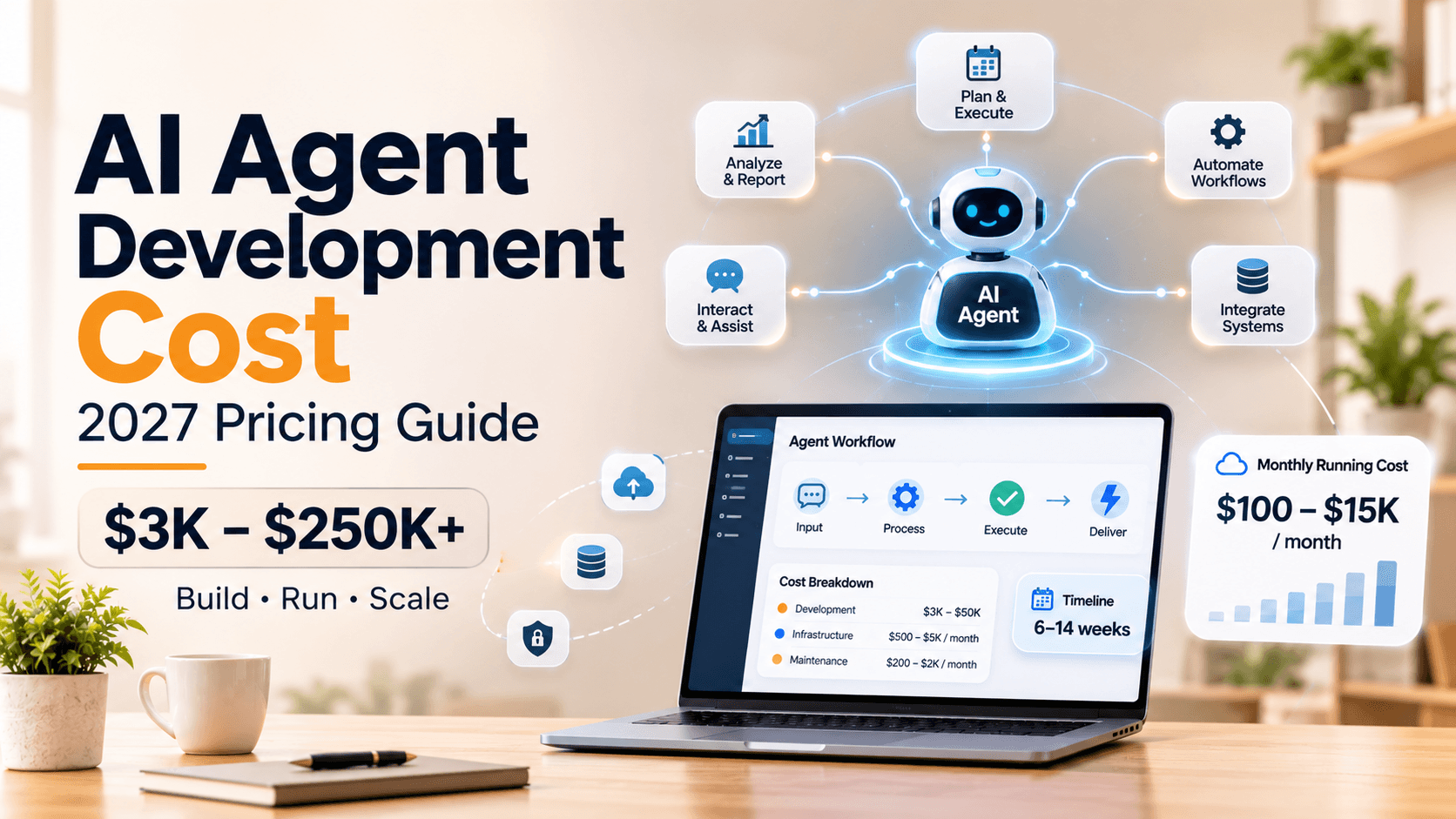
AI agent development cost in 2027 ranges from $3,000 to $12,000 for a single-task agent, $10,000 to $18,000 for a RAG knowledge agent, $15,000 to $50,000 for a workflow agent connected to your CRM or ERP, and $20,000 to $250,000+ for multi-agent enterprise systems. Plan another $100 to $15,000 per month to run it. Most production agents ship in 6 to 14 weeks.
Every budget conversation about AI agents starts with the same question: how much will this actually cost? The honest answer depends less on the model you pick and more on what the agent has to touch. An agent that answers questions from a PDF library is a very different build from one that reads an invoice, checks it against your ERP, updates the CRM and asks a manager for approval.
Below is the pricing we use when scoping agent projects at iSkylar, the hidden costs most quotes leave out, and how to plan a first-year budget that survives contact with production.
How much does it cost to build an AI agent in 2027?
A production AI agent costs between $3,000 and $250,000+ to build. The biggest price drivers are the number of systems it integrates with, how much autonomy it has, and the level of testing, guardrails and compliance it needs.
Agent type | What it does | Build cost | Timeline |
|---|---|---|---|
Single-task agent | Handles one job with one or two tools: lead qualification, FAQ answers, appointment booking, email triage | $3,000 to $12,000 | 3 to 6 weeks |
RAG knowledge agent | Answers from your documents, policies, product data or tickets with cited sources | $10,000 to $18,000 | 6 to 10 weeks |
Workflow agent | Plans and completes multi-step tasks across 3 to 6 systems (CRM, ERP, helpdesk, Slack) with approval rules | $15,000 to $50,000 | 8 to 14 weeks |
Multi-agent enterprise system | Several specialised agents coordinated by an orchestrator, with audit logs, role-based access and full observability | $20,000 to $250,000+ | 4 to 8 months |
For comparison, published 2026 ranges from US and European agencies run from about $10,000 for simple bots to $400,000+ for multi-agent orchestration. The gap usually comes down to team location and how much of the delivery is AI-assisted. iSkylar uses AI-enabled engineers, which is why our ranges sit at the lower end without cutting testing or security.
What are you actually paying for in an AI agent build?
Most of the budget goes into integrations, data preparation and testing, not the language model. The model is often the cheapest line item in the build phase.
Discovery and workflow mapping (8 to 12%): defining the exact task, decision rules, exceptions and the point where a human takes over.
Data preparation and retrieval (15 to 25%): cleaning documents, chunking, embeddings, vector search and access controls so the agent only sees what each user is allowed to see.
Agent logic and orchestration (20 to 30%): prompts, tool calling, memory, planning loops and frameworks such as LangGraph.
System integrations (20 to 30%): secure connections to HubSpot, Salesforce, NetSuite, SAP, Zendesk, Slack or your own APIs, increasingly through the Model Context Protocol (MCP).
Guardrails, evaluation and testing (10 to 20%): spending limits, blocked actions, hallucination checks, red-team tests and regression test sets.
Deployment and monitoring (5 to 10%): hosting, logging, cost dashboards and alerts.
If a quote does not mention evaluation, guardrails or monitoring, it is not a production quote. It is a demo.
How much does an AI agent cost per month to run?
Running an AI agent typically costs $200 to $15,000 per month, driven mainly by model usage (tokens), hosting and the time spent improving prompts and evaluations.
Agent type | Typical monthly running cost | Main cost lines |
|---|---|---|
Single-task agent | $100 to $800 | Model API, light hosting |
RAG knowledge agent | $500 to $2,500 | Model API, vector database, document sync |
Workflow agent | $1,500 to $6,000 | Model API, integrations, monitoring, prompt and eval upkeep |
Multi-agent enterprise system | $5,000 to $15,000+ | High token volume, observability, security reviews, ongoing tuning |
Token prices keep falling, but agents use far more tokens than chatbots because they plan, call tools, retry and check their own work. Three habits keep running costs under control:
Route by difficulty: send routine steps to small, cheap models and reserve frontier models for complex reasoning. We cover this in our LLM vs SLM decision framework.
Cache repeat answers: many support and internal questions repeat, so cached responses cost almost nothing.
Set per-task budgets: cap tokens and tool calls per task so a looping agent cannot run up a bill.
What makes AI agent development cost go up or down?
Six factors explain most of the difference between a $15,000 agent and a $150,000 one.
Number of integrations: each system the agent reads from or writes to adds build and test time, especially older ERPs without clean APIs.
Level of autonomy: an agent that only suggests actions is cheaper than one that executes payments, refunds or record changes on its own.
Data quality: scattered, duplicated or unstructured data can add weeks of preparation.
Accuracy requirements: a marketing assistant can tolerate small errors; a claims or compliance agent cannot, so it needs larger evaluation sets.
Languages and channels: adding Arabic, voice, WhatsApp or multi-region deployment increases scope.
Compliance and hosting: private cloud, in-country data residency or audit trails add infrastructure and review work.
Does AI agent development cost change by country?
The core build costs about the same everywhere, but compliance, data residency and language needs change the final number by roughly 10 to 30 percent depending on your market and industry.
United States: healthcare agents must meet HIPAA, consumer-facing agents need CCPA/CPRA privacy controls, and enterprise buyers usually ask for SOC 2 aligned processes.
United Kingdom: UK GDPR and Data Protection Act 2018 apply to personal data, and agents serving EU users also fall under the EU AI Act timelines. See our guide on what the EU AI Act means for engineering teams.
UAE: the UAE Personal Data Protection Law (PDPL) applies, with DIFC and ADGM having their own data protection regimes. Arabic and English support is now expected for customer-facing agents.
Saudi Arabia (KSA): the Personal Data Protection Law (PDPL), overseen by SDAIA, governs personal data and cross-border transfers, so many projects use in-Kingdom cloud regions.
Canada: PIPEDA and provincial laws such as Quebec's Law 25 shape consent, logging and data handling.
Australia: the Privacy Act 1988 and the Australian Privacy Principles apply, and financial services teams also plan for APRA CPS 234 security requirements.
Demand is strongest in the Gulf right now. Confluent's 2026 Data Streaming Report found that 38% of organisations in the UAE and Saudi Arabia already run agentic AI in production, among the highest rates recorded globally.
Should you build a custom AI agent or buy one?
Buy when the task is generic and your data is simple. Build when the agent must work across your own systems, follow your own rules, or become part of your product.
Factor | Off-the-shelf agent | Custom-built agent |
|---|---|---|
Upfront cost | Low (subscription) | $3,000 to $250,000+ |
Time to launch | Days to weeks | 3 to 14 weeks for most use cases |
Fit with your workflows | Limited to vendor features | Built around your exact process |
Data control | Shared with the vendor | Stays in your cloud |
Cost at scale | Per-seat or per-action fees keep rising | Running cost drops as you optimise |
Competitive advantage | Same tool as competitors | Proprietary capability you own |
Many teams do both: buy a packaged agent for a standard job and build a custom layer that connects it to the rest of the business.
Why do so many AI agent projects get cancelled?
Gartner predicts that over 40% of agentic AI projects will be cancelled by the end of 2027 because of rising costs, unclear business value and weak risk controls. Gartner also estimates that only around 130 of the thousands of vendors claiming agentic AI offer real agentic capability, a trend it calls agent washing.
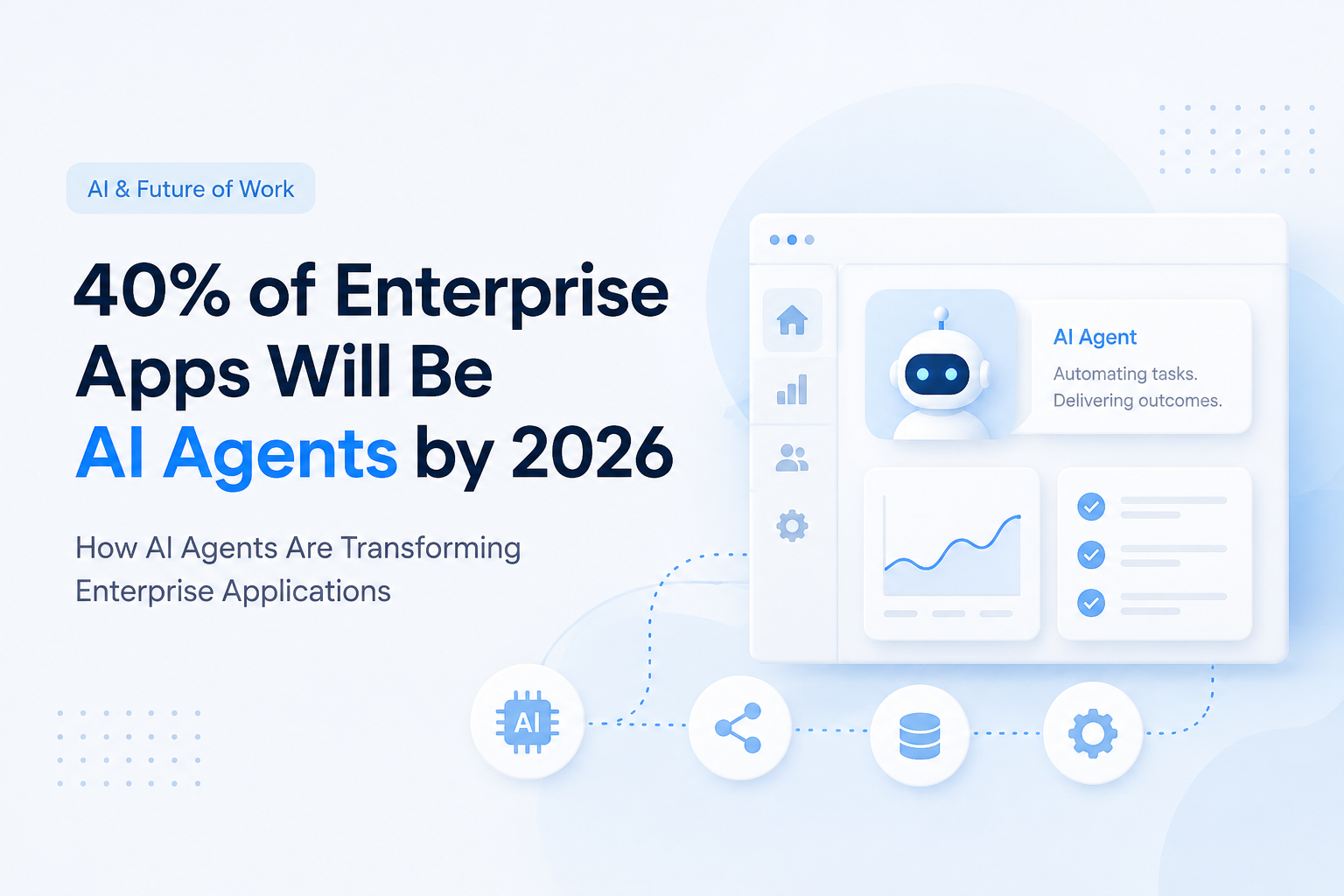
At the same time, Gartner expects 40% of enterprise applications to include task-specific AI agents by the end of 2026, up from less than 5% in 2025. The opportunity is real, but only for teams that budget properly. Four rules protect your spend:
Start with one measurable workflow, such as invoice matching or ticket triage, with a clear baseline.
Budget for running costs from day one, not after the first invoice arrives.
Keep humans in the loop for approvals above a set value or risk level.
Ship an evaluation set with the agent so quality can be measured every week.
What does a real AI agent build look like?
For a B2B distributor, iSkylar built a custom AI layer that connected HubSpot, NetSuite, Zendesk and Slack. The result: 6 systems in one AI workspace, 47 fragile automations retired, 94% daily team adoption within three months, and cross-system customer questions answered in under 30 seconds instead of about 20 minutes. Full rollout took 12 weeks.
The stack included Python, FastAPI, LangGraph, the Model Context Protocol, OpenAI GPT and Anthropic Claude models, PostgreSQL with pgvector, Redis and AWS. This is a typical workflow agent profile: mid-range build cost, fast payback, and running costs kept low by routing simple steps to smaller models.
How should you budget for the first year?
Use a simple formula: first-year cost = build cost + (monthly running cost x 12) + 15 to 20% for improvements. Agents get better after launch as you add edge cases, tools and evaluation data, so plan for that work.
Budget line | RAG knowledge agent | Workflow agent |
|---|---|---|
Build | $30,000 | $70,000 |
Running cost (12 months) | $12,000 (at $1,000/month) | $42,000 (at $3,500/month) |
Post-launch improvements (15 to 20%) | $4,500 to $6,000 | $10,500 to $14,000 |
First-year total | $46,500 to $48,000 | $122,500 to $126,000 |
Compare this with the cost of the manual work the agent replaces. If a workflow agent saves 10 people 5 hours a week, it usually pays for itself within the first year.
How does iSkylar deliver AI agent projects?
Most agentic AI engagements at iSkylar move from discovery to monitored production in 8 to 10 weeks:
Weeks 1 to 2: workflow discovery and mapping.
Weeks 2 to 3: data and systems audit.
Weeks 3 to 5: agent architecture and guardrail design.
Weeks 5 to 8: integration, simulation and testing.
Weeks 8 to 10: production rollout and monitoring.
You own the code, prompts and evaluation sets. If you want to keep building in-house afterwards, you can also hire dedicated AI developers from the same team that built your agent.
Get an exact estimate for your AI agent
Every agent is different, so the fastest way to a reliable number is a short scoping call. Share your workflow, the systems involved and your target markets, and we will send a fixed-scope estimate with build cost, timeline and projected monthly running cost. Book a free AI agent consultation.
WRITTEN BY
Himanshu
Having 8+ years of experience helping startups and enterprises across the US, UK, Middle East and Australia plan, budget and ship AI products.
Frequently Asked Questions
How much does it cost to build an AI agent in 2027?
Can I build a useful AI agent for under $20,000?
How much does an AI agent cost per month after launch?
How long does it take to develop an AI agent?
What is the most expensive part of building an AI agent?
Is it cheaper to use an AI agent platform than to build a custom one?
Does building an AI agent for the UAE or Saudi Arabia cost more?
How do I stop my AI agent project from failing?
Further Reading

Stay at the forefront of innovation.
innovation.
Join our inner circle of industry leaders and get exclusive insights delivered to your inbox every Thursday morning.
WE RESPECT YOUR PRIVACY. NO SPAM, EVER.
Updated At: