Model Context Protocol (MCP) for Business: How to Connect AI Agents to Your Systems in 2027 (Cost, Security and Roadmap)
Model Context Protocol (MCP) is now the standard way to connect AI agents to your CRM, ERP, databases and internal tools. This 2027 guide explains how MCP works, real integration costs, the security rules you cannot skip, and a 90-day rollout plan for US, UK, GCC, Canadian and Australian businesses.
Himanshu
PRINCIPAL ARCHITECT13 MIN READ

Model Context Protocol (MCP) is the open standard that lets AI agents securely use your business systems, such as your CRM, ERP, databases and ticketing tools, through one common connector instead of dozens of custom integrations. In 2027 a single production MCP server costs about $7,800-$17,500 (2-4 weeks), a multi-system enterprise rollout costs $15,000-$58,000+ (6-10 weeks), and running costs are usually $100-$1,150 per month per server before model usage. Security is the part most teams underestimate: plan OAuth, least-privilege scopes, a gateway and audit logs from day one.
What Is Model Context Protocol (MCP)? A Plain-English Explanation
Model Context Protocol is an open standard, first released by Anthropic in November 2024, that defines how an AI application connects to outside data and tools. The easiest way to picture it is a USB-C port for AI. Before MCP, every AI tool needed its own custom connector to every system. Five AI tools and ten systems meant up to fifty integrations to build and maintain. With MCP, you build one MCP server for each system, and every MCP-compatible AI client can use it.
An MCP setup has three parts:
Host and client: the AI application your team uses, such as Claude, ChatGPT, Microsoft Copilot, Gemini, Cursor or your own custom agent.
MCP server: a small service that sits in front of one of your systems (for example HubSpot, SAP, a PostgreSQL database or a document store) and describes what the AI is allowed to do there.
Tools, resources and prompts: the actions the agent can take (create a ticket, update a deal), the data it can read (a customer record, a policy PDF) and reusable task templates.
In December 2025, Anthropic donated MCP to the Agentic AI Foundation, a fund under the Linux Foundation co-founded with Block and OpenAI. That move matters for buyers: MCP is now a vendor-neutral standard, not one company's product, which lowers lock-in risk for a 2027 investment.
Why MCP Matters for Businesses in 2027: The Numbers
MCP has moved from developer experiment to core AI infrastructure in under two years. The data points that matter most for planning:
47,267 active servers were listed in the official MCP Registry in October 2026, against roughly 10,000 public servers reported in December 2025.
The TypeScript SDK recorded 231.9 million npm downloads in September 2026, up from 31.3 million a year earlier, and the Python SDK passed 260 million monthly downloads.
The Agentic AI Foundation grew from 49 founding members to 286 member organisations by October 2026.
In a Stacklok survey of 300 senior technology leaders at large enterprises (published January 2026), 41% said they already run MCP servers in limited or broad production, and 64% of software respondents named security as the main obstacle.
Gartner forecasts that 75% of API gateway vendors will have MCP features by the end of 2026, up from almost none in 2024.
Native MCP support now ships in OpenAI, Google Gemini and Vertex AI, Microsoft Copilot and Azure AI, AWS Bedrock, Salesforce Agentforce, Snowflake Cortex and Apple Xcode.
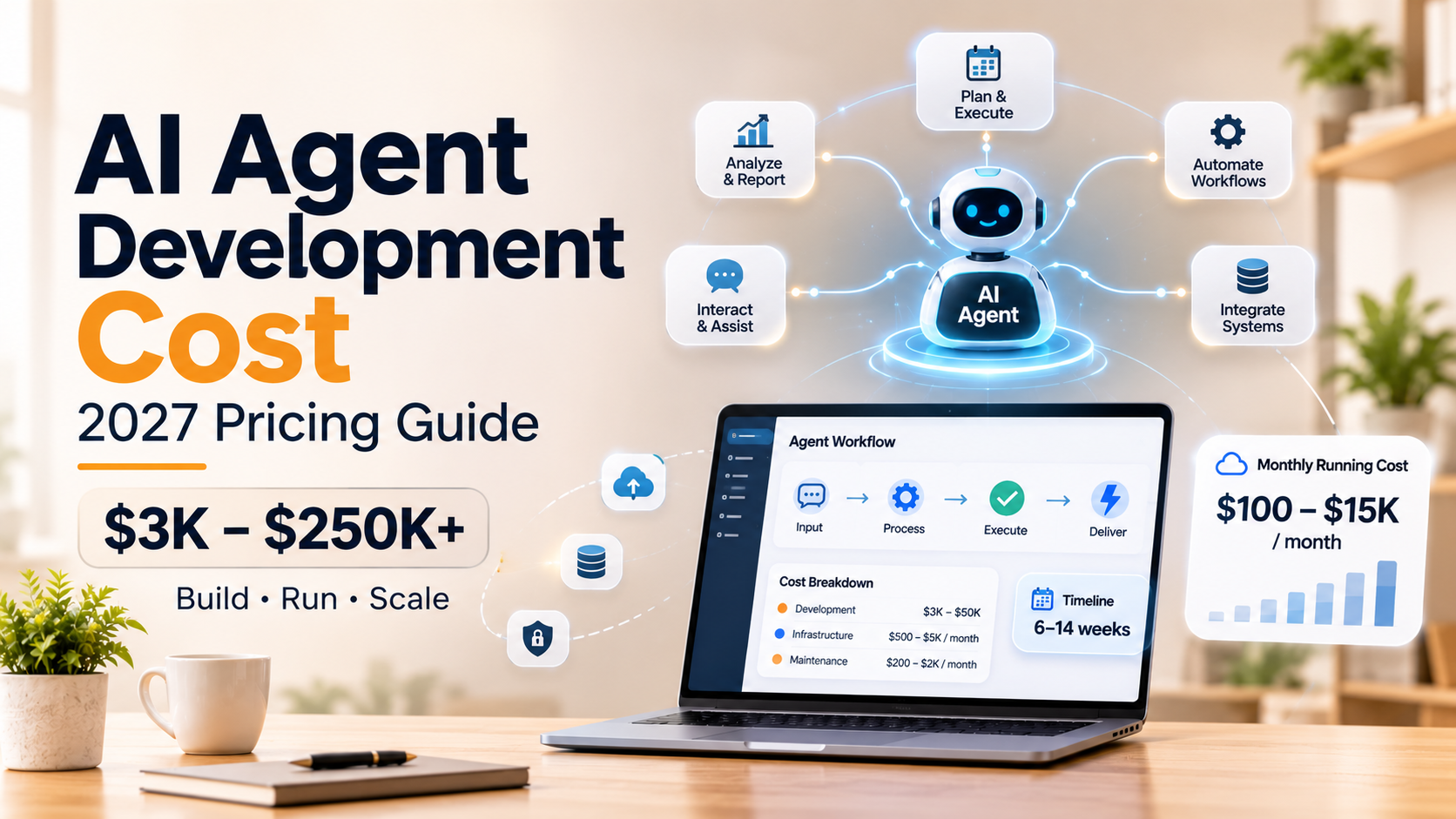
The practical takeaway: if you are building AI agents in 2027, the question is no longer whether to use MCP, but which systems to expose first and how to govern them. If you are still scoping the agent itself, start with our guide to AI agent development cost in 2027.
MCP vs Traditional API Integration: What Is the Difference?
MCP does not replace your APIs. It wraps them in a layer that AI models can understand and use safely.
Factor | Traditional API integration | MCP integration |
|---|---|---|
Built for | Developers writing fixed code paths | AI models deciding which action to take |
Discovery | Developer reads documentation | Agent reads tool descriptions and typed schemas at runtime |
Reuse across AI tools | New connector per AI tool | One server works with any MCP client |
Integration effort for 5 AI tools x 10 systems | Up to 50 connectors | 10 MCP servers |
Permissions | Usually one service account | Per-tool scopes, user-level OAuth, approval steps |
Best for | Stable, high-volume system-to-system flows | Flexible, language-driven tasks done by agents and copilots |
A good rule: keep classic APIs and iPaaS tools for predictable, high-volume data syncs, and use MCP wherever a person or agent needs to ask questions or take actions in natural language.
7 High-ROI MCP Use Cases for Businesses
1. Sales and CRM copilots
An MCP server on HubSpot or Salesforce lets reps ask "Which deals over $50K have had no activity in 14 days?" and then draft follow-ups, log calls or update stages without opening the CRM.
2. Customer support agents
Connect the helpdesk, order system and knowledge base so the agent can check an order, issue a refund within policy and escalate with full context. This pairs well with an RAG knowledge assistant for policy answers.
3. Finance and ERP queries
Read-only MCP tools on ERP and accounting data give finance teams instant answers on spend, overdue invoices and cash position, with write actions such as journal entries kept behind human approval.
4. Internal knowledge and document search
MCP servers on SharePoint, Google Drive, Confluence or Notion let one assistant search across every repository while respecting each user's existing permissions.
5. Engineering and DevOps
GitHub, Jira, cloud and monitoring MCP servers let engineers triage incidents, open pull requests and check deployment status from their AI coding tool.
6. Operations, inventory and logistics
Agents can check stock across warehouses, reschedule deliveries and flag delays by calling MCP tools on WMS, TMS and supplier portals.
7. Arabic and WhatsApp agents in the GCC
For UAE and Saudi businesses, one set of MCP servers can power both an Arabic WhatsApp agent and an English web assistant, because MCP is language-neutral. See our Arabic AI chatbot guide for UAE and Saudi businesses for dialect and model choices.
Build, Buy or Hybrid: Which MCP Approach Fits Your Business?
Use an official vendor MCP server when the SaaS tool already publishes one and its default tools match your workflow. Cost is mostly configuration, testing and security review, often 1-3 weeks.
Build a custom MCP server for internal, legacy or heavily customised systems, or when you need business rules, approval flows and tight data filtering. This is where most of the business value sits.
Go hybrid (the most common 2027 pattern): official servers for mainstream SaaS, custom servers for core internal systems, and one MCP gateway in front of all of them for authentication, rate limits and logging.
Avoid installing community MCP servers from public directories straight into production. An arXiv scan of registry servers in September 2026 found that 9.57% showed unauthenticated network exposure.
How Much Do MCP Integration Services Cost in 2027?
The ranges below are benchmarked against published 2026 agency pricing and set slightly below the market average to reflect lean, AI-assisted delivery. They assume a blended offshore-onshore team and exclude LLM token costs.
Project type | Typical scope | Cost (USD) | Timeline |
|---|---|---|---|
Single MCP server | One system, 3-8 tools, API-key or OAuth auth, logging | $7,800-$17,500 | 2-4 weeks |
Multi-tool MCP server | One complex system or 2 related systems, 10-25 tools, read and write actions | $14,500-$29,000 | 4-6 weeks |
Public MCP server for your SaaS product | Multi-tenant OAuth, docs, registry listing, rate limits | $15,500-$43,600 | 5-8 weeks |
MCP + RAG knowledge layer | Tools plus document retrieval with permissions | $20,000-$68,000 | 6-12 weeks |
Enterprise MCP integration | 3-6 systems, MCP gateway, SSO, audit logs, approval flows | $29,000-$58,000+ | 6-10 weeks |
What pushes MCP cost up
Authentication and authorisation: per-user OAuth, enterprise SSO and fine-grained scopes typically add 20-40% to a project.
Number of systems: effort grows faster than linearly. Five connected systems often take 8-10 times the effort of one because of shared identity, error handling and testing.
Legacy or undocumented systems: older ERPs, on-premise databases and SOAP services can add 50-200 engineering hours.
Write actions: read-only servers are roughly 30-40% cheaper than servers that create, update or delete records.
Compliance: HIPAA, SOC 2, PCI DSS or GCC data residency add reviews, hosting constraints and evidence collection.
Monthly running costs
Cost item | Single server | Multi-system rollout |
|---|---|---|
Hosting (serverless or containers) | $30-$290 | $290-$2,400 |
Gateway, monitoring and logging | $0-$190 | $290-$1,450 |
Maintenance retainer (spec updates, fixes) | $190-$770 | $770-$2,900 |
Typical total before LLM tokens | $190-$1,150 | $1,150-$4,350 |
LLM usage is billed separately and ranges from about $100 per month for light internal use to several thousand dollars for customer-facing agents. Budget 15-20% of the build cost each year for maintenance, because the MCP specification still changes (see below).
MCP Security in 2026-2027: What You Cannot Skip
Security is the biggest gap between an MCP demo and a production rollout. The warning signs from 2026 are clear:
By October 2026, 382 CVE records in the US National Vulnerability Database mentioned MCP, 324 of them published in 2026 and 79 rated Critical.
In April 2026, Gartner predicted that 25% of enterprise GenAI applications will suffer at least five minor security incidents a year by 2028, up from 9% in 2025, and said MCP "does not enforce security by default."
In May 2026, a US NSA report said MCP's rapid spread had outpaced its security model.
The main risks are prompt injection through tool outputs, poisoned tool descriptions in third-party servers, over-broad permissions and agents taking well-meant but wrong actions. Gartner's advice is to treat any use case that combines sensitive data, untrusted content and external communication as a no-go zone.
Production MCP security checklist
Use OAuth 2.1 with per-user tokens. Never pass user tokens through to downstream APIs.
Give agents their own identities and the narrowest scopes possible, not copies of human admin roles.
Put every server behind an MCP gateway with an allow-list, rate limits and full audit logs.
Require human approval for payments, deletions, bulk updates and outbound messages.
Pin and review third-party server versions, and scan tool descriptions for hidden instructions.
Filter tool outputs for sensitive data before they reach the model.
Red-team the agent with prompt injection tests before launch and after every major change.
The July 2026 MCP Specification Update: What It Means for Your Roadmap
The MCP specification released on July 28, 2026 removed the initialization handshake and protocol-level sessions, making MCP stateless at the protocol layer. Version, client identity and capabilities now travel with each request. It also deprecated Roots, Sampling, Logging and Dynamic Client Registration, with a 12-month deprecation window, and the update is not fully backward compatible.
For businesses this is good news and a to-do item. Stateless servers are easier to scale on serverless platforms and cheaper to run, but servers built on 2025 versions should be upgraded before mid-2027. Ask any vendor you hire which specification version they build against and how they will handle the next revision.
MCP Compliance by Country: USA, UK, Canada, Australia, UAE and Saudi Arabia
MCP itself is not regulated, but every MCP server moves data to an AI model, so data protection rules apply to what each tool can read and where logs are stored.
Country | Key rules | What it means for MCP |
|---|---|---|
USA | State privacy laws (such as CCPA/CPRA), HIPAA for health data, SOC 2 expectations from enterprise buyers | Limit tools that expose personal or health data, sign BAAs with model vendors where needed, keep audit logs |
UK | UK GDPR, Data (Use and Access) Act 2025 | Run a DPIA for agents acting on personal data, document lawful basis and keep humans in the loop for significant automated decisions |
Canada | PIPEDA, Quebec Law 25 | Disclose AI processing, assess cross-border transfers to US-hosted models, honour automated decision notice rights in Quebec |
Australia | Privacy Act 1988 and APPs; automated decision transparency duties from December 10, 2026 | Update privacy policies to describe decisions agents make using personal data, check APP 8 for offshore model hosting |
UAE | Federal Decree-Law 45 of 2021 (PDPL), DIFC and ADGM data protection rules | Prefer UAE-region hosting for servers and logs, control cross-border transfers, follow free zone rules if licensed there |
Saudi Arabia (KSA) | Personal Data Protection Law (SDAIA), NCA cybersecurity controls | Host sensitive data in-Kingdom where required, restrict transfers abroad, align MCP gateways with NCA controls |
A 90-Day MCP Rollout Plan
Days 1-15, choose and scope: pick one workflow with clear value and low risk (for example read-only CRM questions). List systems, data classes and who may use the agent.
Days 16-45, build the first server: wrap the system in 5-10 well-described tools, add OAuth and logging, and test with 10-20 real users.
Days 46-70, govern: add an MCP gateway, allow-list approved servers, set up approval steps for write actions and run prompt injection tests.
Days 71-90, scale: add 2-4 more systems, introduce write actions with approval, and track time saved, task success rate and error rate per tool.
How iSkylar Helps You Adopt MCP
iSkylar designs and builds custom MCP servers, gateways and the agents that use them for companies in the US, UK, UAE, Saudi Arabia, Canada and Australia. We start with a short discovery sprint, connect one high-value system first and add governance before scale, so your AI investment does not stall at the pilot stage. Explore our agentic AI development services or book a free MCP scoping call to get a fixed estimate within 48 hours.
WRITTEN BY
Himanshu
Head of Marketing & Growth at iSkylar, where he helps founders and enterprise teams plan, price and launch AI and mobile products across the US, UK, Canada, Australia and the Middle East.
Frequently Asked Questions
What is MCP in simple terms?
How much do MCP integration services cost in 2027?
Is MCP different from a normal API integration?
Should I use an existing MCP server or build a custom one?
Is MCP secure enough for regulated businesses?
How long does it take to roll out MCP across a company?
What changed in the MCP specification in 2026?
Does MCP work with Arabic and with WhatsApp agents in the UAE and Saudi Arabia?
Further Reading

Stay at the forefront of innovation.
innovation.
Join our inner circle of industry leaders and get exclusive insights delivered to your inbox every Thursday morning.
WE RESPECT YOUR PRIVACY. NO SPAM, EVER.
Updated At: