
Predictive Analytics for Mid-Market Companies: 2027 Use Cases, Costs and Timelines
Predictive analytics services for mid-market companies cost $12,500 to $31,000 for a pilot and $17,000 to $34,000 for a production model. See 8 use cases that pay back fastest, timelines, build vs buy and the 2027 rules for the USA, UK, Canada, Australia, UAE and Saudi Arabia.
Hansraj
PRINCIPAL ARCHITECT9 MIN READ
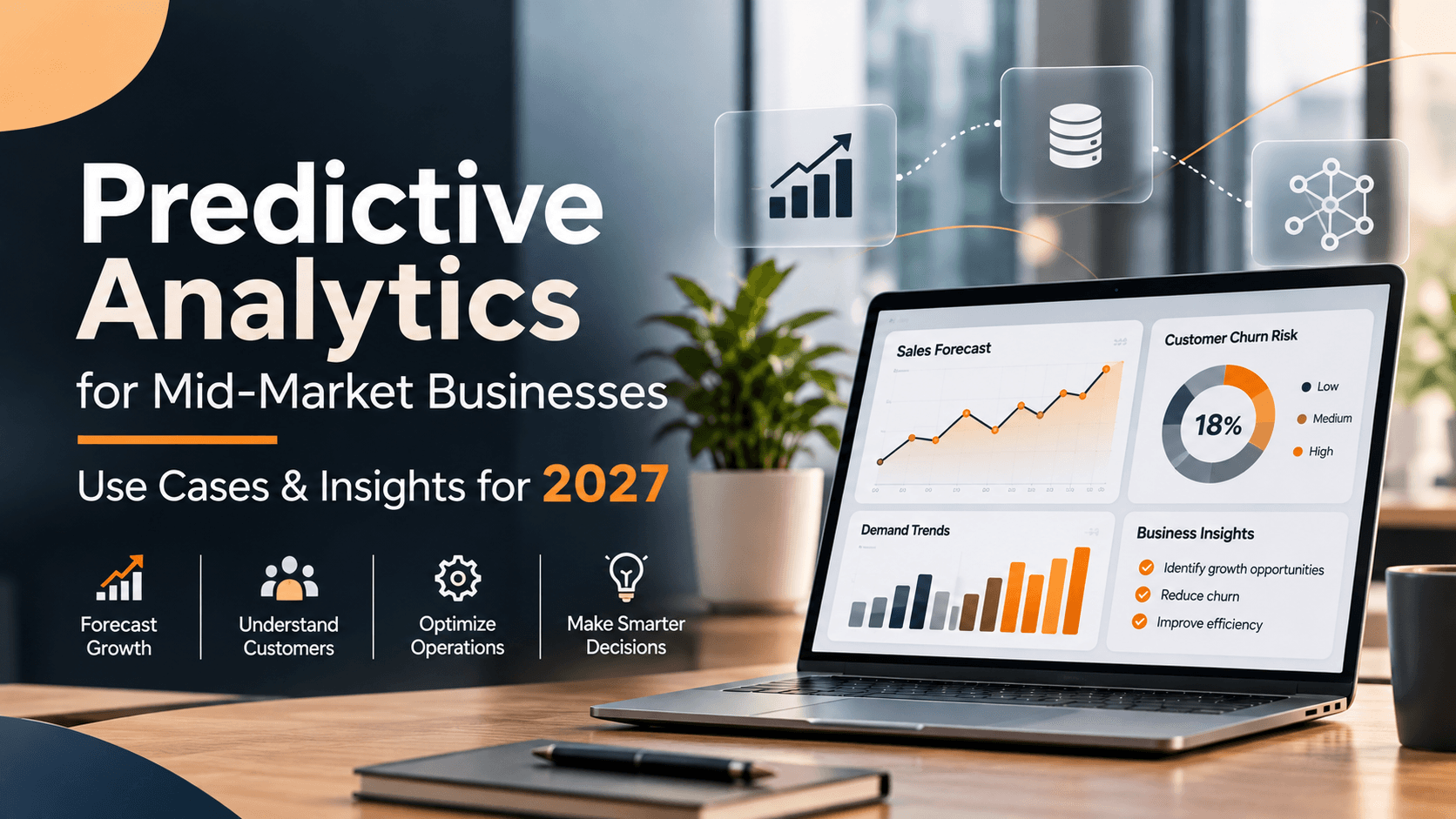
Predictive analytics services for mid-market companies cost $12,500 to $31,000 for a 2-3 week pilot on one use case, $17,000 to $34,000 for a production model in 7-13 weeks, and $34,000 to $84,000 for a multi-model platform. iSkylar builds demand forecasting, churn, lead scoring and risk models that plug into the CRM and ERP you already use.
What is predictive analytics, in plain terms?
Predictive analytics uses your historical data and machine learning to estimate what is likely to happen next: which customers will cancel, how much stock each location needs, which invoices will be paid late. Instead of a dashboard that explains last quarter, you get a score or forecast that tells a team what to do this week.
For mid-market companies (roughly $10M to $1B in revenue), the gap is rarely ambition. It is that enterprise tools assume a data science team you do not have, while spreadsheets stopped scaling two years ago. Adoption is no longer niche: a 2025 Dresner Advisory Services survey, cited by ECOSIRE, found 71% of organisations use some form of predictive analytics, up from 42% in 2021.
Which predictive analytics use cases pay back fastest for mid-market companies?
The fastest wins sit where a decision is made often, the data already exists and a small accuracy gain moves real money. Start with one of these, not all of them.
Use case | Who uses it | Data you need | Build cost (iSkylar) | Time to first result |
|---|---|---|---|---|
Demand forecasting | Retail, distribution, manufacturing | 2+ years of sales by SKU and location, promotions, stock-outs | $20,000 - $34,000 | 8-12 weeks |
Customer churn prediction | SaaS, telecom, subscriptions, B2B services | 12+ months of usage, billing and support history | $17,000 - $30,000 | 7-10 weeks |
Lead scoring | B2B sales and marketing | CRM history with won and lost deals | $14,000 - $25,000 | 6-9 weeks |
Customer lifetime value | E-commerce, financial services | Order and margin history per customer | $14,000 - $25,000 | 6-9 weeks |
Cash flow and late-payment forecasting | Finance teams in any sector | AR/AP ledger, payment terms, customer history | $17,000 - $30,000 | 7-10 weeks |
Employee attrition risk | HR in firms with 200+ staff | HRIS tenure, pay band, performance, engagement | $14,000 - $25,000 | 6-9 weeks |
Predictive maintenance | Manufacturing, logistics, utilities | Sensor or machine logs plus failure records | $25,000 - $42,000 | 10-14 weeks |
Credit and fraud risk scoring | Lenders, fintech, marketplaces | Application, transaction and outcome data | $25,000 - $50,000 | 10-15 weeks |
Costs are iSkylar build estimates for one production model per use case, derived from the benchmark ranges below. Lead scoring, lifetime value and attrition sit at the lower end because they usually rely on one clean CRM or HRIS source.
Two of these carry a direct cost signal you can quote to your CFO. Losing staff is expensive: SHRM estimates replacing an employee costs 50% to 200% of annual salary, which is why attrition models earn their keep even at modest accuracy. Churn works the same way, because retaining a known customer is almost always cheaper than winning a new one.
How much do predictive analytics services cost in 2027?
Most competitor guides put a first predictive model between $40,000 and $80,000 and an enterprise platform above $200,000. Our pricing runs well below that because we scope to one decision at a time and reuse proven pipelines.
Engagement | What you get | Cost | Timeline |
|---|---|---|---|
Pilot (proof of value) | One use case on your historical data, accuracy report, go or no-go recommendation | $12,500 - $31,000 | 2-3 weeks |
Production model | One model wired into your CRM, ERP or BI tool, scoring schedule, monitoring and drift alerts | $17,000 - $34,000 | 7-13 weeks |
Multi-model platform | 3-5 models, shared feature store, MLOps pipeline, role-based dashboards | $34,000 - $84,000 | 14-19 weeks |
Enterprise-grade | Multi-entity data, real-time scoring APIs, model governance and audit trail | $84,000 - $168,000+ | 19-29 weeks |
How we set these numbers: public 2026 guides list a proof of concept at $30,000-$75,000 (WiserBrand), an MVP at $40,000-$80,000 over 4-6 months and an enterprise platform at $200,000-$400,000+ over 8-12 months (Appinventiv), and forecasting builds at $60,000-$200,000 (Netguru). Our ranges sit 55-60% below those benchmarks with timelines 40-50% shorter.
What does predictive analytics cost to run after launch?
Model retraining and upkeep: plan 15-25% of the original build per year (Netguru benchmark). Retail and demand models usually need monthly retraining; lead scoring often only quarterly.
Managed analytics retainer: $4,200-$16,800 per month if you want us to monitor, retrain and add features, against $10,000-$40,000 per month quoted by managed-service providers.
Cloud compute and storage: typically $200-$2,000 per month for mid-market batch scoring on AWS, Azure or Google Cloud (iSkylar estimate). Real-time scoring costs more.
Platform licences: if you already pay for Power BI, Microsoft Fabric, Snowflake or Databricks, we build on top of them, so you add little or nothing here.
How long does a predictive analytics project take?
A focused production model takes 7-13 weeks from kickoff to live scores. Most delays come from data access, not modelling.
Discovery (1-2 weeks): pick one decision, define the metric that proves value, confirm the data exists.
Data preparation (2-4 weeks): connect sources, clean history, build features. This is usually half the effort.
Modelling and validation (2-4 weeks): test baseline and gradient-boosted models, back-test on held-out months, explain the drivers in plain language.
Integration and rollout (2-3 weeks): push scores into the tools people already open, set up monitoring and drift alerts, train the team.
Is your company ready for predictive analytics?
You are ready if you can answer yes to most of these:
You have at least 12-24 months of history for the outcome you want to predict.
One team owns the decision and will change what it does based on a score.
Your core data lives in systems with APIs or exports (Salesforce, HubSpot, Dynamics, NetSuite, SAP Business One, Shopify, a SQL warehouse).
You can name the cost of getting the decision wrong today, such as excess stock, lost renewals or bad debt.
If the data is scattered, the first 2-4 weeks become a data foundation sprint. That is still worth doing, because every later model reuses it.
Should you build custom models or buy a predictive analytics platform?
Buy when your use case is standard and your data already sits in one platform. Build custom when the prediction is core to how you compete or when off-the-shelf models ignore the signals that matter in your business.
Option | Best for | Trade-off |
|---|---|---|
Built-in platform features (Power BI, Fabric, Salesforce Einstein, HubSpot) | Simple forecasts and scores on a single data source | Fast to start; limited control over features and accuracy |
AutoML platforms (DataRobot, Databricks, Snowflake Cortex) | Teams with an analyst who can own models | Licence costs grow with usage; still needs data engineering |
Custom models on your cloud | Multi-source data, industry-specific signals, IP you own | Higher upfront build; lowest long-run cost per prediction |
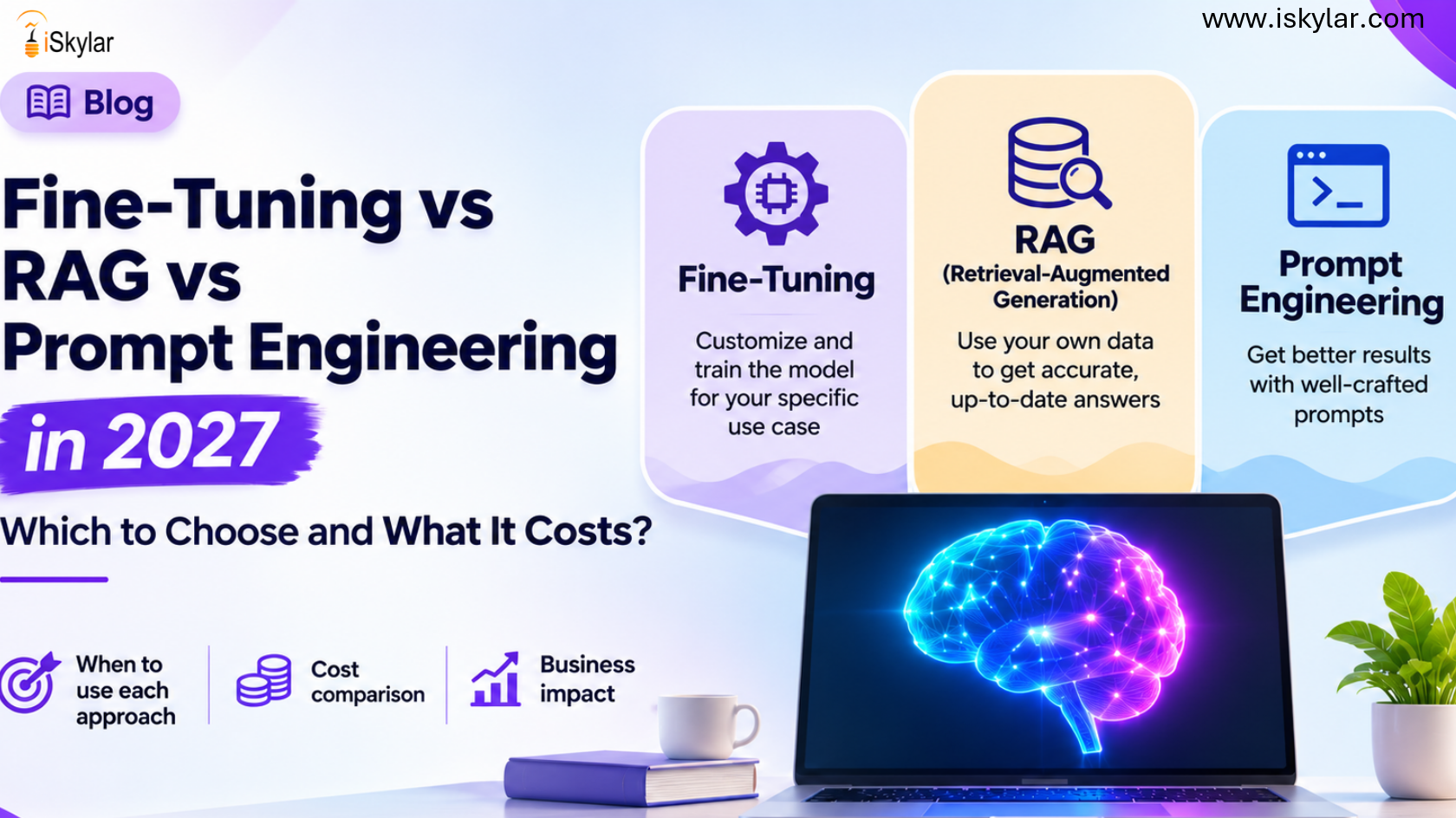
Most mid-market clients end up hybrid: custom models for the one or two decisions that move revenue, with scores published into the BI tool they already pay for. If you are weighing language models as part of the stack, our guide to fine-tuning vs RAG vs prompt engineering explains where each fits.
How do AI agents change predictive analytics in 2027?
The 2027 shift is from scores people read to scores that trigger action. A churn model that flags an at-risk account can now hand that account to an AI agent that drafts a retention offer, opens a CRM task and waits for a manager to approve it. A demand forecast can raise a purchase order draft instead of a spreadsheet alert.
That loop only works if the prediction is trustworthy and the agent has tight permissions. We build both sides through our agentic AI services, with human approval on anything that spends money or contacts a customer.
What rules apply to predictive models in the USA, UK, Canada, Australia, UAE and Saudi Arabia?
Predictive models that only forecast stock or revenue face light regulation. Models that score people for credit, insurance, hiring, housing or pricing are treated as automated decisions, and several new rules land in late 2026 and 2027.
Market | Rules to plan for | What we build in |
|---|---|---|
USA | California CPPA automated decision-making technology (ADMT) regulations from January 1, 2027; Colorado SB 26-189 ADMT duties from January 1, 2027; FCRA and ECOA adverse action notices for credit | Decision logs kept 3+ years, plain-language reason codes, opt-out and review paths |
UK | UK GDPR automated decision rules as reformed by the Data (Use and Access) Act 2025; ICO guidance on AI and data protection | Human review route, DPIA support, explainability report per model |
Canada | PIPEDA; Quebec Law 25 duty to inform people of decisions made exclusively by automated processing | Notice templates, factor explanations on request |
Australia | Privacy Act automated decision transparency (APP 1.7-1.9) from December 10, 2026 | Privacy policy disclosures listing which decisions use models and what data |
UAE | Federal Decree-Law 45 of 2021 (PDPL); DIFC Data Protection Regulation 10 on autonomous and AI systems for DIFC entities | Data residency options in UAE cloud regions, purpose and consent records |
Saudi Arabia (KSA) | Personal Data Protection Law enforced by SDAIA since September 14, 2024, including cross-border transfer rules | In-Kingdom hosting where needed, Arabic-ready reporting, transfer assessments |
Serving EU customers too? Credit scoring and similar systems are high-risk under the EU AI Act, with Annex III obligations now scheduled from December 2, 2027.
How do you measure ROI on predictive analytics?
Agree on the money metric before any model is trained, then run the model against a control group for at least one full business cycle.
Demand forecasting: forecast error (MAPE), stock-out rate, inventory carrying cost.
Churn: retained revenue in the flagged group versus a holdout group.
Lead scoring: conversion rate and sales cycle length for top-scored leads.
Cash flow: days sales outstanding and forecast accuracy at 30, 60 and 90 days.
A pilot at $12,500-$31,000 is sized so that a single good decision, such as one avoided stock write-off or a handful of saved renewals, can cover it. Keep cloud spend in check as you scale with the same approach we used in our cloud cost optimisation case study.
Why mid-market companies choose iSkylar for predictive analytics
One decision first: every engagement starts with a 2-3 week pilot, so you see accuracy on your own data before committing.
Your stack, not ours: Python, scikit-learn, XGBoost, LightGBM and Prophet models, orchestrated with Airflow or Azure Data Factory, deployed on AWS SageMaker, Azure ML or Vertex AI, with scores delivered into Power BI, Tableau, Salesforce or HubSpot.
Explainable by default: SHAP-based driver reports so sales, finance and HR understand why a score changed.
Flexible teams: a fixed-price pilot, or dedicated AI and ML developers who join your team.
Ready to test one prediction on your own data? Explore our predictive analytics services and book a demo to scope a 2-3 week pilot.
WRITTEN BY
Hansraj
Leads marketing, growth and go-to-market strategy at iSkylar, helping founders scope and launch on-demand and marketplace apps.
Frequently Asked Questions
How much do predictive analytics services cost for a mid-sized company?
How much data do I need before starting predictive analytics?
Do we need to hire data scientists to use predictive analytics?
What is the best first predictive analytics project?
How accurate does a predictive model need to be?
How often should predictive models be retrained?
Is predictive analytics compliant with privacy laws in the UK, UAE and Saudi Arabia?
What is the difference between predictive analytics and business intelligence?
Further Reading

Stay at the forefront of innovation.
innovation.
Join our inner circle of industry leaders and get exclusive insights delivered to your inbox every Thursday morning.
WE RESPECT YOUR PRIVACY. NO SPAM, EVER.
Updated At: