Cloud Cost Optimization for AI Workloads in 2027: A FinOps Playbook for GPU, Token and Agent Spend
AI bills grow with every call, and 98% of FinOps teams now manage AI spend. This 2027 playbook shows the unit metrics to track, the eight levers that cut GPU and LLM costs by 40-60%, a worked example, and what a FinOps for AI program costs.
Hansraj
PRINCIPAL ARCHITECT9 MIN READ
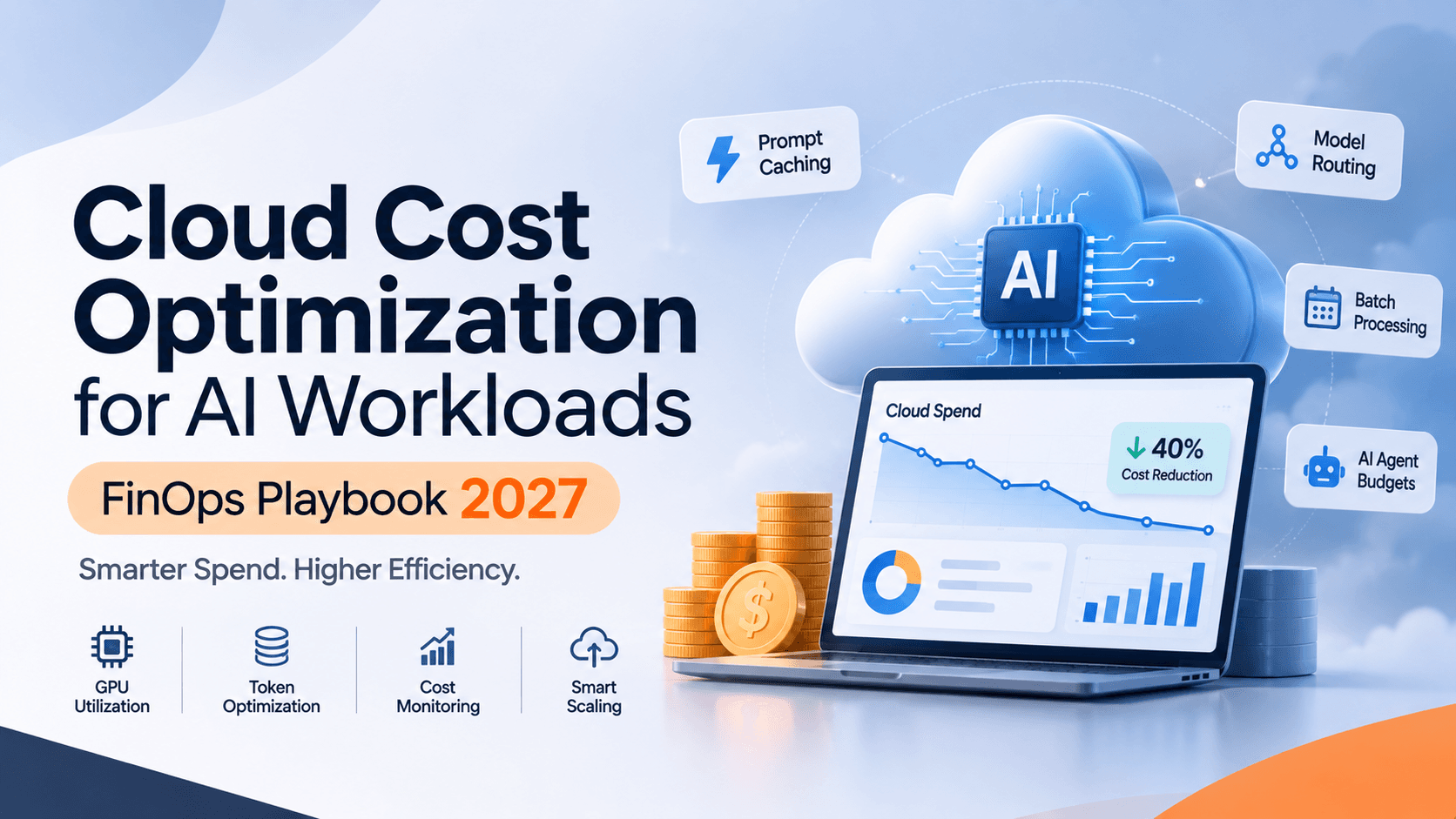
Cloud cost optimization for AI cuts the bill for GPUs, LLM tokens and agent calls by tracking cost per inference, then applying prompt caching, model routing, batch processing, rightsizing and commitment discounts. Stacked together, these levers typically cut AI spend by 40-60%. iSkylar runs a one-week AI cost assessment from $4,000 for teams in the US, UK, Gulf, Canada and Australia.
Why are AI cloud bills growing faster than revenue?
AI spend grows on usage, not on headcount, so a successful feature can double its own bill in a month. The State of FinOps 2026 survey of 1,192 practitioners found that 98% now manage AI spend, up from 31% two years earlier, and FinOps for AI is the top priority for the year ahead.
Three things make AI costs harder to control than classic cloud:
Tokens are metered per call. Output tokens cost about 3x to 5x more than input tokens, according to Flexera, so a chatty agent can cost far more than its prompt suggests.
GPUs sit idle. CloudZero reports that 40-60% of GPU instances its customers run are oversized, and GPU instances range from about $1 to $98 per hour.
Agents loop. An agent that retries a tool ten times spends ten times the tokens, and nobody sees it until the invoice lands.
Proving value is now the main pain. The FinOps Foundation's State of Tokenomics (September 2026) found that showing ROI is the most common challenge (43%), and that companies with clear ownership of AI economics were 3.7x more likely to prove value to their CFO.
What is FinOps for AI?
FinOps for AI is the practice of giving every AI feature an owner, a budget and a unit cost, so engineering, finance and product decide together how much each answer, document or agent run is worth. It extends classic cloud FinOps to tokens, GPUs, vector databases and third-party model APIs.
The shift is from "what did the cloud cost?" to "what did each outcome cost?". A support bot is not judged on its monthly bill but on cost per resolved ticket compared with the human cost of the same ticket.
Which AI cost metrics should you track?
Track five unit metrics before touching any infrastructure. Without them, savings cannot be proven and regressions go unnoticed.
Metric | How to calculate | Healthy signal |
|---|---|---|
Cost per inference | Total model and serving cost / number of requests | Flat or falling as traffic grows |
Cost per successful outcome | AI cost / resolved tickets, approved documents or completed tasks | Below the manual cost of the same task |
Cost per million tokens (blended) | Token spend / tokens used, across all models | Falls as routing and caching mature |
Cache hit rate | Cached input tokens / total input tokens | Above 50% for repeated system prompts |
GPU utilization | Average busy time of provisioned GPUs | Below 30-40% signals overprovisioning |
Example from the FinOps Foundation: $5,000 of monthly spend across 100,000 inferences equals $0.05 per inference. That single number lets product teams price features and lets finance forecast spend from usage plans.
How do you reduce LLM and GPU costs? The 8 levers that work
The biggest savings come from changing how often and how expensively you call models, not from negotiating cloud discounts. Apply the levers roughly in this order.
Lever | Typical saving | Best for | Effort |
|---|---|---|---|
1. Prompt caching | 50-90% on repeated input tokens | Long system prompts, RAG context, agent traces | Low |
2. Model routing | 30-60% blended cost | Mixed traffic where most requests are easy | Medium |
3. Batch processing | About 50% per call | Overnight jobs: tagging, summaries, evals | Low |
4. Output limits and prompt trimming | 10-30% (iSkylar estimate) | Verbose agents and chat replies | Low |
5. Agent loop caps and budgets | Prevents 2-10x cost spikes | Tool-calling and multi-step agents | Low |
6. GPU rightsizing and scheduling | Recovers idle capacity on 40-60% of oversized instances | Self-hosted models, fine-tuning clusters | Medium |
7. Spot and commitment discounts | Spot 60-90%; Savings Plans up to 66%; 3-year reserved up to 72% | Training (spot), steady inference (commitments) | Medium |
8. Quantization and smaller models | 50-75% serving cost | High-volume, narrow tasks | High |
Ranges from CloudZero (Sept 2026), MLflow (June 2026) and GMI Cloud (May 2026) vendor data. Results depend on traffic shape.
Prompt caching
Caching stores the unchanging start of a prompt, such as instructions, policies and tool definitions, so you pay a fraction for it on every repeat call. Anthropic bills cached reads at roughly one tenth of the normal input price, and OpenAI applies an automatic discount on repeated prefixes. Put static content first and variable content last, or the cache never hits.
Model routing
Routing sends easy requests to a small, cheap model and only hard ones to a frontier model. GMI Cloud measured 40-70% lower blended cost on mixed support traffic, but under 10% when every request is equally hard. Build a 200-500 query evaluation set first so you can prove quality held. Our guide to fine-tuning vs RAG vs prompt engineering explains when a smaller tuned model beats a large general one.
Agent budgets and circuit breakers
Give every agent run a token budget and a hard stop after a set number of consecutive tool calls. This is both a cost control and a security control, covered in our AI agent security checklist. Alert when daily spend rises more than 20% above its baseline.
GPU and commitment strategy
Separate training from inference. CloudZero customers that split the two cut AI cloud spend by 35-50%, because training can run on interruptible spot capacity while inference stays on reserved or committed capacity. Shut down idle notebooks and endpoints after 30 minutes, and review commitments every 30-60 days as models change.
What does a worked example look like?
Take a customer support agent answering 300,000 conversations a month at $0.06 each, or $18,000 a month. This is an illustrative iSkylar model, not a client figure.
Step | Change | Monthly cost |
|---|---|---|
Baseline | One frontier model for every message | $18,000 |
Prompt caching | 3,000-token system prompt cached on every call | $13,500 |
Model routing | About 70% of simple questions go to a small model | $8,100 |
Output limits and loop caps | Shorter replies, max 8 tool calls per run | $7,000 |
Batch evals and summaries | Nightly jobs moved to batch pricing | $6,600 |
The result is a 63% lower bill, in line with GMI Cloud's finding that stacked caching, batching and routing cut 60-80% when traffic is mixed. Cost per conversation falls from $0.06 to about $0.022.
How much does FinOps for AI cost in 2027?
A focused AI cost program costs $4,000-6,500 for an assessment and $6,000-18,000 for an implementation sprint, which usually pays back within one to three months. Published consultancy offers sit around $10,000-15,000 for an initial engagement and a 20% share of savings; the figures below are set well under that.
Engagement | Cost (USD) | Timeline | What you get |
|---|---|---|---|
AI cost assessment | $4,000-6,500 | 5-6 working days | Spend breakdown by model, feature and team; unit cost baseline; ranked savings plan |
Optimization sprint | $6,000-18,000 (iSkylar estimate) | 2-5 weeks | Caching, routing, batch jobs, agent budgets, GPU scheduling, tagging |
Savings-share model | 8-10% of verified savings for 12 months | Runs alongside the sprint | No upfront fee; paid only from savings you can see on the invoice |
Managed FinOps for AI | $1,500-4,000/month (iSkylar estimate) | Ongoing | Dashboards, anomaly alerts, monthly model and commitment reviews |
Tooling is separate. Native tools such as AWS Cost Explorer, Azure Cost Management and Google Cloud Billing are free; Kubecost, OpenCost and LLM gateways add per-seat or usage fees.
What results has iSkylar delivered?
In our cloud cost optimization case study, a SaaS company whose cloud bill was growing twice as fast as revenue cut cloud costs by 41% in 90 days, saving $156K a year and bringing cloud spend down from 9.1% to 5.3% of ARR. The work reached 98% tagging coverage using AWS Cost Explorer, Azure Cost Management, Apptio Cloudability, Kubecost, Terraform, AWS Config, Azure Policy, Python and Grafana. The same tagging and ownership model is the base we use for AI workloads.
What should you know by region?
Cost optimization cannot break data residency or AI rules, so check these before moving workloads or switching models.
USA: State AI laws such as Colorado SB 26-189 (effective January 1, 2027) and the California CPPA automated decision rules (January 1, 2027) need logging of how models make decisions, so keep audit trails when you swap models to save money.
UK: UK GDPR and the Data (Use and Access) Act 2025 still apply when you route personal data to a cheaper model or a different region. Record the change in your data protection impact assessment.
UAE: The UAE PDPL and the National Cloud Security Policy push many workloads into in-country regions, which can price differently from US regions. Benchmark per region before committing.
Saudi Arabia: The PDPL, enforced since September 14, 2024, restricts cross-border transfers, so caching or batch jobs may need to run in Saudi-hosted regions.
Canada: PIPEDA and Quebec Law 25 require transfer assessments before sending personal data to a model hosted abroad.
Australia: The Privacy Act's new automated decision transparency duties (APP 1.7-1.9) begin December 10, 2026, so keep model routing decisions explainable.
How do you start in 30 days?
Week 1: Tag every AI resource and API key by feature and team. Pull 90 days of spend.
Week 2: Set the five unit metrics and a baseline. Turn on prompt caching and output limits.
Week 3: Build an evaluation set, then route easy traffic to a smaller model. Move nightly jobs to batch.
Week 4: Add agent budgets, anomaly alerts and GPU idle shutdown. Review commitments against the new, lower baseline.
Planning a new agent? Budget the run cost from day one using our AI agent development cost guide, and see how our agentic AI services team builds cost controls into production agents.
WRITTEN BY
Hansraj
Leads marketing, growth and go-to-market strategy at iSkylar, helping founders scope and launch on-demand and marketplace apps.
Frequently Asked Questions
What is cloud cost optimization for AI?
How much can FinOps reduce AI costs?
What is the fastest way to reduce LLM API costs?
Does model routing hurt answer quality?
Should we self-host open models to save money?
How long does an AI cost assessment take?
What is a good cost per inference?
Who should own AI costs inside a company?
Further Reading

Stay at the forefront of innovation.
innovation.
Join our inner circle of industry leaders and get exclusive insights delivered to your inbox every Thursday morning.
WE RESPECT YOUR PRIVACY. NO SPAM, EVER.
Updated At: